Uniform convergence


In the mathematical field of analysis, uniform convergence is a mode of convergence of functions stronger than pointwise convergence. A sequence of functions converges uniformly to a limiting function on a set as the function domain if, given any arbitrarily small positive number , a number can be found such that each of the functions differs from by no more than at every point in . That is, the required value of only depends on not on any particular .




By contrast, pointwise convergence of to merely guarantees that given any , we can find (that is, possibly depending on as well as ) such that for the specific value of given, falls within of whenever A different may require a larger value of


The difference between uniform convergence and pointwise convergence was not fully appreciated early in the history of calculus, leading to instances of faulty reasoning. The concept, which was first formalized by Karl Weierstrass, is important because several properties of the functions , such as continuity, Riemann integrability, and, with additional hypotheses, differentiability, are transferred to the limit if the convergence is uniform, but not necessarily if the convergence is not uniform.
History
[edit | edit source]In 1821 Augustin-Louis Cauchy published a proof that a convergent sum of continuous functions is always continuous, to which Niels Henrik Abel in 1826 found purported counterexamples in the context of Fourier series, arguing that Cauchy's proof had to be incorrect. Completely standard notions of convergence did not exist at the time, and Cauchy handled convergence using infinitesimal methods. When put into the modern language, what Cauchy proved is that a uniformly convergent sequence of continuous functions has a continuous limit. The failure of a merely pointwise-convergent limit of continuous functions to converge to a continuous function illustrates the importance of distinguishing between different types of convergence when handling sequences of functions.[1]
The term uniform convergence was probably first used by Christoph Gudermann, in an 1838 paper on elliptic functions, where he employed the phrase "convergence in a uniform way" when the "mode of convergence" of a series is independent of the variables and While he thought it a "remarkable fact" when a series converged in this way, he did not give a formal definition, nor use the property in any of his proofs.[2]



Later Gudermann's pupil, Karl Weierstrass, who attended his course on elliptic functions in 1839–1840, coined the term gleichmäßig konvergent (Template:Langx) which he used in his 1841 paper Zur Theorie der Potenzreihen, published in 1894. Independently, similar concepts were articulated by Philipp Ludwig von Seidel[3] and George Gabriel Stokes. G. H. Hardy compares the three definitions in his paper "Sir George Stokes and the concept of uniform convergence" and remarks: "Weierstrass's discovery was the earliest, and he alone fully realized its far-reaching importance as one of the fundamental ideas of analysis."
Under the influence of Weierstrass and Bernhard Riemann this concept and related questions were intensely studied at the end of the 19th century by Hermann Hankel, Paul du Bois-Reymond, Ulisse Dini, Cesare Arzelà and others.
Definition
[edit | edit source]We first define uniform convergence for real-valued functions, although the concept is readily generalized to functions mapping to metric spaces and, more generally, uniform spaces (see below).[4]
Suppose is a set and is a sequence of real-valued functions defined on it. We say the sequence is uniformly convergent on with limit if for every there exists a natural number such that for all and for all


The notation for uniform convergence of to is not quite standardized and different authors have used a variety of symbols, including (in roughly decreasing order of popularity):

Frequently, no special symbol is used, and authors simply write

to indicate that convergence is uniform. (In contrast, the expression on without an adverb is taken to mean pointwise convergence on : for all , as .)

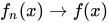

Since is a complete metric space, the Cauchy criterion can be used to give an equivalent alternative formulation for uniform convergence: converges uniformly on (in the previous sense) if and only if for every , there exists a natural number such that


- .

In yet another equivalent formulation (derived by using the definition of limit and supremum), if we define

then converges to Failed to parse (SVG (MathML can be enabled via browser plugin): Invalid response ("Math extension cannot connect to Restbase.") from server "https://wikimedia.org/api/rest_v1/":): {\displaystyle f} uniformly if and only if as Failed to parse (SVG (MathML can be enabled via browser plugin): Invalid response ("Math extension cannot connect to Restbase.") from server "https://wikimedia.org/api/rest_v1/":): {\displaystyle n\to\infty} . Thus, we can characterize uniform convergence of on Failed to parse (SVG (MathML can be enabled via browser plugin): Invalid response ("Math extension cannot connect to Restbase.") from server "https://wikimedia.org/api/rest_v1/":): {\displaystyle E} as (simple) convergence of Failed to parse (SVG (MathML can be enabled via browser plugin): Invalid response ("Math extension cannot connect to Restbase.") from server "https://wikimedia.org/api/rest_v1/":): {\displaystyle (f_n)_{n \in \N}} in the function space Failed to parse (SVG (MathML can be enabled via browser plugin): Invalid response ("Math extension cannot connect to Restbase.") from server "https://wikimedia.org/api/rest_v1/":): {\displaystyle \R^E} with respect to the uniform metric (also called the supremum metric), defined by


- Failed to parse (SVG (MathML can be enabled via browser plugin): Invalid response ("Math extension cannot connect to Restbase.") from server "https://wikimedia.org/api/rest_v1/":): {\displaystyle d(f,g)=\sup_{x\in E} \bigl|f(x)-g(x)\bigr|.}
Symbolically,
- Failed to parse (SVG (MathML can be enabled via browser plugin): Invalid response ("Math extension cannot connect to Restbase.") from server "https://wikimedia.org/api/rest_v1/":): {\displaystyle f_n\rightrightarrows f\iff d(f_n,f) \to 0} .
The sequence Failed to parse (SVG (MathML can be enabled via browser plugin): Invalid response ("Math extension cannot connect to Restbase.") from server "https://wikimedia.org/api/rest_v1/":): {\displaystyle (f_n)_{n \in \N}} is said to be locally uniformly convergent with limit Failed to parse (SVG (MathML can be enabled via browser plugin): Invalid response ("Math extension cannot connect to Restbase.") from server "https://wikimedia.org/api/rest_v1/":): {\displaystyle f} if Failed to parse (SVG (MathML can be enabled via browser plugin): Invalid response ("Math extension cannot connect to Restbase.") from server "https://wikimedia.org/api/rest_v1/":): {\displaystyle E } is a metric space and for every Failed to parse (SVG (MathML can be enabled via browser plugin): Invalid response ("Math extension cannot connect to Restbase.") from server "https://wikimedia.org/api/rest_v1/":): {\displaystyle x\in E} , there exists an Failed to parse (SVG (MathML can be enabled via browser plugin): Invalid response ("Math extension cannot connect to Restbase.") from server "https://wikimedia.org/api/rest_v1/":): {\displaystyle r > 0} such that Failed to parse (SVG (MathML can be enabled via browser plugin): Invalid response ("Math extension cannot connect to Restbase.") from server "https://wikimedia.org/api/rest_v1/":): {\displaystyle (f_n)} converges uniformly on Failed to parse (SVG (MathML can be enabled via browser plugin): Invalid response ("Math extension cannot connect to Restbase.") from server "https://wikimedia.org/api/rest_v1/":): {\displaystyle B(x,r)\cap E} where Failed to parse (SVG (MathML can be enabled via browser plugin): Invalid response ("Math extension cannot connect to Restbase.") from server "https://wikimedia.org/api/rest_v1/":): {\displaystyle B(x,r)} is a ball centered at x with the radius r. It is clear that uniform convergence implies local uniform convergence, which implies pointwise convergence.
Notes
[edit | edit source]Intuitively, a sequence of functions Failed to parse (SVG (MathML can be enabled via browser plugin): Invalid response ("Math extension cannot connect to Restbase.") from server "https://wikimedia.org/api/rest_v1/":): {\displaystyle f_n} converges uniformly to Failed to parse (SVG (MathML can be enabled via browser plugin): Invalid response ("Math extension cannot connect to Restbase.") from server "https://wikimedia.org/api/rest_v1/":): {\displaystyle f} if, given an arbitrarily small Failed to parse (SVG (MathML can be enabled via browser plugin): Invalid response ("Math extension cannot connect to Restbase.") from server "https://wikimedia.org/api/rest_v1/":): {\displaystyle \varepsilon>0} , we can find an Failed to parse (SVG (MathML can be enabled via browser plugin): Invalid response ("Math extension cannot connect to Restbase.") from server "https://wikimedia.org/api/rest_v1/":): {\displaystyle N\in\N} so that the functions Failed to parse (SVG (MathML can be enabled via browser plugin): Invalid response ("Math extension cannot connect to Restbase.") from server "https://wikimedia.org/api/rest_v1/":): {\displaystyle f_n} with Failed to parse (SVG (MathML can be enabled via browser plugin): Invalid response ("Math extension cannot connect to Restbase.") from server "https://wikimedia.org/api/rest_v1/":): {\displaystyle n>N} all fall within a "tube" of width Failed to parse (SVG (MathML can be enabled via browser plugin): Invalid response ("Math extension cannot connect to Restbase.") from server "https://wikimedia.org/api/rest_v1/":): {\displaystyle 2\varepsilon} centered around Failed to parse (SVG (MathML can be enabled via browser plugin): Invalid response ("Math extension cannot connect to Restbase.") from server "https://wikimedia.org/api/rest_v1/":): {\displaystyle f} (i.e., between Failed to parse (SVG (MathML can be enabled via browser plugin): Invalid response ("Math extension cannot connect to Restbase.") from server "https://wikimedia.org/api/rest_v1/":): {\displaystyle f(x)-\varepsilon} and Failed to parse (SVG (MathML can be enabled via browser plugin): Invalid response ("Math extension cannot connect to Restbase.") from server "https://wikimedia.org/api/rest_v1/":): {\displaystyle f(x)+\varepsilon} ) for the entire domain of the function.
Note that interchanging the order of quantifiers in the definition of uniform convergence by moving "for all Failed to parse (SVG (MathML can be enabled via browser plugin): Invalid response ("Math extension cannot connect to Restbase.") from server "https://wikimedia.org/api/rest_v1/":): {\displaystyle x\in E} " in front of "there exists a natural number Failed to parse (SVG (MathML can be enabled via browser plugin): Invalid response ("Math extension cannot connect to Restbase.") from server "https://wikimedia.org/api/rest_v1/":): {\displaystyle N} " results in a definition of pointwise convergence of the sequence. To make this difference explicit, in the case of uniform convergence, Failed to parse (SVG (MathML can be enabled via browser plugin): Invalid response ("Math extension cannot connect to Restbase.") from server "https://wikimedia.org/api/rest_v1/":): {\displaystyle N=N(\varepsilon)} can only depend on Failed to parse (SVG (MathML can be enabled via browser plugin): Invalid response ("Math extension cannot connect to Restbase.") from server "https://wikimedia.org/api/rest_v1/":): {\displaystyle \varepsilon} , and the choice of Failed to parse (SVG (MathML can be enabled via browser plugin): Invalid response ("Math extension cannot connect to Restbase.") from server "https://wikimedia.org/api/rest_v1/":): {\displaystyle N} has to work for all Failed to parse (SVG (MathML can be enabled via browser plugin): Invalid response ("Math extension cannot connect to Restbase.") from server "https://wikimedia.org/api/rest_v1/":): {\displaystyle x\in E} , for a specific value of Failed to parse (SVG (MathML can be enabled via browser plugin): Invalid response ("Math extension cannot connect to Restbase.") from server "https://wikimedia.org/api/rest_v1/":): {\displaystyle \varepsilon} that is given. In contrast, in the case of pointwise convergence, Failed to parse (SVG (MathML can be enabled via browser plugin): Invalid response ("Math extension cannot connect to Restbase.") from server "https://wikimedia.org/api/rest_v1/":): {\displaystyle N=N(\varepsilon,x)} may depend on both Failed to parse (SVG (MathML can be enabled via browser plugin): Invalid response ("Math extension cannot connect to Restbase.") from server "https://wikimedia.org/api/rest_v1/":): {\displaystyle \varepsilon} and Failed to parse (SVG (MathML can be enabled via browser plugin): Invalid response ("Math extension cannot connect to Restbase.") from server "https://wikimedia.org/api/rest_v1/":): {\displaystyle x} , and the choice of Failed to parse (SVG (MathML can be enabled via browser plugin): Invalid response ("Math extension cannot connect to Restbase.") from server "https://wikimedia.org/api/rest_v1/":): {\displaystyle N} only has to work for the specific values of Failed to parse (SVG (MathML can be enabled via browser plugin): Invalid response ("Math extension cannot connect to Restbase.") from server "https://wikimedia.org/api/rest_v1/":): {\displaystyle \varepsilon} and Failed to parse (SVG (MathML can be enabled via browser plugin): Invalid response ("Math extension cannot connect to Restbase.") from server "https://wikimedia.org/api/rest_v1/":): {\displaystyle x} that are given. Thus uniform convergence implies pointwise convergence, however the converse is not true, as the example in the section below illustrates.
Generalizations
[edit | edit source]One may straightforwardly extend the concept to functions E → M, where (M, d) is a metric space, by replacing Failed to parse (SVG (MathML can be enabled via browser plugin): Invalid response ("Math extension cannot connect to Restbase.") from server "https://wikimedia.org/api/rest_v1/":): {\displaystyle |f_n(x)-f(x)|} with Failed to parse (SVG (MathML can be enabled via browser plugin): Invalid response ("Math extension cannot connect to Restbase.") from server "https://wikimedia.org/api/rest_v1/":): {\displaystyle d(f_n(x),f(x))} .
The most general setting is the uniform convergence of nets of functions E → X, where X is a uniform space. We say that the net Failed to parse (SVG (MathML can be enabled via browser plugin): Invalid response ("Math extension cannot connect to Restbase.") from server "https://wikimedia.org/api/rest_v1/":): {\displaystyle (f_\alpha)} converges uniformly with limit f : E → X if and only if for every entourage V in X, there exists an Failed to parse (SVG (MathML can be enabled via browser plugin): Invalid response ("Math extension cannot connect to Restbase.") from server "https://wikimedia.org/api/rest_v1/":): {\displaystyle \alpha_0} , such that for every x in E and every Failed to parse (SVG (MathML can be enabled via browser plugin): Invalid response ("Math extension cannot connect to Restbase.") from server "https://wikimedia.org/api/rest_v1/":): {\displaystyle \alpha\geq \alpha_0} , Failed to parse (SVG (MathML can be enabled via browser plugin): Invalid response ("Math extension cannot connect to Restbase.") from server "https://wikimedia.org/api/rest_v1/":): {\displaystyle (f_\alpha(x),f(x))} is in V. In this situation, uniform limit of continuous functions remains continuous.
Definition in a hyperreal setting
[edit | edit source]Uniform convergence admits a simplified definition in a hyperreal setting. Thus, a sequence Failed to parse (SVG (MathML can be enabled via browser plugin): Invalid response ("Math extension cannot connect to Restbase.") from server "https://wikimedia.org/api/rest_v1/":): {\displaystyle f_n} converges to f uniformly if for all hyperreal x in the domain of Failed to parse (SVG (MathML can be enabled via browser plugin): Invalid response ("Math extension cannot connect to Restbase.") from server "https://wikimedia.org/api/rest_v1/":): {\displaystyle {f}^*} and all infinite n, Failed to parse (SVG (MathML can be enabled via browser plugin): Invalid response ("Math extension cannot connect to Restbase.") from server "https://wikimedia.org/api/rest_v1/":): {\displaystyle {f}_n^*(x)} is infinitely close to Failed to parse (SVG (MathML can be enabled via browser plugin): Invalid response ("Math extension cannot connect to Restbase.") from server "https://wikimedia.org/api/rest_v1/":): {\displaystyle {f}^*(x)} (see microcontinuity for a similar definition of uniform continuity). In contrast, pointwise continuity requires this only for real x.
Examples
[edit | edit source]For Failed to parse (SVG (MathML can be enabled via browser plugin): Invalid response ("Math extension cannot connect to Restbase.") from server "https://wikimedia.org/api/rest_v1/":): {\displaystyle x \in [0,1)} , a basic example of uniform convergence can be illustrated as follows: the sequence Failed to parse (SVG (MathML can be enabled via browser plugin): Invalid response ("Math extension cannot connect to Restbase.") from server "https://wikimedia.org/api/rest_v1/":): {\displaystyle \textstyle \bigl(\tfrac12\bigr)\vphantom)^{x+n}} converges uniformly, while Failed to parse (SVG (MathML can be enabled via browser plugin): Invalid response ("Math extension cannot connect to Restbase.") from server "https://wikimedia.org/api/rest_v1/":): {\displaystyle x^n} does not. Specifically, assume Failed to parse (SVG (MathML can be enabled via browser plugin): Invalid response ("Math extension cannot connect to Restbase.") from server "https://wikimedia.org/api/rest_v1/":): {\displaystyle \varepsilon=\tfrac14} . Each function Failed to parse (SVG (MathML can be enabled via browser plugin): Invalid response ("Math extension cannot connect to Restbase.") from server "https://wikimedia.org/api/rest_v1/":): {\displaystyle \textstyle \bigl(\tfrac12\bigr)\vphantom)^{x+n}} is less than or equal to Failed to parse (SVG (MathML can be enabled via browser plugin): Invalid response ("Math extension cannot connect to Restbase.") from server "https://wikimedia.org/api/rest_v1/":): {\displaystyle \tfrac14} when Failed to parse (SVG (MathML can be enabled via browser plugin): Invalid response ("Math extension cannot connect to Restbase.") from server "https://wikimedia.org/api/rest_v1/":): {\displaystyle n \geq 2} , regardless of the value of Failed to parse (SVG (MathML can be enabled via browser plugin): Invalid response ("Math extension cannot connect to Restbase.") from server "https://wikimedia.org/api/rest_v1/":): {\displaystyle x} . On the other hand, Failed to parse (SVG (MathML can be enabled via browser plugin): Invalid response ("Math extension cannot connect to Restbase.") from server "https://wikimedia.org/api/rest_v1/":): {\displaystyle x^n} is only less than or equal to Failed to parse (SVG (MathML can be enabled via browser plugin): Invalid response ("Math extension cannot connect to Restbase.") from server "https://wikimedia.org/api/rest_v1/":): {\displaystyle \tfrac14} at ever increasing values of Failed to parse (SVG (MathML can be enabled via browser plugin): Invalid response ("Math extension cannot connect to Restbase.") from server "https://wikimedia.org/api/rest_v1/":): {\displaystyle n} when values of Failed to parse (SVG (MathML can be enabled via browser plugin): Invalid response ("Math extension cannot connect to Restbase.") from server "https://wikimedia.org/api/rest_v1/":): {\displaystyle x} are selected closer and closer to 1 (explained more in depth further below).
Given a topological space X, we can equip the space of bounded real or complex-valued functions over X with the uniform norm topology, with the uniform metric defined by
- Failed to parse (SVG (MathML can be enabled via browser plugin): Invalid response ("Math extension cannot connect to Restbase.") from server "https://wikimedia.org/api/rest_v1/":): {\displaystyle d(f,g)={\|f-g\|}_{\infty}=\sup_{x\in X} \bigl|f(x)-g(x)\bigr|.}
Then uniform convergence simply means convergence in the uniform norm topology:
- Failed to parse (SVG (MathML can be enabled via browser plugin): Invalid response ("Math extension cannot connect to Restbase.") from server "https://wikimedia.org/api/rest_v1/":): {\displaystyle \lim_{n\to\infty}{\|f_n-f\|}_{\infty}=0} .
The sequence of functions Failed to parse (SVG (MathML can be enabled via browser plugin): Invalid response ("Math extension cannot connect to Restbase.") from server "https://wikimedia.org/api/rest_v1/":): {\displaystyle (f_n)}
- Failed to parse (SVG (MathML can be enabled via browser plugin): Invalid response ("Math extension cannot connect to Restbase.") from server "https://wikimedia.org/api/rest_v1/":): {\displaystyle \begin{cases} f_n:[0,1]\to [0,1] \\[3mu] f_n(x)=x^n \end{cases}}
is a classic example of a sequence of functions that converges to a function Failed to parse (SVG (MathML can be enabled via browser plugin): Invalid response ("Math extension cannot connect to Restbase.") from server "https://wikimedia.org/api/rest_v1/":): {\displaystyle f} pointwise but not uniformly. To show this, we first observe that the pointwise limit of Failed to parse (SVG (MathML can be enabled via browser plugin): Invalid response ("Math extension cannot connect to Restbase.") from server "https://wikimedia.org/api/rest_v1/":): {\displaystyle (f_n)} as Failed to parse (SVG (MathML can be enabled via browser plugin): Invalid response ("Math extension cannot connect to Restbase.") from server "https://wikimedia.org/api/rest_v1/":): {\displaystyle n\to\infty} is the function Failed to parse (SVG (MathML can be enabled via browser plugin): Invalid response ("Math extension cannot connect to Restbase.") from server "https://wikimedia.org/api/rest_v1/":): {\displaystyle f} , given by
- Failed to parse (SVG (MathML can be enabled via browser plugin): Invalid response ("Math extension cannot connect to Restbase.") from server "https://wikimedia.org/api/rest_v1/":): {\displaystyle f(x) = \lim_{n\to \infty} f_n(x) = \begin{cases} 0, & x \in [0,1); \\[3mu] 1, & x=1. \end{cases} }
Pointwise convergence: Convergence is trivial for Failed to parse (SVG (MathML can be enabled via browser plugin): Invalid response ("Math extension cannot connect to Restbase.") from server "https://wikimedia.org/api/rest_v1/":): {\displaystyle x=0} and Failed to parse (SVG (MathML can be enabled via browser plugin): Invalid response ("Math extension cannot connect to Restbase.") from server "https://wikimedia.org/api/rest_v1/":): {\displaystyle x=1} , since Failed to parse (SVG (MathML can be enabled via browser plugin): Invalid response ("Math extension cannot connect to Restbase.") from server "https://wikimedia.org/api/rest_v1/":): {\displaystyle f_n(0)=f(0)=0} and Failed to parse (SVG (MathML can be enabled via browser plugin): Invalid response ("Math extension cannot connect to Restbase.") from server "https://wikimedia.org/api/rest_v1/":): {\displaystyle f_n(1)=f(1)=1} , for all Failed to parse (SVG (MathML can be enabled via browser plugin): Invalid response ("Math extension cannot connect to Restbase.") from server "https://wikimedia.org/api/rest_v1/":): {\displaystyle n} . For Failed to parse (SVG (MathML can be enabled via browser plugin): Invalid response ("Math extension cannot connect to Restbase.") from server "https://wikimedia.org/api/rest_v1/":): {\displaystyle x \in (0,1)} and given Failed to parse (SVG (MathML can be enabled via browser plugin): Invalid response ("Math extension cannot connect to Restbase.") from server "https://wikimedia.org/api/rest_v1/":): {\displaystyle \varepsilon>0} , we can ensure that Failed to parse (SVG (MathML can be enabled via browser plugin): Invalid response ("Math extension cannot connect to Restbase.") from server "https://wikimedia.org/api/rest_v1/":): {\displaystyle |f_n(x)-f(x)|<\varepsilon} whenever Failed to parse (SVG (MathML can be enabled via browser plugin): Invalid response ("Math extension cannot connect to Restbase.") from server "https://wikimedia.org/api/rest_v1/":): {\displaystyle n\geq N} by choosing Failed to parse (SVG (MathML can be enabled via browser plugin): Invalid response ("Math extension cannot connect to Restbase.") from server "https://wikimedia.org/api/rest_v1/":): {\displaystyle N = \lceil\log\varepsilon/\log x\rceil} , which is the minimum integer exponent of that allows it to reach or dip below (here the upper square brackets indicate rounding up, see ceiling function). Hence, pointwise for all . Note that the choice of depends on the value of and . Moreover, for a fixed choice of , (which cannot be defined to be smaller) grows without bound as approaches 1. These observations preclude the possibility of uniform convergence.
![{\displaystyle x\in [0,1]}](https://wikimedia.org/api/rest_v1/media/math/render/svg/64a15936df283add394ab909aa7a5e24e7fb6bb2)
Non-uniformity of convergence: The convergence is not uniform, because we can find an so that no matter how large we choose there will be values of and such that To see this, first observe that regardless of how large Failed to parse (SVG (MathML can be enabled via browser plugin): Invalid response ("Math extension cannot connect to Restbase.") from server "https://wikimedia.org/api/rest_v1/":): {\displaystyle n} becomes, there is always an Failed to parse (SVG (MathML can be enabled via browser plugin): Invalid response ("Math extension cannot connect to Restbase.") from server "https://wikimedia.org/api/rest_v1/":): {\displaystyle x_0 \in [0,1)} such that Failed to parse (SVG (MathML can be enabled via browser plugin): Invalid response ("Math extension cannot connect to Restbase.") from server "https://wikimedia.org/api/rest_v1/":): {\displaystyle f_n(x_0)=\tfrac12.} Thus, if we choose Failed to parse (SVG (MathML can be enabled via browser plugin): Invalid response ("Math extension cannot connect to Restbase.") from server "https://wikimedia.org/api/rest_v1/":): {\displaystyle \varepsilon = \tfrac14,} we can never find an Failed to parse (SVG (MathML can be enabled via browser plugin): Invalid response ("Math extension cannot connect to Restbase.") from server "https://wikimedia.org/api/rest_v1/":): {\displaystyle N} such that Failed to parse (SVG (MathML can be enabled via browser plugin): Invalid response ("Math extension cannot connect to Restbase.") from server "https://wikimedia.org/api/rest_v1/":): {\displaystyle |f_n(x)-f(x)|<\varepsilon} for all Failed to parse (SVG (MathML can be enabled via browser plugin): Invalid response ("Math extension cannot connect to Restbase.") from server "https://wikimedia.org/api/rest_v1/":): {\displaystyle x\in[0,1]} and Failed to parse (SVG (MathML can be enabled via browser plugin): Invalid response ("Math extension cannot connect to Restbase.") from server "https://wikimedia.org/api/rest_v1/":): {\displaystyle n\geq N} . Explicitly, whatever candidate we choose for Failed to parse (SVG (MathML can be enabled via browser plugin): Invalid response ("Math extension cannot connect to Restbase.") from server "https://wikimedia.org/api/rest_v1/":): {\displaystyle N} , consider the value of Failed to parse (SVG (MathML can be enabled via browser plugin): Invalid response ("Math extension cannot connect to Restbase.") from server "https://wikimedia.org/api/rest_v1/":): {\displaystyle f_N} at Failed to parse (SVG (MathML can be enabled via browser plugin): Invalid response ("Math extension cannot connect to Restbase.") from server "https://wikimedia.org/api/rest_v1/":): {\displaystyle \textstyle x_0 = \bigl(\tfrac12\bigr)\vphantom)^{1/N}} . Since


- Failed to parse (SVG (MathML can be enabled via browser plugin): Invalid response ("Math extension cannot connect to Restbase.") from server "https://wikimedia.org/api/rest_v1/":): {\displaystyle \bigl|f_N(x_0) - f(x_0)\bigr| = \left| {\Bigl( \bigl(\tfrac{1}{2} \bigr)^{1/N} \Bigr)\vphantom\big|^N\! - 0}~\! \right| = \tfrac{1}{2} > \tfrac{1}{4} = \varepsilon,}
the candidate fails because we have found an example of an Failed to parse (SVG (MathML can be enabled via browser plugin): Invalid response ("Math extension cannot connect to Restbase.") from server "https://wikimedia.org/api/rest_v1/":): {\displaystyle x\in[0,1]} that "escaped" our attempt to "confine" each Failed to parse (SVG (MathML can be enabled via browser plugin): Invalid response ("Math extension cannot connect to Restbase.") from server "https://wikimedia.org/api/rest_v1/":): {\displaystyle f_n\ (n\geq N)} to within Failed to parse (SVG (MathML can be enabled via browser plugin): Invalid response ("Math extension cannot connect to Restbase.") from server "https://wikimedia.org/api/rest_v1/":): {\displaystyle \varepsilon} of Failed to parse (SVG (MathML can be enabled via browser plugin): Invalid response ("Math extension cannot connect to Restbase.") from server "https://wikimedia.org/api/rest_v1/":): {\displaystyle f } for all Failed to parse (SVG (MathML can be enabled via browser plugin): Invalid response ("Math extension cannot connect to Restbase.") from server "https://wikimedia.org/api/rest_v1/":): {\displaystyle x\in[0,1]} . In fact, it is easy to see that
- Failed to parse (SVG (MathML can be enabled via browser plugin): Invalid response ("Math extension cannot connect to Restbase.") from server "https://wikimedia.org/api/rest_v1/":): {\displaystyle \lim_{n\to\infty}\|f_n-f\|_{\infty}=1,}
contrary to the requirement that Failed to parse (SVG (MathML can be enabled via browser plugin): Invalid response ("Math extension cannot connect to Restbase.") from server "https://wikimedia.org/api/rest_v1/":): {\displaystyle \|f_n-f\|_{\infty}\to 0} if Failed to parse (SVG (MathML can be enabled via browser plugin): Invalid response ("Math extension cannot connect to Restbase.") from server "https://wikimedia.org/api/rest_v1/":): {\displaystyle f_n \rightrightarrows f} .
In this example one can easily see that pointwise convergence does not preserve differentiability or continuity. While each function of the sequence is smooth, that is to say that for all n, Failed to parse (SVG (MathML can be enabled via browser plugin): Invalid response ("Math extension cannot connect to Restbase.") from server "https://wikimedia.org/api/rest_v1/":): {\displaystyle f_n\in C^{\infty}([0,1])} , the limit Failed to parse (SVG (MathML can be enabled via browser plugin): Invalid response ("Math extension cannot connect to Restbase.") from server "https://wikimedia.org/api/rest_v1/":): {\displaystyle \lim_{n\to \infty}f_n} is not even continuous.
Exponential function
[edit | edit source]The series expansion of the exponential function can be shown to be uniformly convergent on any bounded subset Failed to parse (SVG (MathML can be enabled via browser plugin): Invalid response ("Math extension cannot connect to Restbase.") from server "https://wikimedia.org/api/rest_v1/":): {\displaystyle S \subset \C} using the Weierstrass M-test.
Theorem (Weierstrass M-test). Let Failed to parse (SVG (MathML can be enabled via browser plugin): Invalid response ("Math extension cannot connect to Restbase.") from server "https://wikimedia.org/api/rest_v1/":): {\displaystyle (f_n)} be a sequence of functions Failed to parse (SVG (MathML can be enabled via browser plugin): Invalid response ("Math extension cannot connect to Restbase.") from server "https://wikimedia.org/api/rest_v1/":): {\displaystyle f_n:E\to \C} and let Failed to parse (SVG (MathML can be enabled via browser plugin): Invalid response ("Math extension cannot connect to Restbase.") from server "https://wikimedia.org/api/rest_v1/":): {\displaystyle M_n } be a sequence of positive real numbers such that Failed to parse (SVG (MathML can be enabled via browser plugin): Invalid response ("Math extension cannot connect to Restbase.") from server "https://wikimedia.org/api/rest_v1/":): {\displaystyle |f_n(x)|\le M_n} for all Failed to parse (SVG (MathML can be enabled via browser plugin): Invalid response ("Math extension cannot connect to Restbase.") from server "https://wikimedia.org/api/rest_v1/":): {\displaystyle x\in E} and Failed to parse (SVG (MathML can be enabled via browser plugin): Invalid response ("Math extension cannot connect to Restbase.") from server "https://wikimedia.org/api/rest_v1/":): {\displaystyle n=1,2, 3, \ldots} If Failed to parse (SVG (MathML can be enabled via browser plugin): Invalid response ("Math extension cannot connect to Restbase.") from server "https://wikimedia.org/api/rest_v1/":): {\textstyle \sum_n M_n} converges, then Failed to parse (SVG (MathML can be enabled via browser plugin): Invalid response ("Math extension cannot connect to Restbase.") from server "https://wikimedia.org/api/rest_v1/":): {\textstyle \sum_n f_n} converges absolutely and uniformly on Failed to parse (SVG (MathML can be enabled via browser plugin): Invalid response ("Math extension cannot connect to Restbase.") from server "https://wikimedia.org/api/rest_v1/":): {\displaystyle E} .
The complex exponential function can be expressed as the series:
- Failed to parse (SVG (MathML can be enabled via browser plugin): Invalid response ("Math extension cannot connect to Restbase.") from server "https://wikimedia.org/api/rest_v1/":): {\displaystyle \sum_{n=0}^{\infty}\frac{z^n}{n!}.}
Any bounded subset is a subset of some disc Failed to parse (SVG (MathML can be enabled via browser plugin): Invalid response ("Math extension cannot connect to Restbase.") from server "https://wikimedia.org/api/rest_v1/":): {\displaystyle D_R} of radius Failed to parse (SVG (MathML can be enabled via browser plugin): Invalid response ("Math extension cannot connect to Restbase.") from server "https://wikimedia.org/api/rest_v1/":): {\displaystyle R,} centered on the origin in the complex plane. The Weierstrass M-test requires us to find an upper bound Failed to parse (SVG (MathML can be enabled via browser plugin): Invalid response ("Math extension cannot connect to Restbase.") from server "https://wikimedia.org/api/rest_v1/":): {\displaystyle M_n} on the terms of the series, with Failed to parse (SVG (MathML can be enabled via browser plugin): Invalid response ("Math extension cannot connect to Restbase.") from server "https://wikimedia.org/api/rest_v1/":): {\displaystyle M_n} independent of the position in the disc:
- Failed to parse (SVG (MathML can be enabled via browser plugin): Invalid response ("Math extension cannot connect to Restbase.") from server "https://wikimedia.org/api/rest_v1/":): {\displaystyle \left| \frac{z^n}{n!} \right|\le M_n, \forall z\in D_R.}
To do this, we notice
- Failed to parse (SVG (MathML can be enabled via browser plugin): Invalid response ("Math extension cannot connect to Restbase.") from server "https://wikimedia.org/api/rest_v1/":): {\displaystyle \left| \frac{z^n}{n!}\right| \le \frac{|z|^n}{n!} \le \frac{R^n}{n!}}
and take Failed to parse (SVG (MathML can be enabled via browser plugin): Invalid response ("Math extension cannot connect to Restbase.") from server "https://wikimedia.org/api/rest_v1/":): {\displaystyle M_n=\tfrac{R^n}{n!}.}
If Failed to parse (SVG (MathML can be enabled via browser plugin): Invalid response ("Math extension cannot connect to Restbase.") from server "https://wikimedia.org/api/rest_v1/":): {\displaystyle \sum_{n=0}^{\infty}M_n} is convergent, then the M-test asserts that the original series is uniformly convergent.
The ratio test can be used here:
- Failed to parse (SVG (MathML can be enabled via browser plugin): Invalid response ("Math extension cannot connect to Restbase.") from server "https://wikimedia.org/api/rest_v1/":): {\displaystyle \lim_{n \to \infty}\frac{M_{n+1}}{M_n}=\lim_{n \to \infty}\frac{R^{n+1}}{R^n}\frac{n!}{(n+1)!}=\lim_{n \to \infty}\frac{R}{n+1}=0}
which means the series over Failed to parse (SVG (MathML can be enabled via browser plugin): Invalid response ("Math extension cannot connect to Restbase.") from server "https://wikimedia.org/api/rest_v1/":): {\displaystyle M_n} is convergent. Thus the original series converges uniformly for all Failed to parse (SVG (MathML can be enabled via browser plugin): Invalid response ("Math extension cannot connect to Restbase.") from server "https://wikimedia.org/api/rest_v1/":): {\displaystyle z\in D_R,} and since Failed to parse (SVG (MathML can be enabled via browser plugin): Invalid response ("Math extension cannot connect to Restbase.") from server "https://wikimedia.org/api/rest_v1/":): {\displaystyle S\subset D_R} , the series is also uniformly convergent on Failed to parse (SVG (MathML can be enabled via browser plugin): Invalid response ("Math extension cannot connect to Restbase.") from server "https://wikimedia.org/api/rest_v1/":): {\displaystyle S.}
Properties
[edit | edit source]- Every uniformly convergent sequence is locally uniformly convergent.
- Every locally uniformly convergent sequence is compactly convergent.
- For locally compact spaces local uniform convergence and compact convergence coincide.
- A sequence of continuous functions on metric spaces, with the image metric space being complete, is uniformly convergent if and only if it is uniformly Cauchy.
- If Failed to parse (SVG (MathML can be enabled via browser plugin): Invalid response ("Math extension cannot connect to Restbase.") from server "https://wikimedia.org/api/rest_v1/":): {\displaystyle S} is a compact interval (or in general a compact topological space), and Failed to parse (SVG (MathML can be enabled via browser plugin): Invalid response ("Math extension cannot connect to Restbase.") from server "https://wikimedia.org/api/rest_v1/":): {\displaystyle (f_n)} is a monotone increasing sequence (meaning Failed to parse (SVG (MathML can be enabled via browser plugin): Invalid response ("Math extension cannot connect to Restbase.") from server "https://wikimedia.org/api/rest_v1/":): {\displaystyle f_n(x) \leq f_{n+1}(x)} for all n and x) of continuous functions with a pointwise limit Failed to parse (SVG (MathML can be enabled via browser plugin): Invalid response ("Math extension cannot connect to Restbase.") from server "https://wikimedia.org/api/rest_v1/":): {\displaystyle f} which is also continuous, then the convergence is necessarily uniform (Dini's theorem). Uniform convergence is also guaranteed if Failed to parse (SVG (MathML can be enabled via browser plugin): Invalid response ("Math extension cannot connect to Restbase.") from server "https://wikimedia.org/api/rest_v1/":): {\displaystyle S} is a compact interval and Failed to parse (SVG (MathML can be enabled via browser plugin): Invalid response ("Math extension cannot connect to Restbase.") from server "https://wikimedia.org/api/rest_v1/":): {\displaystyle (f_n)} is an equicontinuous sequence that converges pointwise.
Applications
[edit | edit source]To continuity
[edit | edit source]If Failed to parse (SVG (MathML can be enabled via browser plugin): Invalid response ("Math extension cannot connect to Restbase.") from server "https://wikimedia.org/api/rest_v1/":): {\displaystyle E} and Failed to parse (SVG (MathML can be enabled via browser plugin): Invalid response ("Math extension cannot connect to Restbase.") from server "https://wikimedia.org/api/rest_v1/":): {\displaystyle M} are topological spaces, then it makes sense to talk about the continuity of the functions Failed to parse (SVG (MathML can be enabled via browser plugin): Invalid response ("Math extension cannot connect to Restbase.") from server "https://wikimedia.org/api/rest_v1/":): {\displaystyle f_n,f:E\to M} . If we further assume that Failed to parse (SVG (MathML can be enabled via browser plugin): Invalid response ("Math extension cannot connect to Restbase.") from server "https://wikimedia.org/api/rest_v1/":): {\displaystyle M} is a metric space, then (uniform) convergence of the Failed to parse (SVG (MathML can be enabled via browser plugin): Invalid response ("Math extension cannot connect to Restbase.") from server "https://wikimedia.org/api/rest_v1/":): {\displaystyle f_n} to Failed to parse (SVG (MathML can be enabled via browser plugin): Invalid response ("Math extension cannot connect to Restbase.") from server "https://wikimedia.org/api/rest_v1/":): {\displaystyle f} is also well defined. The following result states that continuity is preserved by uniform convergence:
This theorem is proved by the "Template:Tmath trick", and is the archetypal example of this trick: to prove a given inequality (that a desired quantity is less than Template:Tmath), one uses the definitions of continuity and uniform convergence to produce 3 inequalities (demonstrating three separate quantities are each less than Template:Tmath), and then combines them via the triangle inequality to produce the desired inequality.
This theorem is an important one in the history of real and Fourier analysis, since many 18th century mathematicians had the intuitive understanding that a sequence of continuous functions always converges to a continuous function. The image above shows a counterexample, and many discontinuous functions could, in fact, be written as a Fourier series of continuous functions. The erroneous claim that the pointwise limit of a sequence of continuous functions is continuous (originally stated in terms of convergent series of continuous functions) is infamously known as "Cauchy's wrong theorem". The uniform limit theorem shows that a stronger form of convergence, uniform convergence, is needed to ensure the preservation of continuity in the limit function.
More precisely, this theorem states that the uniform limit of uniformly continuous functions is uniformly continuous; for a locally compact space, continuity is equivalent to local uniform continuity, and thus the uniform limit of continuous functions is continuous.
To differentiability
[edit | edit source]If Failed to parse (SVG (MathML can be enabled via browser plugin): Invalid response ("Math extension cannot connect to Restbase.") from server "https://wikimedia.org/api/rest_v1/":): {\displaystyle S} is an interval and all the functions Failed to parse (SVG (MathML can be enabled via browser plugin): Invalid response ("Math extension cannot connect to Restbase.") from server "https://wikimedia.org/api/rest_v1/":): {\displaystyle f_n} are differentiable and converge to a limit Failed to parse (SVG (MathML can be enabled via browser plugin): Invalid response ("Math extension cannot connect to Restbase.") from server "https://wikimedia.org/api/rest_v1/":): {\displaystyle f} , it is often desirable to determine the derivative function Failed to parse (SVG (MathML can be enabled via browser plugin): Invalid response ("Math extension cannot connect to Restbase.") from server "https://wikimedia.org/api/rest_v1/":): {\displaystyle f'} by taking the limit of the sequence Failed to parse (SVG (MathML can be enabled via browser plugin): Invalid response ("Math extension cannot connect to Restbase.") from server "https://wikimedia.org/api/rest_v1/":): {\displaystyle f'_n} . This is however in general not possible: even if the convergence is uniform, the limit function need not be differentiable (not even if the sequence consists of everywhere-analytic functions, see Weierstrass function), and even if it is differentiable, the derivative of the limit function need not be equal to the limit of the derivatives. Consider for instance Failed to parse (SVG (MathML can be enabled via browser plugin): Invalid response ("Math extension cannot connect to Restbase.") from server "https://wikimedia.org/api/rest_v1/":): {\displaystyle f_n(x) = n^{-1/2}{\sin(nx)}} with uniform limit Failed to parse (SVG (MathML can be enabled via browser plugin): Invalid response ("Math extension cannot connect to Restbase.") from server "https://wikimedia.org/api/rest_v1/":): {\displaystyle f_n\rightrightarrows f\equiv 0} . Clearly, Failed to parse (SVG (MathML can be enabled via browser plugin): Invalid response ("Math extension cannot connect to Restbase.") from server "https://wikimedia.org/api/rest_v1/":): {\displaystyle f'} is also identically zero. However, the derivatives of the sequence of functions are given by Failed to parse (SVG (MathML can be enabled via browser plugin): Invalid response ("Math extension cannot connect to Restbase.") from server "https://wikimedia.org/api/rest_v1/":): {\displaystyle f'_n(x)=n^{1/2}\cos nx,} and the sequence Failed to parse (SVG (MathML can be enabled via browser plugin): Invalid response ("Math extension cannot connect to Restbase.") from server "https://wikimedia.org/api/rest_v1/":): {\displaystyle f'_n} does not converge to Failed to parse (SVG (MathML can be enabled via browser plugin): Invalid response ("Math extension cannot connect to Restbase.") from server "https://wikimedia.org/api/rest_v1/":): {\displaystyle f',} or even to any function at all. In order to ensure a connection between the limit of a sequence of differentiable functions and the limit of the sequence of derivatives, the uniform convergence of the sequence of derivatives plus the convergence of the sequence of functions at at least one point is required:[4]
- If Failed to parse (SVG (MathML can be enabled via browser plugin): Invalid response ("Math extension cannot connect to Restbase.") from server "https://wikimedia.org/api/rest_v1/":): {\displaystyle (f_n)} is a sequence of differentiable functions on Failed to parse (SVG (MathML can be enabled via browser plugin): Invalid response ("Math extension cannot connect to Restbase.") from server "https://wikimedia.org/api/rest_v1/":): {\displaystyle [a,b]} such that Failed to parse (SVG (MathML can be enabled via browser plugin): Invalid response ("Math extension cannot connect to Restbase.") from server "https://wikimedia.org/api/rest_v1/":): {\displaystyle \lim_{n\to\infty} f_n(x_0)} exists (and is finite) for some Failed to parse (SVG (MathML can be enabled via browser plugin): Invalid response ("Math extension cannot connect to Restbase.") from server "https://wikimedia.org/api/rest_v1/":): {\displaystyle x_0\in[a,b]} and the sequence Failed to parse (SVG (MathML can be enabled via browser plugin): Invalid response ("Math extension cannot connect to Restbase.") from server "https://wikimedia.org/api/rest_v1/":): {\displaystyle (f'_n)} converges uniformly on Failed to parse (SVG (MathML can be enabled via browser plugin): Invalid response ("Math extension cannot connect to Restbase.") from server "https://wikimedia.org/api/rest_v1/":): {\displaystyle [a,b]} , then Failed to parse (SVG (MathML can be enabled via browser plugin): Invalid response ("Math extension cannot connect to Restbase.") from server "https://wikimedia.org/api/rest_v1/":): {\displaystyle f_n} converges uniformly to a function Failed to parse (SVG (MathML can be enabled via browser plugin): Invalid response ("Math extension cannot connect to Restbase.") from server "https://wikimedia.org/api/rest_v1/":): {\displaystyle f} on Failed to parse (SVG (MathML can be enabled via browser plugin): Invalid response ("Math extension cannot connect to Restbase.") from server "https://wikimedia.org/api/rest_v1/":): {\displaystyle [a,b]} , and Failed to parse (SVG (MathML can be enabled via browser plugin): Invalid response ("Math extension cannot connect to Restbase.") from server "https://wikimedia.org/api/rest_v1/":): {\displaystyle f'(x) = \lim_{n\to \infty} f'_n(x)} for Failed to parse (SVG (MathML can be enabled via browser plugin): Invalid response ("Math extension cannot connect to Restbase.") from server "https://wikimedia.org/api/rest_v1/":): {\displaystyle x \in [a, b]} .
To integrability
[edit | edit source]Similarly, one often wants to exchange integrals and limit processes. For the Riemann integral, this can be done if uniform convergence is assumed:
- If Failed to parse (SVG (MathML can be enabled via browser plugin): Invalid response ("Math extension cannot connect to Restbase.") from server "https://wikimedia.org/api/rest_v1/":): {\displaystyle {(f_n)}_{n=1}^\infty} is a sequence of Riemann integrable functions defined on a compact interval Failed to parse (SVG (MathML can be enabled via browser plugin): Invalid response ("Math extension cannot connect to Restbase.") from server "https://wikimedia.org/api/rest_v1/":): {\displaystyle I} which uniformly converge with limit Failed to parse (SVG (MathML can be enabled via browser plugin): Invalid response ("Math extension cannot connect to Restbase.") from server "https://wikimedia.org/api/rest_v1/":): {\displaystyle f} , then is Riemann integrable and its integral can be computed as the limit of the integrals of the :
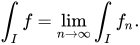
In fact, for a uniformly convergent family of bounded functions on an interval, the upper and lower Riemann integrals converge to the upper and lower Riemann integrals of the limit function. This follows because, for n sufficiently large, the graph of is within ε of the graph of f, and so the upper sum and lower sum of are each within of the value of the upper and lower sums of , respectively.

Much stronger theorems in this respect, which require not much more than pointwise convergence, can be obtained if one abandons the Riemann integral and uses the Lebesgue integral instead.
To analyticity
[edit | edit source]Using Morera's Theorem, one can show that if a sequence of analytic functions converges uniformly in a region S of the complex plane, then the limit is analytic in S. This example demonstrates that complex functions are more well-behaved than real functions, since the uniform limit of analytic functions on a real interval need not even be differentiable (see Weierstrass function).
To series
[edit | edit source]We say that converges:

- pointwise on E if and only if the sequence of partial sums converges for every .
- uniformly on E if and only if sn converges uniformly as .
- absolutely on E if and only if converges for every .


With this definition comes the following result:
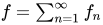
Let x0 be contained in the set E and each fn be continuous at x0. If converges uniformly on E then f is continuous at x0 in E. Suppose that and each fn is integrable on E. If Failed to parse (SVG (MathML can be enabled via browser plugin): Invalid response ("Math extension cannot connect to Restbase.") from server "https://wikimedia.org/api/rest_v1/":): {\textstyle \sum_{n=1}^\infty f_n} converges uniformly on E then f is integrable on E and the series of integrals of fn is equal to integral of the series of fn.
![{\displaystyle E=[a,b]}](https://wikimedia.org/api/rest_v1/media/math/render/svg/a0ebe1a4eb485acb08955d39021a3d141e2b4152)


Function spaces
[edit | edit source]Uniform convergence is the norm topology on several important function spaces. For example, let Failed to parse (SVG (MathML can be enabled via browser plugin): Invalid response ("Math extension cannot connect to Restbase.") from server "https://wikimedia.org/api/rest_v1/":): {\displaystyle C([0,1])} denote the space of real-valued or complex-valued continuous functions on the unit interval. With the supremum norm Failed to parse (SVG (MathML can be enabled via browser plugin): Invalid response ("Math extension cannot connect to Restbase.") from server "https://wikimedia.org/api/rest_v1/":): {\displaystyle \|f\|_\infty=\sup_{x\in[0,1]} |f(x)|,} this is a Banach space. A sequence Failed to parse (SVG (MathML can be enabled via browser plugin): Invalid response ("Math extension cannot connect to Restbase.") from server "https://wikimedia.org/api/rest_v1/":): {\displaystyle f_n} in Failed to parse (SVG (MathML can be enabled via browser plugin): Invalid response ("Math extension cannot connect to Restbase.") from server "https://wikimedia.org/api/rest_v1/":): {\displaystyle C([0,1])} converges to Failed to parse (SVG (MathML can be enabled via browser plugin): Invalid response ("Math extension cannot connect to Restbase.") from server "https://wikimedia.org/api/rest_v1/":): {\displaystyle f} in this norm precisely when Failed to parse (SVG (MathML can be enabled via browser plugin): Invalid response ("Math extension cannot connect to Restbase.") from server "https://wikimedia.org/api/rest_v1/":): {\displaystyle \|f_n-f\|_\infty\to 0,} which is exactly uniform convergence on Failed to parse (SVG (MathML can be enabled via browser plugin): Invalid response ("Math extension cannot connect to Restbase.") from server "https://wikimedia.org/api/rest_v1/":): {\displaystyle [0,1]} .
The completeness of Failed to parse (SVG (MathML can be enabled via browser plugin): Invalid response ("Math extension cannot connect to Restbase.") from server "https://wikimedia.org/api/rest_v1/":): {\displaystyle C([0,1])} follows from the completeness of the real or complex numbers. If Failed to parse (SVG (MathML can be enabled via browser plugin): Invalid response ("Math extension cannot connect to Restbase.") from server "https://wikimedia.org/api/rest_v1/":): {\displaystyle (f_n)} is Cauchy in the supremum norm, then for each Failed to parse (SVG (MathML can be enabled via browser plugin): Invalid response ("Math extension cannot connect to Restbase.") from server "https://wikimedia.org/api/rest_v1/":): {\displaystyle x\in[0,1]} the sequence Failed to parse (SVG (MathML can be enabled via browser plugin): Invalid response ("Math extension cannot connect to Restbase.") from server "https://wikimedia.org/api/rest_v1/":): {\displaystyle (f_n(x))} is Cauchy, since Failed to parse (SVG (MathML can be enabled via browser plugin): Invalid response ("Math extension cannot connect to Restbase.") from server "https://wikimedia.org/api/rest_v1/":): {\displaystyle |f_n(x)-f_m(x)|\leq \|f_n-f_m\|_\infty.} Thus Failed to parse (SVG (MathML can be enabled via browser plugin): Invalid response ("Math extension cannot connect to Restbase.") from server "https://wikimedia.org/api/rest_v1/":): {\displaystyle f_n(x)} converges pointwise to a function Failed to parse (SVG (MathML can be enabled via browser plugin): Invalid response ("Math extension cannot connect to Restbase.") from server "https://wikimedia.org/api/rest_v1/":): {\displaystyle f(x)} . Moreover, the convergence is uniform: for every Failed to parse (SVG (MathML can be enabled via browser plugin): Invalid response ("Math extension cannot connect to Restbase.") from server "https://wikimedia.org/api/rest_v1/":): {\displaystyle \varepsilon>0} , there is an Failed to parse (SVG (MathML can be enabled via browser plugin): Invalid response ("Math extension cannot connect to Restbase.") from server "https://wikimedia.org/api/rest_v1/":): {\displaystyle N} such that Failed to parse (SVG (MathML can be enabled via browser plugin): Invalid response ("Math extension cannot connect to Restbase.") from server "https://wikimedia.org/api/rest_v1/":): {\displaystyle \|f_n-f_m\|_\infty<\varepsilon} whenever Failed to parse (SVG (MathML can be enabled via browser plugin): Invalid response ("Math extension cannot connect to Restbase.") from server "https://wikimedia.org/api/rest_v1/":): {\displaystyle n,m\geq N} ; letting Failed to parse (SVG (MathML can be enabled via browser plugin): Invalid response ("Math extension cannot connect to Restbase.") from server "https://wikimedia.org/api/rest_v1/":): {\displaystyle m\to\infty} gives Failed to parse (SVG (MathML can be enabled via browser plugin): Invalid response ("Math extension cannot connect to Restbase.") from server "https://wikimedia.org/api/rest_v1/":): {\displaystyle |f_n(x)-f(x)|\leq\varepsilon} for all Failed to parse (SVG (MathML can be enabled via browser plugin): Invalid response ("Math extension cannot connect to Restbase.") from server "https://wikimedia.org/api/rest_v1/":): {\displaystyle x\in[0,1]} and all Failed to parse (SVG (MathML can be enabled via browser plugin): Invalid response ("Math extension cannot connect to Restbase.") from server "https://wikimedia.org/api/rest_v1/":): {\displaystyle n\geq N} . Since a uniform limit of continuous functions is continuous, Failed to parse (SVG (MathML can be enabled via browser plugin): Invalid response ("Math extension cannot connect to Restbase.") from server "https://wikimedia.org/api/rest_v1/":): {\displaystyle f\in C([0,1])} .
More generally, if Failed to parse (SVG (MathML can be enabled via browser plugin): Invalid response ("Math extension cannot connect to Restbase.") from server "https://wikimedia.org/api/rest_v1/":): {\displaystyle X} is a compact Hausdorff space, then Failed to parse (SVG (MathML can be enabled via browser plugin): Invalid response ("Math extension cannot connect to Restbase.") from server "https://wikimedia.org/api/rest_v1/":): {\displaystyle C(X)} , with the supremum norm, is a Banach space. If Failed to parse (SVG (MathML can be enabled via browser plugin): Invalid response ("Math extension cannot connect to Restbase.") from server "https://wikimedia.org/api/rest_v1/":): {\displaystyle X} is not compact, the supremum norm need not be finite on all of Failed to parse (SVG (MathML can be enabled via browser plugin): Invalid response ("Math extension cannot connect to Restbase.") from server "https://wikimedia.org/api/rest_v1/":): {\displaystyle C(X)} . In that case one often uses the topology of uniform convergence on compact subsets, also called the compact-open topology in this setting. For example, if Failed to parse (SVG (MathML can be enabled via browser plugin): Invalid response ("Math extension cannot connect to Restbase.") from server "https://wikimedia.org/api/rest_v1/":): {\displaystyle X} is a locally compact, σ-compact Hausdorff space, this topology is generated by the seminorms
- Failed to parse (SVG (MathML can be enabled via browser plugin): Invalid response ("Math extension cannot connect to Restbase.") from server "https://wikimedia.org/api/rest_v1/":): {\displaystyle p_K(f)=\sup_{x\in K}|f(x)|,}
where Failed to parse (SVG (MathML can be enabled via browser plugin): Invalid response ("Math extension cannot connect to Restbase.") from server "https://wikimedia.org/api/rest_v1/":): {\displaystyle K} ranges over compact subsets of Failed to parse (SVG (MathML can be enabled via browser plugin): Invalid response ("Math extension cannot connect to Restbase.") from server "https://wikimedia.org/api/rest_v1/":): {\displaystyle X} , making Failed to parse (SVG (MathML can be enabled via browser plugin): Invalid response ("Math extension cannot connect to Restbase.") from server "https://wikimedia.org/api/rest_v1/":): {\displaystyle C(X)} into a Fréchet space.
For any set Failed to parse (SVG (MathML can be enabled via browser plugin): Invalid response ("Math extension cannot connect to Restbase.") from server "https://wikimedia.org/api/rest_v1/":): {\displaystyle X} , the space Failed to parse (SVG (MathML can be enabled via browser plugin): Invalid response ("Math extension cannot connect to Restbase.") from server "https://wikimedia.org/api/rest_v1/":): {\displaystyle \ell^\infty(X)} of all bounded real-valued or complex-valued functions on Failed to parse (SVG (MathML can be enabled via browser plugin): Invalid response ("Math extension cannot connect to Restbase.") from server "https://wikimedia.org/api/rest_v1/":): {\displaystyle X} , equipped with the supremum norm Failed to parse (SVG (MathML can be enabled via browser plugin): Invalid response ("Math extension cannot connect to Restbase.") from server "https://wikimedia.org/api/rest_v1/":): {\displaystyle \|f\|_\infty=\sup_{x\in X}|f(x)|,} is also a Banach space. Convergence in this norm is exactly uniform convergence on Failed to parse (SVG (MathML can be enabled via browser plugin): Invalid response ("Math extension cannot connect to Restbase.") from server "https://wikimedia.org/api/rest_v1/":): {\displaystyle X} . The sup norm on Failed to parse (SVG (MathML can be enabled via browser plugin): Invalid response ("Math extension cannot connect to Restbase.") from server "https://wikimedia.org/api/rest_v1/":): {\displaystyle C(X)} for a compact space Failed to parse (SVG (MathML can be enabled via browser plugin): Invalid response ("Math extension cannot connect to Restbase.") from server "https://wikimedia.org/api/rest_v1/":): {\displaystyle X} is inherited from the norm of Failed to parse (SVG (MathML can be enabled via browser plugin): Invalid response ("Math extension cannot connect to Restbase.") from server "https://wikimedia.org/api/rest_v1/":): {\displaystyle \ell^\infty} , so Failed to parse (SVG (MathML can be enabled via browser plugin): Invalid response ("Math extension cannot connect to Restbase.") from server "https://wikimedia.org/api/rest_v1/":): {\displaystyle C(X)\subset\ell^\infty(X)} is a closed subspace.
If Failed to parse (SVG (MathML can be enabled via browser plugin): Invalid response ("Math extension cannot connect to Restbase.") from server "https://wikimedia.org/api/rest_v1/":): {\displaystyle (X,\mu)} is a measure space, the space Failed to parse (SVG (MathML can be enabled via browser plugin): Invalid response ("Math extension cannot connect to Restbase.") from server "https://wikimedia.org/api/rest_v1/":): {\displaystyle L^\infty(X,\mu)} of essentially bounded measurable functions on Failed to parse (SVG (MathML can be enabled via browser plugin): Invalid response ("Math extension cannot connect to Restbase.") from server "https://wikimedia.org/api/rest_v1/":): {\displaystyle X} , together with the essential supremum norm Failed to parse (SVG (MathML can be enabled via browser plugin): Invalid response ("Math extension cannot connect to Restbase.") from server "https://wikimedia.org/api/rest_v1/":): {\displaystyle \|f\|=\operatorname{ess sup}_{x\in X}|f(x)|} . For many spaces of practical interest, such as compact subsets of Euclidean space and compact topological, the natural Borel measure embeds Failed to parse (SVG (MathML can be enabled via browser plugin): Invalid response ("Math extension cannot connect to Restbase.") from server "https://wikimedia.org/api/rest_v1/":): {\displaystyle C(X)} into a closed subspace of Failed to parse (SVG (MathML can be enabled via browser plugin): Invalid response ("Math extension cannot connect to Restbase.") from server "https://wikimedia.org/api/rest_v1/":): {\displaystyle L^\infty(X,\mu)} . In these cases the norm giving uniform convergence is the same as the Failed to parse (SVG (MathML can be enabled via browser plugin): Invalid response ("Math extension cannot connect to Restbase.") from server "https://wikimedia.org/api/rest_v1/":): {\displaystyle L^\infty} norm, and therefore called the Failed to parse (SVG (MathML can be enabled via browser plugin): Invalid response ("Math extension cannot connect to Restbase.") from server "https://wikimedia.org/api/rest_v1/":): {\displaystyle L^\infty} norm.
Almost uniform convergence
[edit | edit source]If the domain of the functions is a measure space E then the related notion of almost uniform convergence can be defined. We say a sequence of functions Failed to parse (SVG (MathML can be enabled via browser plugin): Invalid response ("Math extension cannot connect to Restbase.") from server "https://wikimedia.org/api/rest_v1/":): {\displaystyle (f_n)} converges almost uniformly on E if for every Failed to parse (SVG (MathML can be enabled via browser plugin): Invalid response ("Math extension cannot connect to Restbase.") from server "https://wikimedia.org/api/rest_v1/":): {\displaystyle \delta > 0} there exists a measurable set Failed to parse (SVG (MathML can be enabled via browser plugin): Invalid response ("Math extension cannot connect to Restbase.") from server "https://wikimedia.org/api/rest_v1/":): {\displaystyle E_\delta} with measure less than Failed to parse (SVG (MathML can be enabled via browser plugin): Invalid response ("Math extension cannot connect to Restbase.") from server "https://wikimedia.org/api/rest_v1/":): {\displaystyle \delta} such that the sequence of functions Failed to parse (SVG (MathML can be enabled via browser plugin): Invalid response ("Math extension cannot connect to Restbase.") from server "https://wikimedia.org/api/rest_v1/":): {\displaystyle (f_n)} converges uniformly on Failed to parse (SVG (MathML can be enabled via browser plugin): Invalid response ("Math extension cannot connect to Restbase.") from server "https://wikimedia.org/api/rest_v1/":): {\displaystyle E \setminus E_\delta} . In other words, almost uniform convergence means there are sets of arbitrarily small measure for which the sequence of functions converges uniformly on their complement.
Note that almost uniform convergence of a sequence does not mean that the sequence converges uniformly almost everywhere as might be inferred from the name. However, Egorov's theorem does guarantee that on a finite measure space, a sequence of functions that converges almost everywhere also converges almost uniformly on the same set.
Almost uniform convergence implies almost everywhere convergence and convergence in measure.
See also
[edit | edit source]- Uniform convergence in probability
- Modes of convergence (annotated index)
- Dini's theorem
- Arzelà–Ascoli theorem
- Compact-open topology
Notes
[edit | edit source]- ↑ Sørensen, Henrik Kragh (2005). "Exceptions and counterexamples: Understanding Abel's comment on Cauchy's Theorem". Historia Mathematica. 32 (4): 453–480. doi:10.1016/j.hm.2004.11.010.
- ↑ Jahnke, Hans Niels (2003). "6.7 The Foundation of Analysis in the 19th Century: Weierstrass". A history of analysis. AMS Bookstore. p. 184. ISBN 978-0-8218-2623-2.
- ↑ Lakatos, Imre (1976). Proofs and Refutations. Cambridge University Press. pp. 141. ISBN 978-0-521-21078-2.
- ↑ 4.0 4.1 Rudin, Walter (1976). Principles of Mathematical Analysis 3rd edition, Theorem 7.17. McGraw-Hill: New York.
References
[edit | edit source]- Konrad Knopp, Theory and Application of Infinite Series; Blackie and Son, London, 1954, reprinted by Dover Publications, ISBN 0-486-66165-2.
- G. H. Hardy, Sir George Stokes and the concept of uniform convergence; Proceedings of the Cambridge Philosophical Society, 19, pp. 148–156 (1918)
- Bourbaki; Elements of Mathematics: General Topology. Chapters 5–10 (paperback); ISBN 0-387-19374-X
- Walter Rudin, Principles of Mathematical Analysis, 3rd ed., McGraw–Hill, 1976.
- Gerald Folland, Real Analysis: Modern Techniques and Their Applications, Second Edition, John Wiley & Sons, Inc., 1999, ISBN 0-471-31716-0.
- William Wade, An Introduction to Analysis, 3rd ed., Pearson, 2005
External links
[edit | edit source]- Graphic examples of uniform convergence of Fourier series from the University of Colorado