Riemann mapping theorem
Template:Complex analysis sidebar In complex analysis, the Riemann mapping theorem states that if is a non-empty simply connected open subset of the complex number plane which is not all of , then there exists a biholomorphic mapping (i.e. a bijective holomorphic mapping whose inverse is also holomorphic) from onto the open unit disk



This mapping is sometimes called the Riemann mapping from to the unit disk.[1]
Intuitively, the condition that be simply connected means that does not contain any “holes”. The fact that is biholomorphic implies that it is a conformal map and therefore angle-preserving. Such a map may be interpreted as preserving the shape of any sufficiently small figure, while possibly rotating and scaling (but not reflecting) it.
Henri Poincaré proved that the map is unique up to rotation and recentering: if is an element of and is an arbitrary angle, then there exists precisely one f as above such that and such that the argument of the derivative of at the point is equal to . This is an easy consequence of the Schwarz lemma.


As a corollary of the theorem, any two simply connected open subsets of the Riemann sphere which both lack at least two points of the sphere can be conformally mapped into each other.
History
[edit | edit source]The theorem was stated (under the assumption that the boundary of is piecewise smooth) by Bernhard Riemann in 1851 in his PhD thesis. Lars Ahlfors wrote once, concerning the original formulation of the theorem, that it was “ultimately formulated in terms which would defy any attempt of proof, even with modern methods”.[2] Riemann's flawed proof depended on the Dirichlet principle (which was named by Riemann himself), which was considered sound at the time. However, Karl Weierstrass found that this principle was not universally valid. Later, David Hilbert was able to prove that, to a large extent, the Dirichlet principle is valid under the hypothesis that Riemann was working with. However, in order to be valid, the Dirichlet principle needs certain hypotheses concerning the boundary of (namely, that it is a Jordan curve) which are not valid for simply connected domains in general.
The first rigorous proof of the theorem was given by William Fogg Osgood in 1900. He proved the existence of Green's function on arbitrary simply connected domains other than itself; this established the Riemann mapping theorem.[3]
Constantin Carathéodory gave another proof of the theorem in 1912, which was the first to rely purely on the methods of function theory rather than potential theory.[4] His proof used Montel's concept of normal families, which became the standard method of proof in textbooks.[5] Carathéodory continued in 1913 by resolving the additional question of whether the Riemann mapping between the domains can be extended to a homeomorphism of the boundaries (see Carathéodory's theorem).[6]
Carathéodory's proof used Riemann surfaces and it was simplified by Paul Koebe two years later in a way that did not require them. Another proof, due to Lipót Fejér and to Frigyes Riesz, was published in 1922 and it was rather shorter than the previous ones. In this proof, like in Riemann's proof, the desired mapping was obtained as the solution of an extremal problem. The Fejér–Riesz proof was further simplified by Alexander Ostrowski and by Carathéodory.[7]
Importance
[edit | edit source]The following points detail the uniqueness and power of the Riemann mapping theorem:
- Even relatively simple Riemann mappings (for example a map from the interior of a circle to the interior of a square) have no explicit formula using only elementary functions.
- Simply connected open sets in the plane can be highly complicated, for instance, the boundary can be a nowhere-differentiable fractal curve of infinite length, even if the set itself is bounded. One such example is the Koch curve.[8] The fact that such a set can be mapped in an angle-preserving manner to the nice and regular unit disc seems counter-intuitive.
- The analog of the Riemann mapping theorem for more complicated domains is not true. The next simplest case is of doubly connected domains (domains with a single hole). Any doubly connected domain except for the punctured disk and the punctured plane is conformally equivalent to some annulus with , however there are no conformal maps between annuli except inversion and multiplication by constants so the annulus is not conformally equivalent to the annulus (as can be proven using extremal length).
- The analogue of the Riemann mapping theorem in three or more real dimensions is not true. The family of conformal maps in three dimensions is very poor, and essentially contains only Möbius transformations (see Liouville's theorem).
- Even if arbitrary homeomorphisms in higher dimensions are permitted, contractible manifolds can be found that are not homeomorphic to the ball (e.g., the Whitehead continuum).
- The analogue of the Riemann mapping theorem in several complex variables is also not true. In (), the ball and polydisk are both simply connected, but there is no biholomorphic map between them.[9]






Proof via normal families
[edit | edit source]Simple connectivity
[edit | edit source]Theorem. For an open domain the following conditions are equivalent:[10]

- is simply connected;
- the integral of every holomorphic function around a closed piecewise smooth curve in vanishes;
- every holomorphic function in is the derivative of a holomorphic function;
- every nowhere-vanishing holomorphic function on has a holomorphic logarithm;
- every nowhere-vanishing holomorphic function on has a holomorphic square root;
- for any , the winding number of for any piecewise smooth closed curve in is ;
- the complement of in the extended complex plane is connected.


(1) ⇒ (2) because any continuous closed curve, with base point , can be continuously deformed to the constant curve . So the line integral of over the curve is .


(2) ⇒ (3) because the integral over any piecewise smooth path from to can be used to define a primitive.


(3) ⇒ (4) by integrating along from to to give a branch of the logarithm.


(4) ⇒ (5) by taking the square root as where is a holomorphic choice of logarithm.

(5) ⇒ (6) because if is a piecewise closed curve and are successive square roots of for outside , then the winding number of about is times the winding number of about . Hence the winding number of about Failed to parse (SVG (MathML can be enabled via browser plugin): Invalid response ("Math extension cannot connect to Restbase.") from server "https://wikimedia.org/api/rest_v1/":): {\displaystyle w} must be divisible by Failed to parse (SVG (MathML can be enabled via browser plugin): Invalid response ("Math extension cannot connect to Restbase.") from server "https://wikimedia.org/api/rest_v1/":): {\displaystyle 2^n} for all Failed to parse (SVG (MathML can be enabled via browser plugin): Invalid response ("Math extension cannot connect to Restbase.") from server "https://wikimedia.org/api/rest_v1/":): {\displaystyle n} , so it must equal Failed to parse (SVG (MathML can be enabled via browser plugin): Invalid response ("Math extension cannot connect to Restbase.") from server "https://wikimedia.org/api/rest_v1/":): {\displaystyle 0} .


(6) ⇒ (7) for otherwise the extended plane Failed to parse (SVG (MathML can be enabled via browser plugin): Invalid response ("Math extension cannot connect to Restbase.") from server "https://wikimedia.org/api/rest_v1/":): {\displaystyle \mathbb{C}\cup\{\infty\}\setminus G} can be written as the disjoint union of two open and closed sets Failed to parse (SVG (MathML can be enabled via browser plugin): Invalid response ("Math extension cannot connect to Restbase.") from server "https://wikimedia.org/api/rest_v1/":): {\displaystyle A} and Failed to parse (SVG (MathML can be enabled via browser plugin): Invalid response ("Math extension cannot connect to Restbase.") from server "https://wikimedia.org/api/rest_v1/":): {\displaystyle B} with Failed to parse (SVG (MathML can be enabled via browser plugin): Invalid response ("Math extension cannot connect to Restbase.") from server "https://wikimedia.org/api/rest_v1/":): {\displaystyle \infty\in B} and Failed to parse (SVG (MathML can be enabled via browser plugin): Invalid response ("Math extension cannot connect to Restbase.") from server "https://wikimedia.org/api/rest_v1/":): {\displaystyle A} bounded. Let Failed to parse (SVG (MathML can be enabled via browser plugin): Invalid response ("Math extension cannot connect to Restbase.") from server "https://wikimedia.org/api/rest_v1/":): {\displaystyle \delta>0} be the shortest Euclidean distance between Failed to parse (SVG (MathML can be enabled via browser plugin): Invalid response ("Math extension cannot connect to Restbase.") from server "https://wikimedia.org/api/rest_v1/":): {\displaystyle A} and Failed to parse (SVG (MathML can be enabled via browser plugin): Invalid response ("Math extension cannot connect to Restbase.") from server "https://wikimedia.org/api/rest_v1/":): {\displaystyle B} and build a square grid on Failed to parse (SVG (MathML can be enabled via browser plugin): Invalid response ("Math extension cannot connect to Restbase.") from server "https://wikimedia.org/api/rest_v1/":): {\displaystyle \mathbb{C}} with length Failed to parse (SVG (MathML can be enabled via browser plugin): Invalid response ("Math extension cannot connect to Restbase.") from server "https://wikimedia.org/api/rest_v1/":): {\displaystyle \delta/4} with a point Failed to parse (SVG (MathML can be enabled via browser plugin): Invalid response ("Math extension cannot connect to Restbase.") from server "https://wikimedia.org/api/rest_v1/":): {\displaystyle a} of Failed to parse (SVG (MathML can be enabled via browser plugin): Invalid response ("Math extension cannot connect to Restbase.") from server "https://wikimedia.org/api/rest_v1/":): {\displaystyle A} at the centre of a square. Let Failed to parse (SVG (MathML can be enabled via browser plugin): Invalid response ("Math extension cannot connect to Restbase.") from server "https://wikimedia.org/api/rest_v1/":): {\displaystyle C} be the compact set of the union of all squares with distance Failed to parse (SVG (MathML can be enabled via browser plugin): Invalid response ("Math extension cannot connect to Restbase.") from server "https://wikimedia.org/api/rest_v1/":): {\displaystyle \leq\delta/4} from Failed to parse (SVG (MathML can be enabled via browser plugin): Invalid response ("Math extension cannot connect to Restbase.") from server "https://wikimedia.org/api/rest_v1/":): {\displaystyle A} . Then Failed to parse (SVG (MathML can be enabled via browser plugin): Invalid response ("Math extension cannot connect to Restbase.") from server "https://wikimedia.org/api/rest_v1/":): {\displaystyle C\cap B=\varnothing} and Failed to parse (SVG (MathML can be enabled via browser plugin): Invalid response ("Math extension cannot connect to Restbase.") from server "https://wikimedia.org/api/rest_v1/":): {\displaystyle \partial C} does not meet Failed to parse (SVG (MathML can be enabled via browser plugin): Invalid response ("Math extension cannot connect to Restbase.") from server "https://wikimedia.org/api/rest_v1/":): {\displaystyle A} or Failed to parse (SVG (MathML can be enabled via browser plugin): Invalid response ("Math extension cannot connect to Restbase.") from server "https://wikimedia.org/api/rest_v1/":): {\displaystyle B} : it consists of finitely many horizontal and vertical segments in Failed to parse (SVG (MathML can be enabled via browser plugin): Invalid response ("Math extension cannot connect to Restbase.") from server "https://wikimedia.org/api/rest_v1/":): {\displaystyle G} forming a finite number of closed rectangular paths Failed to parse (SVG (MathML can be enabled via browser plugin): Invalid response ("Math extension cannot connect to Restbase.") from server "https://wikimedia.org/api/rest_v1/":): {\displaystyle \gamma_j\in G} . Taking Failed to parse (SVG (MathML can be enabled via browser plugin): Invalid response ("Math extension cannot connect to Restbase.") from server "https://wikimedia.org/api/rest_v1/":): {\displaystyle C_i} to be all the squares covering Failed to parse (SVG (MathML can be enabled via browser plugin): Invalid response ("Math extension cannot connect to Restbase.") from server "https://wikimedia.org/api/rest_v1/":): {\displaystyle A} , then Failed to parse (SVG (MathML can be enabled via browser plugin): Invalid response ("Math extension cannot connect to Restbase.") from server "https://wikimedia.org/api/rest_v1/":): {\displaystyle \frac{1}{2\pi}\int_{\partial C}\mathrm{d}\mathrm{arg}(z-a)} equals the sum of the winding numbers of Failed to parse (SVG (MathML can be enabled via browser plugin): Invalid response ("Math extension cannot connect to Restbase.") from server "https://wikimedia.org/api/rest_v1/":): {\displaystyle C_i} over Failed to parse (SVG (MathML can be enabled via browser plugin): Invalid response ("Math extension cannot connect to Restbase.") from server "https://wikimedia.org/api/rest_v1/":): {\displaystyle a} , thus giving Failed to parse (SVG (MathML can be enabled via browser plugin): Invalid response ("Math extension cannot connect to Restbase.") from server "https://wikimedia.org/api/rest_v1/":): {\displaystyle 1} . On the other hand the sum of the winding numbers of Failed to parse (SVG (MathML can be enabled via browser plugin): Invalid response ("Math extension cannot connect to Restbase.") from server "https://wikimedia.org/api/rest_v1/":): {\displaystyle \gamma_j} about Failed to parse (SVG (MathML can be enabled via browser plugin): Invalid response ("Math extension cannot connect to Restbase.") from server "https://wikimedia.org/api/rest_v1/":): {\displaystyle a} equals Failed to parse (SVG (MathML can be enabled via browser plugin): Invalid response ("Math extension cannot connect to Restbase.") from server "https://wikimedia.org/api/rest_v1/":): {\displaystyle 1} . Hence the winding number of at least one of the Failed to parse (SVG (MathML can be enabled via browser plugin): Invalid response ("Math extension cannot connect to Restbase.") from server "https://wikimedia.org/api/rest_v1/":): {\displaystyle \gamma_j} about Failed to parse (SVG (MathML can be enabled via browser plugin): Invalid response ("Math extension cannot connect to Restbase.") from server "https://wikimedia.org/api/rest_v1/":): {\displaystyle a} is non-zero.
(7) ⇒ (1) This is a purely topological argument. Let Failed to parse (SVG (MathML can be enabled via browser plugin): Invalid response ("Math extension cannot connect to Restbase.") from server "https://wikimedia.org/api/rest_v1/":): {\displaystyle \gamma} be a piecewise smooth closed curve based at Failed to parse (SVG (MathML can be enabled via browser plugin): Invalid response ("Math extension cannot connect to Restbase.") from server "https://wikimedia.org/api/rest_v1/":): {\displaystyle z_0\in G} . By approximation γ is in the same homotopy class as a rectangular path on the square grid of length Failed to parse (SVG (MathML can be enabled via browser plugin): Invalid response ("Math extension cannot connect to Restbase.") from server "https://wikimedia.org/api/rest_v1/":): {\displaystyle \delta>0} based at Failed to parse (SVG (MathML can be enabled via browser plugin): Invalid response ("Math extension cannot connect to Restbase.") from server "https://wikimedia.org/api/rest_v1/":): {\displaystyle z_0} ; such a rectangular path is determined by a succession of Failed to parse (SVG (MathML can be enabled via browser plugin): Invalid response ("Math extension cannot connect to Restbase.") from server "https://wikimedia.org/api/rest_v1/":): {\displaystyle N} consecutive directed vertical and horizontal sides. By induction on Failed to parse (SVG (MathML can be enabled via browser plugin): Invalid response ("Math extension cannot connect to Restbase.") from server "https://wikimedia.org/api/rest_v1/":): {\displaystyle N} , such a path can be deformed to a constant path at a corner of the grid. If the path intersects at a point Failed to parse (SVG (MathML can be enabled via browser plugin): Invalid response ("Math extension cannot connect to Restbase.") from server "https://wikimedia.org/api/rest_v1/":): {\displaystyle z_1} , then it breaks up into two rectangular paths of length Failed to parse (SVG (MathML can be enabled via browser plugin): Invalid response ("Math extension cannot connect to Restbase.") from server "https://wikimedia.org/api/rest_v1/":): {\displaystyle <N} , and thus can be deformed to the constant path at Failed to parse (SVG (MathML can be enabled via browser plugin): Invalid response ("Math extension cannot connect to Restbase.") from server "https://wikimedia.org/api/rest_v1/":): {\displaystyle z_1} by the induction hypothesis and elementary properties of the fundamental group. The reasoning follows a "northeast argument":[11][12] in the non self-intersecting path there will be a corner Failed to parse (SVG (MathML can be enabled via browser plugin): Invalid response ("Math extension cannot connect to Restbase.") from server "https://wikimedia.org/api/rest_v1/":): {\displaystyle z_0} with largest real part (easterly) and then amongst those one with largest imaginary part (northerly). Reversing direction if need be, the path go from Failed to parse (SVG (MathML can be enabled via browser plugin): Invalid response ("Math extension cannot connect to Restbase.") from server "https://wikimedia.org/api/rest_v1/":): {\displaystyle z_0-\delta} to Failed to parse (SVG (MathML can be enabled via browser plugin): Invalid response ("Math extension cannot connect to Restbase.") from server "https://wikimedia.org/api/rest_v1/":): {\displaystyle z_0} and then to Failed to parse (SVG (MathML can be enabled via browser plugin): Invalid response ("Math extension cannot connect to Restbase.") from server "https://wikimedia.org/api/rest_v1/":): {\displaystyle w_0=z_0-in\delta} for Failed to parse (SVG (MathML can be enabled via browser plugin): Invalid response ("Math extension cannot connect to Restbase.") from server "https://wikimedia.org/api/rest_v1/":): {\displaystyle n\geq1} and then goes leftwards to Failed to parse (SVG (MathML can be enabled via browser plugin): Invalid response ("Math extension cannot connect to Restbase.") from server "https://wikimedia.org/api/rest_v1/":): {\displaystyle w_0-\delta} . Let Failed to parse (SVG (MathML can be enabled via browser plugin): Invalid response ("Math extension cannot connect to Restbase.") from server "https://wikimedia.org/api/rest_v1/":): {\displaystyle R} be the open rectangle with these vertices. The winding number of the path is Failed to parse (SVG (MathML can be enabled via browser plugin): Invalid response ("Math extension cannot connect to Restbase.") from server "https://wikimedia.org/api/rest_v1/":): {\displaystyle 0} for points to the right of the vertical segment from Failed to parse (SVG (MathML can be enabled via browser plugin): Invalid response ("Math extension cannot connect to Restbase.") from server "https://wikimedia.org/api/rest_v1/":): {\displaystyle z_0} to Failed to parse (SVG (MathML can be enabled via browser plugin): Invalid response ("Math extension cannot connect to Restbase.") from server "https://wikimedia.org/api/rest_v1/":): {\displaystyle w_0} and Failed to parse (SVG (MathML can be enabled via browser plugin): Invalid response ("Math extension cannot connect to Restbase.") from server "https://wikimedia.org/api/rest_v1/":): {\displaystyle -1} for points to the right; and hence inside Failed to parse (SVG (MathML can be enabled via browser plugin): Invalid response ("Math extension cannot connect to Restbase.") from server "https://wikimedia.org/api/rest_v1/":): {\displaystyle R} . Since the winding number is Failed to parse (SVG (MathML can be enabled via browser plugin): Invalid response ("Math extension cannot connect to Restbase.") from server "https://wikimedia.org/api/rest_v1/":): {\displaystyle 0} off Failed to parse (SVG (MathML can be enabled via browser plugin): Invalid response ("Math extension cannot connect to Restbase.") from server "https://wikimedia.org/api/rest_v1/":): {\displaystyle G} , Failed to parse (SVG (MathML can be enabled via browser plugin): Invalid response ("Math extension cannot connect to Restbase.") from server "https://wikimedia.org/api/rest_v1/":): {\displaystyle R} lies in Failed to parse (SVG (MathML can be enabled via browser plugin): Invalid response ("Math extension cannot connect to Restbase.") from server "https://wikimedia.org/api/rest_v1/":): {\displaystyle G} . If Failed to parse (SVG (MathML can be enabled via browser plugin): Invalid response ("Math extension cannot connect to Restbase.") from server "https://wikimedia.org/api/rest_v1/":): {\displaystyle z} is a point of the path, it must lie in Failed to parse (SVG (MathML can be enabled via browser plugin): Invalid response ("Math extension cannot connect to Restbase.") from server "https://wikimedia.org/api/rest_v1/":): {\displaystyle G} ; if Failed to parse (SVG (MathML can be enabled via browser plugin): Invalid response ("Math extension cannot connect to Restbase.") from server "https://wikimedia.org/api/rest_v1/":): {\displaystyle z} is on Failed to parse (SVG (MathML can be enabled via browser plugin): Invalid response ("Math extension cannot connect to Restbase.") from server "https://wikimedia.org/api/rest_v1/":): {\displaystyle \partial R} but not on the path, by continuity the winding number of the path about Failed to parse (SVG (MathML can be enabled via browser plugin): Invalid response ("Math extension cannot connect to Restbase.") from server "https://wikimedia.org/api/rest_v1/":): {\displaystyle z} is Failed to parse (SVG (MathML can be enabled via browser plugin): Invalid response ("Math extension cannot connect to Restbase.") from server "https://wikimedia.org/api/rest_v1/":): {\displaystyle -1} , so Failed to parse (SVG (MathML can be enabled via browser plugin): Invalid response ("Math extension cannot connect to Restbase.") from server "https://wikimedia.org/api/rest_v1/":): {\displaystyle z} must also lie in Failed to parse (SVG (MathML can be enabled via browser plugin): Invalid response ("Math extension cannot connect to Restbase.") from server "https://wikimedia.org/api/rest_v1/":): {\displaystyle G} . Hence Failed to parse (SVG (MathML can be enabled via browser plugin): Invalid response ("Math extension cannot connect to Restbase.") from server "https://wikimedia.org/api/rest_v1/":): {\displaystyle R\cup\partial R\subset G} . But in this case the path can be deformed by replacing the three sides of the rectangle by the fourth, resulting in two less sides (with self-intersections permitted).
Riemann mapping theorem
[edit | edit source]- Weierstrass' convergence theorem. The uniform limit on compacta of a sequence of holomorphic functions is holomorphic; similarly for derivatives.
- This is an immediate consequence of Morera's theorem for the first statement. Cauchy's integral formula gives a formula for the derivatives which can be used to check that the derivatives also converge uniformly on compacta.[13]
- Hurwitz's theorem. If a sequence of nowhere-vanishing holomorphic functions on an open domain has a uniform limit on compacta, then either the limit is identically zero or the limit is nowhere-vanishing. If a sequence of univalent holomorphic functions on an open domain has a uniform limit on compacta, then either the limit is constant or the limit is univalent.
- If the limit function is non-zero, then its zeros have to be isolated. Zeros with multiplicities can be counted by the winding number Failed to parse (SVG (MathML can be enabled via browser plugin): Invalid response ("Math extension cannot connect to Restbase.") from server "https://wikimedia.org/api/rest_v1/":): {\displaystyle \frac{1}{2\pi i}\int_C\left(g(z)\right)^{-1}g'(z)\mathrm{d}z} for a holomorphic function Failed to parse (SVG (MathML can be enabled via browser plugin): Invalid response ("Math extension cannot connect to Restbase.") from server "https://wikimedia.org/api/rest_v1/":): {\displaystyle g} . Hence winding numbers are continuous under uniform limits, so that if each function in the sequence has no zeros nor can the limit. For the second statement suppose that Failed to parse (SVG (MathML can be enabled via browser plugin): Invalid response ("Math extension cannot connect to Restbase.") from server "https://wikimedia.org/api/rest_v1/":): {\displaystyle f(a)=f(b)} and set Failed to parse (SVG (MathML can be enabled via browser plugin): Invalid response ("Math extension cannot connect to Restbase.") from server "https://wikimedia.org/api/rest_v1/":): {\displaystyle g_n(z)=f_n(z)-f_n(a)} . These are nowhere-vanishing on a disk but Failed to parse (SVG (MathML can be enabled via browser plugin): Invalid response ("Math extension cannot connect to Restbase.") from server "https://wikimedia.org/api/rest_v1/":): {\displaystyle g(z)=f(z)-f(a)} vanishes at Failed to parse (SVG (MathML can be enabled via browser plugin): Invalid response ("Math extension cannot connect to Restbase.") from server "https://wikimedia.org/api/rest_v1/":): {\displaystyle b} , so Failed to parse (SVG (MathML can be enabled via browser plugin): Invalid response ("Math extension cannot connect to Restbase.") from server "https://wikimedia.org/api/rest_v1/":): {\displaystyle g} must vanish identically.[14]
Definitions. A family Failed to parse (SVG (MathML can be enabled via browser plugin): Invalid response ("Math extension cannot connect to Restbase.") from server "https://wikimedia.org/api/rest_v1/":): {\displaystyle {\cal F}} of holomorphic functions on an open domain is said to be normal if any sequence of functions in Failed to parse (SVG (MathML can be enabled via browser plugin): Invalid response ("Math extension cannot connect to Restbase.") from server "https://wikimedia.org/api/rest_v1/":): {\displaystyle {\cal F}} has a subsequence that converges to a holomorphic function uniformly on compacta. A family Failed to parse (SVG (MathML can be enabled via browser plugin): Invalid response ("Math extension cannot connect to Restbase.") from server "https://wikimedia.org/api/rest_v1/":): {\displaystyle {\cal F}} is compact if whenever a sequence Failed to parse (SVG (MathML can be enabled via browser plugin): Invalid response ("Math extension cannot connect to Restbase.") from server "https://wikimedia.org/api/rest_v1/":): {\displaystyle f_n} lies in Failed to parse (SVG (MathML can be enabled via browser plugin): Invalid response ("Math extension cannot connect to Restbase.") from server "https://wikimedia.org/api/rest_v1/":): {\displaystyle {\cal F}} and converges uniformly to Failed to parse (SVG (MathML can be enabled via browser plugin): Invalid response ("Math extension cannot connect to Restbase.") from server "https://wikimedia.org/api/rest_v1/":): {\displaystyle f} on compacta, then also lies in . A family is said to be locally bounded if their functions are uniformly bounded on each compact disk. Differentiating the Cauchy integral formula, it follows that the derivatives of a locally bounded family are also locally bounded.[15][16]

- Montel's theorem. Every locally bounded family of holomorphic functions in a domain is normal.
- Let be a totally bounded sequence and chose a countable dense subset of . By locally boundedness and a "diagonal argument", a subsequence can be chosen so that is convergent at each point . It must be verified that this sequence of holomorphic functions converges on uniformly on each compactum . Take open with such that the closure of is compact and contains . Since the sequence is locally bounded, Failed to parse (SVG (MathML can be enabled via browser plugin): Invalid response ("Math extension cannot connect to Restbase.") from server "https://wikimedia.org/api/rest_v1/":): {\displaystyle |g_n'|\leq M}
on Failed to parse (SVG (MathML can be enabled via browser plugin): Invalid response ("Math extension cannot connect to Restbase.") from server "https://wikimedia.org/api/rest_v1/":): {\displaystyle E}
. By compactness, if Failed to parse (SVG (MathML can be enabled via browser plugin): Invalid response ("Math extension cannot connect to Restbase.") from server "https://wikimedia.org/api/rest_v1/":): {\displaystyle \delta>0}
is taken small enough, finitely many open disks Failed to parse (SVG (MathML can be enabled via browser plugin): Invalid response ("Math extension cannot connect to Restbase.") from server "https://wikimedia.org/api/rest_v1/":): {\displaystyle D_k}
of radius Failed to parse (SVG (MathML can be enabled via browser plugin): Invalid response ("Math extension cannot connect to Restbase.") from server "https://wikimedia.org/api/rest_v1/":): {\displaystyle \delta>0}
are required to cover Failed to parse (SVG (MathML can be enabled via browser plugin): Invalid response ("Math extension cannot connect to Restbase.") from server "https://wikimedia.org/api/rest_v1/":): {\displaystyle K}
while remaining in Failed to parse (SVG (MathML can be enabled via browser plugin): Invalid response ("Math extension cannot connect to Restbase.") from server "https://wikimedia.org/api/rest_v1/":): {\displaystyle E}
. Since
- Failed to parse (SVG (MathML can be enabled via browser plugin): Invalid response ("Math extension cannot connect to Restbase.") from server "https://wikimedia.org/api/rest_v1/":): {\displaystyle g_n(b) - g_n(a)= \int_a^b g_n^\prime(z)\, dz} ,
- we have that Failed to parse (SVG (MathML can be enabled via browser plugin): Invalid response ("Math extension cannot connect to Restbase.") from server "https://wikimedia.org/api/rest_v1/":): {\displaystyle |g_n(a)-g_n(b)|\leq M|a-b|\leq2\delta M}
. Now for each Failed to parse (SVG (MathML can be enabled via browser plugin): Invalid response ("Math extension cannot connect to Restbase.") from server "https://wikimedia.org/api/rest_v1/":): {\displaystyle k}
choose some Failed to parse (SVG (MathML can be enabled via browser plugin): Invalid response ("Math extension cannot connect to Restbase.") from server "https://wikimedia.org/api/rest_v1/":): {\displaystyle w_i}
in Failed to parse (SVG (MathML can be enabled via browser plugin): Invalid response ("Math extension cannot connect to Restbase.") from server "https://wikimedia.org/api/rest_v1/":): {\displaystyle D_k}
where Failed to parse (SVG (MathML can be enabled via browser plugin): Invalid response ("Math extension cannot connect to Restbase.") from server "https://wikimedia.org/api/rest_v1/":): {\displaystyle g_n(w_i)}
converges, take Failed to parse (SVG (MathML can be enabled via browser plugin): Invalid response ("Math extension cannot connect to Restbase.") from server "https://wikimedia.org/api/rest_v1/":): {\displaystyle n}
and Failed to parse (SVG (MathML can be enabled via browser plugin): Invalid response ("Math extension cannot connect to Restbase.") from server "https://wikimedia.org/api/rest_v1/":): {\displaystyle m}
so large to be within Failed to parse (SVG (MathML can be enabled via browser plugin): Invalid response ("Math extension cannot connect to Restbase.") from server "https://wikimedia.org/api/rest_v1/":): {\displaystyle \delta}
of its limit. Then for Failed to parse (SVG (MathML can be enabled via browser plugin): Invalid response ("Math extension cannot connect to Restbase.") from server "https://wikimedia.org/api/rest_v1/":): {\displaystyle z\in D_k}
,
- Failed to parse (SVG (MathML can be enabled via browser plugin): Invalid response ("Math extension cannot connect to Restbase.") from server "https://wikimedia.org/api/rest_v1/":): {\displaystyle |g_n(z) - g_m(z)| \leq |g_n(z) - g_n(w_i)| + |g_n(w_i) - g_m(w_i)| + |g_m(w_1) - g_m(z)|\leq 4M\delta + 2\delta.}
- Hence the sequence Failed to parse (SVG (MathML can be enabled via browser plugin): Invalid response ("Math extension cannot connect to Restbase.") from server "https://wikimedia.org/api/rest_v1/":): {\displaystyle \{g_n\}} forms a Cauchy sequence in the uniform norm on Failed to parse (SVG (MathML can be enabled via browser plugin): Invalid response ("Math extension cannot connect to Restbase.") from server "https://wikimedia.org/api/rest_v1/":): {\displaystyle K} as required.[17][18]
- Let be a totally bounded sequence and chose a countable dense subset of . By locally boundedness and a "diagonal argument", a subsequence can be chosen so that is convergent at each point . It must be verified that this sequence of holomorphic functions converges on uniformly on each compactum . Take open with such that the closure of is compact and contains . Since the sequence is locally bounded, Failed to parse (SVG (MathML can be enabled via browser plugin): Invalid response ("Math extension cannot connect to Restbase.") from server "https://wikimedia.org/api/rest_v1/":): {\displaystyle |g_n'|\leq M}
on Failed to parse (SVG (MathML can be enabled via browser plugin): Invalid response ("Math extension cannot connect to Restbase.") from server "https://wikimedia.org/api/rest_v1/":): {\displaystyle E}
. By compactness, if Failed to parse (SVG (MathML can be enabled via browser plugin): Invalid response ("Math extension cannot connect to Restbase.") from server "https://wikimedia.org/api/rest_v1/":): {\displaystyle \delta>0}
is taken small enough, finitely many open disks Failed to parse (SVG (MathML can be enabled via browser plugin): Invalid response ("Math extension cannot connect to Restbase.") from server "https://wikimedia.org/api/rest_v1/":): {\displaystyle D_k}
of radius Failed to parse (SVG (MathML can be enabled via browser plugin): Invalid response ("Math extension cannot connect to Restbase.") from server "https://wikimedia.org/api/rest_v1/":): {\displaystyle \delta>0}
are required to cover Failed to parse (SVG (MathML can be enabled via browser plugin): Invalid response ("Math extension cannot connect to Restbase.") from server "https://wikimedia.org/api/rest_v1/":): {\displaystyle K}
while remaining in Failed to parse (SVG (MathML can be enabled via browser plugin): Invalid response ("Math extension cannot connect to Restbase.") from server "https://wikimedia.org/api/rest_v1/":): {\displaystyle E}
. Since


- Riemann mapping theorem. If Failed to parse (SVG (MathML can be enabled via browser plugin): Invalid response ("Math extension cannot connect to Restbase.") from server "https://wikimedia.org/api/rest_v1/":): {\displaystyle G\neq\mathbb{C}} is a simply connected domain and Failed to parse (SVG (MathML can be enabled via browser plugin): Invalid response ("Math extension cannot connect to Restbase.") from server "https://wikimedia.org/api/rest_v1/":): {\displaystyle a\in G} , there is a unique conformal mapping Failed to parse (SVG (MathML can be enabled via browser plugin): Invalid response ("Math extension cannot connect to Restbase.") from server "https://wikimedia.org/api/rest_v1/":): {\displaystyle f} of Failed to parse (SVG (MathML can be enabled via browser plugin): Invalid response ("Math extension cannot connect to Restbase.") from server "https://wikimedia.org/api/rest_v1/":): {\displaystyle G} onto the unit disk Failed to parse (SVG (MathML can be enabled via browser plugin): Invalid response ("Math extension cannot connect to Restbase.") from server "https://wikimedia.org/api/rest_v1/":): {\displaystyle D} normalized such that Failed to parse (SVG (MathML can be enabled via browser plugin): Invalid response ("Math extension cannot connect to Restbase.") from server "https://wikimedia.org/api/rest_v1/":): {\displaystyle f(a)=0} and Failed to parse (SVG (MathML can be enabled via browser plugin): Invalid response ("Math extension cannot connect to Restbase.") from server "https://wikimedia.org/api/rest_v1/":): {\displaystyle f'(a)>0} .
- Uniqueness follows because if Failed to parse (SVG (MathML can be enabled via browser plugin): Invalid response ("Math extension cannot connect to Restbase.") from server "https://wikimedia.org/api/rest_v1/":): {\displaystyle f}
and Failed to parse (SVG (MathML can be enabled via browser plugin): Invalid response ("Math extension cannot connect to Restbase.") from server "https://wikimedia.org/api/rest_v1/":): {\displaystyle g}
satisfied the same conditions, Failed to parse (SVG (MathML can be enabled via browser plugin): Invalid response ("Math extension cannot connect to Restbase.") from server "https://wikimedia.org/api/rest_v1/":): {\displaystyle h=f\circ g^{-1}}
would be a univalent holomorphic map of the unit disk with Failed to parse (SVG (MathML can be enabled via browser plugin): Invalid response ("Math extension cannot connect to Restbase.") from server "https://wikimedia.org/api/rest_v1/":): {\displaystyle h(0)=0}
and Failed to parse (SVG (MathML can be enabled via browser plugin): Invalid response ("Math extension cannot connect to Restbase.") from server "https://wikimedia.org/api/rest_v1/":): {\displaystyle h'(0)>0}
. But by the Schwarz lemma, the univalent holomorphic maps of the unit disk onto itself are given by the Möbius transformations
- Failed to parse (SVG (MathML can be enabled via browser plugin): Invalid response ("Math extension cannot connect to Restbase.") from server "https://wikimedia.org/api/rest_v1/":): {\displaystyle k(z)=e^{i\theta}(z-\alpha)/(1-\overline{\alpha} z)}
- with Failed to parse (SVG (MathML can be enabled via browser plugin): Invalid response ("Math extension cannot connect to Restbase.") from server "https://wikimedia.org/api/rest_v1/":): {\displaystyle |\alpha|<1} . So Failed to parse (SVG (MathML can be enabled via browser plugin): Invalid response ("Math extension cannot connect to Restbase.") from server "https://wikimedia.org/api/rest_v1/":): {\displaystyle h} must be the identity map and Failed to parse (SVG (MathML can be enabled via browser plugin): Invalid response ("Math extension cannot connect to Restbase.") from server "https://wikimedia.org/api/rest_v1/":): {\displaystyle f=g} .
- To prove existence, take Failed to parse (SVG (MathML can be enabled via browser plugin): Invalid response ("Math extension cannot connect to Restbase.") from server "https://wikimedia.org/api/rest_v1/":): {\displaystyle {\cal F}}
to be the family of holomorphic univalent mappings Failed to parse (SVG (MathML can be enabled via browser plugin): Invalid response ("Math extension cannot connect to Restbase.") from server "https://wikimedia.org/api/rest_v1/":): {\displaystyle f}
of Failed to parse (SVG (MathML can be enabled via browser plugin): Invalid response ("Math extension cannot connect to Restbase.") from server "https://wikimedia.org/api/rest_v1/":): {\displaystyle G}
into the open unit disk Failed to parse (SVG (MathML can be enabled via browser plugin): Invalid response ("Math extension cannot connect to Restbase.") from server "https://wikimedia.org/api/rest_v1/":): {\displaystyle D}
with Failed to parse (SVG (MathML can be enabled via browser plugin): Invalid response ("Math extension cannot connect to Restbase.") from server "https://wikimedia.org/api/rest_v1/":): {\displaystyle f(a)=0}
and Failed to parse (SVG (MathML can be enabled via browser plugin): Invalid response ("Math extension cannot connect to Restbase.") from server "https://wikimedia.org/api/rest_v1/":): {\displaystyle f'(a)>0}
. It is a normal family by Montel's theorem. By the characterization of simple-connectivity, for Failed to parse (SVG (MathML can be enabled via browser plugin): Invalid response ("Math extension cannot connect to Restbase.") from server "https://wikimedia.org/api/rest_v1/":): {\displaystyle b\in\mathbb{C}\setminus G}
there is a holomorphic branch of the square root Failed to parse (SVG (MathML can be enabled via browser plugin): Invalid response ("Math extension cannot connect to Restbase.") from server "https://wikimedia.org/api/rest_v1/":): {\displaystyle h(z)=\sqrt{z -b}}
in Failed to parse (SVG (MathML can be enabled via browser plugin): Invalid response ("Math extension cannot connect to Restbase.") from server "https://wikimedia.org/api/rest_v1/":): {\displaystyle G}
. It is univalent and Failed to parse (SVG (MathML can be enabled via browser plugin): Invalid response ("Math extension cannot connect to Restbase.") from server "https://wikimedia.org/api/rest_v1/":): {\displaystyle h(z_1)\neq-h(z_2)}
for Failed to parse (SVG (MathML can be enabled via browser plugin): Invalid response ("Math extension cannot connect to Restbase.") from server "https://wikimedia.org/api/rest_v1/":): {\displaystyle z_1,z_2\in G}
. By the open mapping theorem, Failed to parse (SVG (MathML can be enabled via browser plugin): Invalid response ("Math extension cannot connect to Restbase.") from server "https://wikimedia.org/api/rest_v1/":): {\displaystyle h(G)}
contains a closed disk Failed to parse (SVG (MathML can be enabled via browser plugin): Invalid response ("Math extension cannot connect to Restbase.") from server "https://wikimedia.org/api/rest_v1/":): {\displaystyle \Delta}
; say with centre Failed to parse (SVG (MathML can be enabled via browser plugin): Invalid response ("Math extension cannot connect to Restbase.") from server "https://wikimedia.org/api/rest_v1/":): {\displaystyle h(a)}
and radius Failed to parse (SVG (MathML can be enabled via browser plugin): Invalid response ("Math extension cannot connect to Restbase.") from server "https://wikimedia.org/api/rest_v1/":): {\displaystyle r>0}
. Thus no points of Failed to parse (SVG (MathML can be enabled via browser plugin): Invalid response ("Math extension cannot connect to Restbase.") from server "https://wikimedia.org/api/rest_v1/":): {\displaystyle -\Delta}
can lie in Failed to parse (SVG (MathML can be enabled via browser plugin): Invalid response ("Math extension cannot connect to Restbase.") from server "https://wikimedia.org/api/rest_v1/":): {\displaystyle h(G)}
. Let Failed to parse (SVG (MathML can be enabled via browser plugin): Invalid response ("Math extension cannot connect to Restbase.") from server "https://wikimedia.org/api/rest_v1/":): {\displaystyle F}
be the unique Möbius transformation taking Failed to parse (SVG (MathML can be enabled via browser plugin): Invalid response ("Math extension cannot connect to Restbase.") from server "https://wikimedia.org/api/rest_v1/":): {\displaystyle \mathbb{C}\setminus-\Delta}
onto Failed to parse (SVG (MathML can be enabled via browser plugin): Invalid response ("Math extension cannot connect to Restbase.") from server "https://wikimedia.org/api/rest_v1/":): {\displaystyle D}
with the normalization Failed to parse (SVG (MathML can be enabled via browser plugin): Invalid response ("Math extension cannot connect to Restbase.") from server "https://wikimedia.org/api/rest_v1/":): {\displaystyle F(h(a))=0}
and Failed to parse (SVG (MathML can be enabled via browser plugin): Invalid response ("Math extension cannot connect to Restbase.") from server "https://wikimedia.org/api/rest_v1/":): {\displaystyle (F \circ h)'(a)=F'(h(a))\cdot h'(a)>0}
. By construction Failed to parse (SVG (MathML can be enabled via browser plugin): Invalid response ("Math extension cannot connect to Restbase.") from server "https://wikimedia.org/api/rest_v1/":): {\displaystyle F\circ h}
is in Failed to parse (SVG (MathML can be enabled via browser plugin): Invalid response ("Math extension cannot connect to Restbase.") from server "https://wikimedia.org/api/rest_v1/":): {\displaystyle {\cal F}}
, so that Failed to parse (SVG (MathML can be enabled via browser plugin): Invalid response ("Math extension cannot connect to Restbase.") from server "https://wikimedia.org/api/rest_v1/":): {\displaystyle {\cal F}}
is non-empty. The method of Koebe is to use an extremal function to produce a conformal mapping solving the problem: in this situation it is often called the Ahlfors function of G, after Ahlfors.[19] Let Failed to parse (SVG (MathML can be enabled via browser plugin): Invalid response ("Math extension cannot connect to Restbase.") from server "https://wikimedia.org/api/rest_v1/":): {\displaystyle 0<M\leq\infty}
be the supremum of Failed to parse (SVG (MathML can be enabled via browser plugin): Invalid response ("Math extension cannot connect to Restbase.") from server "https://wikimedia.org/api/rest_v1/":): {\displaystyle f'(a)}
for Failed to parse (SVG (MathML can be enabled via browser plugin): Invalid response ("Math extension cannot connect to Restbase.") from server "https://wikimedia.org/api/rest_v1/":): {\displaystyle f\in{\cal F}}
. Pick Failed to parse (SVG (MathML can be enabled via browser plugin): Invalid response ("Math extension cannot connect to Restbase.") from server "https://wikimedia.org/api/rest_v1/":): {\displaystyle f_n\in{\cal F}}
with Failed to parse (SVG (MathML can be enabled via browser plugin): Invalid response ("Math extension cannot connect to Restbase.") from server "https://wikimedia.org/api/rest_v1/":): {\displaystyle f_n'(a)}
tending to Failed to parse (SVG (MathML can be enabled via browser plugin): Invalid response ("Math extension cannot connect to Restbase.") from server "https://wikimedia.org/api/rest_v1/":): {\displaystyle M}
. By Montel's theorem, passing to a subsequence if necessary, Failed to parse (SVG (MathML can be enabled via browser plugin): Invalid response ("Math extension cannot connect to Restbase.") from server "https://wikimedia.org/api/rest_v1/":): {\displaystyle f_n}
tends to a holomorphic function Failed to parse (SVG (MathML can be enabled via browser plugin): Invalid response ("Math extension cannot connect to Restbase.") from server "https://wikimedia.org/api/rest_v1/":): {\displaystyle f}
uniformly on compacta. By Hurwitz's theorem, Failed to parse (SVG (MathML can be enabled via browser plugin): Invalid response ("Math extension cannot connect to Restbase.") from server "https://wikimedia.org/api/rest_v1/":): {\displaystyle f}
is either univalent or constant. But Failed to parse (SVG (MathML can be enabled via browser plugin): Invalid response ("Math extension cannot connect to Restbase.") from server "https://wikimedia.org/api/rest_v1/":): {\displaystyle f}
has Failed to parse (SVG (MathML can be enabled via browser plugin): Invalid response ("Math extension cannot connect to Restbase.") from server "https://wikimedia.org/api/rest_v1/":): {\displaystyle f(a)=0}
and Failed to parse (SVG (MathML can be enabled via browser plugin): Invalid response ("Math extension cannot connect to Restbase.") from server "https://wikimedia.org/api/rest_v1/":): {\displaystyle f'(a)>0}
. So Failed to parse (SVG (MathML can be enabled via browser plugin): Invalid response ("Math extension cannot connect to Restbase.") from server "https://wikimedia.org/api/rest_v1/":): {\displaystyle M}
is finite, equal to Failed to parse (SVG (MathML can be enabled via browser plugin): Invalid response ("Math extension cannot connect to Restbase.") from server "https://wikimedia.org/api/rest_v1/":): {\displaystyle f'(a)>0}
and Failed to parse (SVG (MathML can be enabled via browser plugin): Invalid response ("Math extension cannot connect to Restbase.") from server "https://wikimedia.org/api/rest_v1/":): {\displaystyle {f\in\cal F}}
. It remains to check that the conformal mapping Failed to parse (SVG (MathML can be enabled via browser plugin): Invalid response ("Math extension cannot connect to Restbase.") from server "https://wikimedia.org/api/rest_v1/":): {\displaystyle f}
takes Failed to parse (SVG (MathML can be enabled via browser plugin): Invalid response ("Math extension cannot connect to Restbase.") from server "https://wikimedia.org/api/rest_v1/":): {\displaystyle G}
onto Failed to parse (SVG (MathML can be enabled via browser plugin): Invalid response ("Math extension cannot connect to Restbase.") from server "https://wikimedia.org/api/rest_v1/":): {\displaystyle D}
. If not, take Failed to parse (SVG (MathML can be enabled via browser plugin): Invalid response ("Math extension cannot connect to Restbase.") from server "https://wikimedia.org/api/rest_v1/":): {\displaystyle c\neq0}
in Failed to parse (SVG (MathML can be enabled via browser plugin): Invalid response ("Math extension cannot connect to Restbase.") from server "https://wikimedia.org/api/rest_v1/":): {\displaystyle D\setminus f(G)}
and let Failed to parse (SVG (MathML can be enabled via browser plugin): Invalid response ("Math extension cannot connect to Restbase.") from server "https://wikimedia.org/api/rest_v1/":): {\displaystyle H}
be a holomorphic square root of Failed to parse (SVG (MathML can be enabled via browser plugin): Invalid response ("Math extension cannot connect to Restbase.") from server "https://wikimedia.org/api/rest_v1/":): {\displaystyle (f(z)-c)/(1-\overline{c}f(z))}
on . The function is univalent and maps into . Let
- where . Then and a routine computation shows that
- This contradicts the maximality of , so that Failed to parse (SVG (MathML can be enabled via browser plugin): Invalid response ("Math extension cannot connect to Restbase.") from server "https://wikimedia.org/api/rest_v1/":): {\displaystyle f} must take all values in Failed to parse (SVG (MathML can be enabled via browser plugin): Invalid response ("Math extension cannot connect to Restbase.") from server "https://wikimedia.org/api/rest_v1/":): {\displaystyle D} .[20][21][22]
- Uniqueness follows because if Failed to parse (SVG (MathML can be enabled via browser plugin): Invalid response ("Math extension cannot connect to Restbase.") from server "https://wikimedia.org/api/rest_v1/":): {\displaystyle f}
and Failed to parse (SVG (MathML can be enabled via browser plugin): Invalid response ("Math extension cannot connect to Restbase.") from server "https://wikimedia.org/api/rest_v1/":): {\displaystyle g}
satisfied the same conditions, Failed to parse (SVG (MathML can be enabled via browser plugin): Invalid response ("Math extension cannot connect to Restbase.") from server "https://wikimedia.org/api/rest_v1/":): {\displaystyle h=f\circ g^{-1}}
would be a univalent holomorphic map of the unit disk with Failed to parse (SVG (MathML can be enabled via browser plugin): Invalid response ("Math extension cannot connect to Restbase.") from server "https://wikimedia.org/api/rest_v1/":): {\displaystyle h(0)=0}
and Failed to parse (SVG (MathML can be enabled via browser plugin): Invalid response ("Math extension cannot connect to Restbase.") from server "https://wikimedia.org/api/rest_v1/":): {\displaystyle h'(0)>0}
. But by the Schwarz lemma, the univalent holomorphic maps of the unit disk onto itself are given by the Möbius transformations


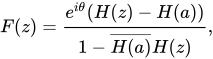



Remark. As a consequence of the Riemann mapping theorem, every simply connected domain in the plane is homeomorphic to the unit disk. If points are omitted, this follows from the theorem. For the whole plane, the homeomorphism Failed to parse (SVG (MathML can be enabled via browser plugin): Invalid response ("Math extension cannot connect to Restbase.") from server "https://wikimedia.org/api/rest_v1/":): {\displaystyle \phi(z)=z/(1+|z|)} gives a homeomorphism of Failed to parse (SVG (MathML can be enabled via browser plugin): Invalid response ("Math extension cannot connect to Restbase.") from server "https://wikimedia.org/api/rest_v1/":): {\displaystyle \mathbb{C}} onto Failed to parse (SVG (MathML can be enabled via browser plugin): Invalid response ("Math extension cannot connect to Restbase.") from server "https://wikimedia.org/api/rest_v1/":): {\displaystyle D} .
Parallel slit mappings
[edit | edit source]Koebe's uniformization theorem for normal families also generalizes to yield uniformizers Failed to parse (SVG (MathML can be enabled via browser plugin): Invalid response ("Math extension cannot connect to Restbase.") from server "https://wikimedia.org/api/rest_v1/":): {\displaystyle f} for multiply-connected domains to finite parallel slit domains, where the slits have angle Failed to parse (SVG (MathML can be enabled via browser plugin): Invalid response ("Math extension cannot connect to Restbase.") from server "https://wikimedia.org/api/rest_v1/":): {\displaystyle \theta} to the x-axis. Thus if Failed to parse (SVG (MathML can be enabled via browser plugin): Invalid response ("Math extension cannot connect to Restbase.") from server "https://wikimedia.org/api/rest_v1/":): {\displaystyle G} is a domain in Failed to parse (SVG (MathML can be enabled via browser plugin): Invalid response ("Math extension cannot connect to Restbase.") from server "https://wikimedia.org/api/rest_v1/":): {\displaystyle \mathbb{C}\cup\{\infty\}} containing Failed to parse (SVG (MathML can be enabled via browser plugin): Invalid response ("Math extension cannot connect to Restbase.") from server "https://wikimedia.org/api/rest_v1/":): {\displaystyle \infty} and bounded by finitely many Jordan contours, there is a unique univalent function Failed to parse (SVG (MathML can be enabled via browser plugin): Invalid response ("Math extension cannot connect to Restbase.") from server "https://wikimedia.org/api/rest_v1/":): {\displaystyle f} on Failed to parse (SVG (MathML can be enabled via browser plugin): Invalid response ("Math extension cannot connect to Restbase.") from server "https://wikimedia.org/api/rest_v1/":): {\displaystyle G} with
- Failed to parse (SVG (MathML can be enabled via browser plugin): Invalid response ("Math extension cannot connect to Restbase.") from server "https://wikimedia.org/api/rest_v1/":): {\displaystyle f(z)=z^{-1}+a_1z+a_2z^2+\cdots}
near Failed to parse (SVG (MathML can be enabled via browser plugin): Invalid response ("Math extension cannot connect to Restbase.") from server "https://wikimedia.org/api/rest_v1/":): {\displaystyle \infty} , maximizing Failed to parse (SVG (MathML can be enabled via browser plugin): Invalid response ("Math extension cannot connect to Restbase.") from server "https://wikimedia.org/api/rest_v1/":): {\displaystyle \mathrm{Re}(e^{-2i\theta}a_1)} and having image Failed to parse (SVG (MathML can be enabled via browser plugin): Invalid response ("Math extension cannot connect to Restbase.") from server "https://wikimedia.org/api/rest_v1/":): {\displaystyle f(G)} a parallel slit domain with angle Failed to parse (SVG (MathML can be enabled via browser plugin): Invalid response ("Math extension cannot connect to Restbase.") from server "https://wikimedia.org/api/rest_v1/":): {\displaystyle \theta} to the x-axis.[23][24][25]
The first proof that parallel slit domains were canonical domains for in the multiply connected case was given by David Hilbert in 1909. Jenkins (1958), on his book on univalent functions and conformal mappings, gave a treatment based on the work of Herbert Grötzsch and René de Possel from the early 1930s; it was the precursor of quasiconformal mappings and quadratic differentials, later developed as the technique of extremal metric due to Oswald Teichmüller.[26] Menahem Schiffer gave a treatment based on very general variational principles, summarised in addresses he gave to the International Congress of Mathematicians in 1950 and 1958. In a theorem on "boundary variation" (to distinguish it from "interior variation"), he derived a differential equation and inequality, that relied on a measure-theoretic characterisation of straight-line segments due to Ughtred Shuttleworth Haslam-Jones from 1936. Haslam-Jones' proof was regarded as difficult and was only given a satisfactory proof in the mid-1970s by Schober and Campbell–Lamoureux.[27][28][29]
Schiff (1993) gave a proof of uniformization for parallel slit domains which was similar to the Riemann mapping theorem. To simplify notation, horizontal slits will be taken. Firstly, by Bieberbach's inequality, any univalent function
- Failed to parse (SVG (MathML can be enabled via browser plugin): Invalid response ("Math extension cannot connect to Restbase.") from server "https://wikimedia.org/api/rest_v1/":): {\displaystyle g(z)=z+cz^2+\cdots}
with Failed to parse (SVG (MathML can be enabled via browser plugin): Invalid response ("Math extension cannot connect to Restbase.") from server "https://wikimedia.org/api/rest_v1/":): {\displaystyle z} in the open unit disk must satisfy Failed to parse (SVG (MathML can be enabled via browser plugin): Invalid response ("Math extension cannot connect to Restbase.") from server "https://wikimedia.org/api/rest_v1/":): {\displaystyle |c|\leq2} . As a consequence, if
- Failed to parse (SVG (MathML can be enabled via browser plugin): Invalid response ("Math extension cannot connect to Restbase.") from server "https://wikimedia.org/api/rest_v1/":): {\displaystyle f(z)=z+a_0+a_1z^{-1}+\cdots}
is univalent in Failed to parse (SVG (MathML can be enabled via browser plugin): Invalid response ("Math extension cannot connect to Restbase.") from server "https://wikimedia.org/api/rest_v1/":): {\displaystyle |z|>R} , then Failed to parse (SVG (MathML can be enabled via browser plugin): Invalid response ("Math extension cannot connect to Restbase.") from server "https://wikimedia.org/api/rest_v1/":): {\displaystyle |f(z)-a_0|\leq2|z|} . To see this, take Failed to parse (SVG (MathML can be enabled via browser plugin): Invalid response ("Math extension cannot connect to Restbase.") from server "https://wikimedia.org/api/rest_v1/":): {\displaystyle S>R} and set
- Failed to parse (SVG (MathML can be enabled via browser plugin): Invalid response ("Math extension cannot connect to Restbase.") from server "https://wikimedia.org/api/rest_v1/":): {\displaystyle g(z)=S(f(S/z)-b)^{-1}}
for Failed to parse (SVG (MathML can be enabled via browser plugin): Invalid response ("Math extension cannot connect to Restbase.") from server "https://wikimedia.org/api/rest_v1/":): {\displaystyle z} in the unit disk, choosing Failed to parse (SVG (MathML can be enabled via browser plugin): Invalid response ("Math extension cannot connect to Restbase.") from server "https://wikimedia.org/api/rest_v1/":): {\displaystyle b} so the denominator is nowhere-vanishing, and apply the Schwarz lemma. Next the function Failed to parse (SVG (MathML can be enabled via browser plugin): Invalid response ("Math extension cannot connect to Restbase.") from server "https://wikimedia.org/api/rest_v1/":): {\displaystyle f_R(z)=z+R^2/z} is characterized by an "extremal condition" as the unique univalent function in Failed to parse (SVG (MathML can be enabled via browser plugin): Invalid response ("Math extension cannot connect to Restbase.") from server "https://wikimedia.org/api/rest_v1/":): {\displaystyle z>R} of the form Failed to parse (SVG (MathML can be enabled via browser plugin): Invalid response ("Math extension cannot connect to Restbase.") from server "https://wikimedia.org/api/rest_v1/":): {\displaystyle z+a_1z^{-1}+\cdots} that maximises Failed to parse (SVG (MathML can be enabled via browser plugin): Invalid response ("Math extension cannot connect to Restbase.") from server "https://wikimedia.org/api/rest_v1/":): {\displaystyle \mathrm{Re}(a_1)} : this is an immediate consequence of Grönwall's area theorem, applied to the family of univalent functions Failed to parse (SVG (MathML can be enabled via browser plugin): Invalid response ("Math extension cannot connect to Restbase.") from server "https://wikimedia.org/api/rest_v1/":): {\displaystyle f(zR)/R} in Failed to parse (SVG (MathML can be enabled via browser plugin): Invalid response ("Math extension cannot connect to Restbase.") from server "https://wikimedia.org/api/rest_v1/":): {\displaystyle z>1} .[30][31]
To prove now that the multiply connected domain Failed to parse (SVG (MathML can be enabled via browser plugin): Invalid response ("Math extension cannot connect to Restbase.") from server "https://wikimedia.org/api/rest_v1/":): {\displaystyle G\subset\mathbb{C}\cup\{\infty\}} can be uniformized by a horizontal parallel slit conformal mapping
- Failed to parse (SVG (MathML can be enabled via browser plugin): Invalid response ("Math extension cannot connect to Restbase.") from server "https://wikimedia.org/api/rest_v1/":): {\displaystyle f(z)=z+a_1z^{-1}+\cdots} ,
take Failed to parse (SVG (MathML can be enabled via browser plugin): Invalid response ("Math extension cannot connect to Restbase.") from server "https://wikimedia.org/api/rest_v1/":): {\displaystyle R} large enough that Failed to parse (SVG (MathML can be enabled via browser plugin): Invalid response ("Math extension cannot connect to Restbase.") from server "https://wikimedia.org/api/rest_v1/":): {\displaystyle \partial G} lies in the open disk Failed to parse (SVG (MathML can be enabled via browser plugin): Invalid response ("Math extension cannot connect to Restbase.") from server "https://wikimedia.org/api/rest_v1/":): {\displaystyle |z|<R} . For Failed to parse (SVG (MathML can be enabled via browser plugin): Invalid response ("Math extension cannot connect to Restbase.") from server "https://wikimedia.org/api/rest_v1/":): {\displaystyle S>R} , univalency and the estimate Failed to parse (SVG (MathML can be enabled via browser plugin): Invalid response ("Math extension cannot connect to Restbase.") from server "https://wikimedia.org/api/rest_v1/":): {\displaystyle |f(z)|\leq2|z|} imply that, if Failed to parse (SVG (MathML can be enabled via browser plugin): Invalid response ("Math extension cannot connect to Restbase.") from server "https://wikimedia.org/api/rest_v1/":): {\displaystyle z} lies in Failed to parse (SVG (MathML can be enabled via browser plugin): Invalid response ("Math extension cannot connect to Restbase.") from server "https://wikimedia.org/api/rest_v1/":): {\displaystyle G} with Failed to parse (SVG (MathML can be enabled via browser plugin): Invalid response ("Math extension cannot connect to Restbase.") from server "https://wikimedia.org/api/rest_v1/":): {\displaystyle |z|\leq S} , then Failed to parse (SVG (MathML can be enabled via browser plugin): Invalid response ("Math extension cannot connect to Restbase.") from server "https://wikimedia.org/api/rest_v1/":): {\displaystyle |f(z)|\leq2S} . Since the family of univalent Failed to parse (SVG (MathML can be enabled via browser plugin): Invalid response ("Math extension cannot connect to Restbase.") from server "https://wikimedia.org/api/rest_v1/":): {\displaystyle f} are locally bounded in Failed to parse (SVG (MathML can be enabled via browser plugin): Invalid response ("Math extension cannot connect to Restbase.") from server "https://wikimedia.org/api/rest_v1/":): {\displaystyle G\setminus\{\infty\}} , by Montel's theorem they form a normal family. Furthermore if Failed to parse (SVG (MathML can be enabled via browser plugin): Invalid response ("Math extension cannot connect to Restbase.") from server "https://wikimedia.org/api/rest_v1/":): {\displaystyle f_n} is in the family and tends to Failed to parse (SVG (MathML can be enabled via browser plugin): Invalid response ("Math extension cannot connect to Restbase.") from server "https://wikimedia.org/api/rest_v1/":): {\displaystyle f} uniformly on compacta, then Failed to parse (SVG (MathML can be enabled via browser plugin): Invalid response ("Math extension cannot connect to Restbase.") from server "https://wikimedia.org/api/rest_v1/":): {\displaystyle f} is also in the family and each coefficient of the Laurent expansion at Failed to parse (SVG (MathML can be enabled via browser plugin): Invalid response ("Math extension cannot connect to Restbase.") from server "https://wikimedia.org/api/rest_v1/":): {\displaystyle \infty} of the Failed to parse (SVG (MathML can be enabled via browser plugin): Invalid response ("Math extension cannot connect to Restbase.") from server "https://wikimedia.org/api/rest_v1/":): {\displaystyle f_n} tends to the corresponding coefficient of Failed to parse (SVG (MathML can be enabled via browser plugin): Invalid response ("Math extension cannot connect to Restbase.") from server "https://wikimedia.org/api/rest_v1/":): {\displaystyle f} . This applies in particular to the coefficient: so by compactness there is a univalent Failed to parse (SVG (MathML can be enabled via browser plugin): Invalid response ("Math extension cannot connect to Restbase.") from server "https://wikimedia.org/api/rest_v1/":): {\displaystyle f} which maximizes Failed to parse (SVG (MathML can be enabled via browser plugin): Invalid response ("Math extension cannot connect to Restbase.") from server "https://wikimedia.org/api/rest_v1/":): {\displaystyle \mathrm{Re}(a_1)} . To check that
- Failed to parse (SVG (MathML can be enabled via browser plugin): Invalid response ("Math extension cannot connect to Restbase.") from server "https://wikimedia.org/api/rest_v1/":): {\displaystyle f(z)=z+a_1+\cdots}
is the required parallel slit transformation, suppose reductio ad absurdum that Failed to parse (SVG (MathML can be enabled via browser plugin): Invalid response ("Math extension cannot connect to Restbase.") from server "https://wikimedia.org/api/rest_v1/":): {\displaystyle f(G)=G_1} has a compact and connected component Failed to parse (SVG (MathML can be enabled via browser plugin): Invalid response ("Math extension cannot connect to Restbase.") from server "https://wikimedia.org/api/rest_v1/":): {\displaystyle K} of its boundary which is not a horizontal slit. Then the complement Failed to parse (SVG (MathML can be enabled via browser plugin): Invalid response ("Math extension cannot connect to Restbase.") from server "https://wikimedia.org/api/rest_v1/":): {\displaystyle G_2} of Failed to parse (SVG (MathML can be enabled via browser plugin): Invalid response ("Math extension cannot connect to Restbase.") from server "https://wikimedia.org/api/rest_v1/":): {\displaystyle K} in Failed to parse (SVG (MathML can be enabled via browser plugin): Invalid response ("Math extension cannot connect to Restbase.") from server "https://wikimedia.org/api/rest_v1/":): {\displaystyle \mathbb{C}\cup\{\infty\}} is simply connected with Failed to parse (SVG (MathML can be enabled via browser plugin): Invalid response ("Math extension cannot connect to Restbase.") from server "https://wikimedia.org/api/rest_v1/":): {\displaystyle G_2\supset G_1} . By the Riemann mapping theorem there is a conformal mapping
- Failed to parse (SVG (MathML can be enabled via browser plugin): Invalid response ("Math extension cannot connect to Restbase.") from server "https://wikimedia.org/api/rest_v1/":): {\displaystyle h(w)=w+b_1w^{-1}+\cdots,}
such that Failed to parse (SVG (MathML can be enabled via browser plugin): Invalid response ("Math extension cannot connect to Restbase.") from server "https://wikimedia.org/api/rest_v1/":): {\displaystyle h(G_2)} is Failed to parse (SVG (MathML can be enabled via browser plugin): Invalid response ("Math extension cannot connect to Restbase.") from server "https://wikimedia.org/api/rest_v1/":): {\displaystyle \mathbb{C}} with a horizontal slit removed. So we have that
- Failed to parse (SVG (MathML can be enabled via browser plugin): Invalid response ("Math extension cannot connect to Restbase.") from server "https://wikimedia.org/api/rest_v1/":): {\displaystyle h(f(z))=z+(a_1+b_1)z^{-1}+\cdots,}
and thus Failed to parse (SVG (MathML can be enabled via browser plugin): Invalid response ("Math extension cannot connect to Restbase.") from server "https://wikimedia.org/api/rest_v1/":): {\displaystyle \mathrm{Re}(a_1+b_1)\leq\mathrm{Re}(a_1)} by the extremality of Failed to parse (SVG (MathML can be enabled via browser plugin): Invalid response ("Math extension cannot connect to Restbase.") from server "https://wikimedia.org/api/rest_v1/":): {\displaystyle f} . Therefore, Failed to parse (SVG (MathML can be enabled via browser plugin): Invalid response ("Math extension cannot connect to Restbase.") from server "https://wikimedia.org/api/rest_v1/":): {\displaystyle \mathrm{Re}(b_1)\leq0} . On the other hand by the Riemann mapping theorem there is a conformal mapping
- Failed to parse (SVG (MathML can be enabled via browser plugin): Invalid response ("Math extension cannot connect to Restbase.") from server "https://wikimedia.org/api/rest_v1/":): {\displaystyle k(w)=w+c_0+c_1w^{-1}+\cdots,}
mapping from Failed to parse (SVG (MathML can be enabled via browser plugin): Invalid response ("Math extension cannot connect to Restbase.") from server "https://wikimedia.org/api/rest_v1/":): {\displaystyle |w|>S} onto Failed to parse (SVG (MathML can be enabled via browser plugin): Invalid response ("Math extension cannot connect to Restbase.") from server "https://wikimedia.org/api/rest_v1/":): {\displaystyle G_2} . Then
- Failed to parse (SVG (MathML can be enabled via browser plugin): Invalid response ("Math extension cannot connect to Restbase.") from server "https://wikimedia.org/api/rest_v1/":): {\displaystyle f(k(w))-c_0=w+(a_1+c_1)w^{-1}+\cdots.}
By the strict maximality for the slit mapping in the previous paragraph, we can see that Failed to parse (SVG (MathML can be enabled via browser plugin): Invalid response ("Math extension cannot connect to Restbase.") from server "https://wikimedia.org/api/rest_v1/":): {\displaystyle \mathrm{Re}(c_1)<\mathrm{Re}(b_1+c_1)} , so that Failed to parse (SVG (MathML can be enabled via browser plugin): Invalid response ("Math extension cannot connect to Restbase.") from server "https://wikimedia.org/api/rest_v1/":): {\displaystyle \mathrm{Re}(b_1)>0} . The two inequalities for Failed to parse (SVG (MathML can be enabled via browser plugin): Invalid response ("Math extension cannot connect to Restbase.") from server "https://wikimedia.org/api/rest_v1/":): {\displaystyle \mathrm{Re}(b_1)} are contradictory.[32][33][34]
The proof of the uniqueness of the conformal parallel slit transformation is given in Goluzin (1969) and Grunsky (1978). Applying the inverse of the Joukowsky transform Failed to parse (SVG (MathML can be enabled via browser plugin): Invalid response ("Math extension cannot connect to Restbase.") from server "https://wikimedia.org/api/rest_v1/":): {\displaystyle h} to the horizontal slit domain, it can be assumed that Failed to parse (SVG (MathML can be enabled via browser plugin): Invalid response ("Math extension cannot connect to Restbase.") from server "https://wikimedia.org/api/rest_v1/":): {\displaystyle G} is a domain bounded by the unit circle Failed to parse (SVG (MathML can be enabled via browser plugin): Invalid response ("Math extension cannot connect to Restbase.") from server "https://wikimedia.org/api/rest_v1/":): {\displaystyle C_0} and contains analytic arcs Failed to parse (SVG (MathML can be enabled via browser plugin): Invalid response ("Math extension cannot connect to Restbase.") from server "https://wikimedia.org/api/rest_v1/":): {\displaystyle C_i} and isolated points (the images of other the inverse of the Joukowsky transform under the other parallel horizontal slits). Thus, taking a fixed Failed to parse (SVG (MathML can be enabled via browser plugin): Invalid response ("Math extension cannot connect to Restbase.") from server "https://wikimedia.org/api/rest_v1/":): {\displaystyle a\in G} , there is a univalent mapping
- Failed to parse (SVG (MathML can be enabled via browser plugin): Invalid response ("Math extension cannot connect to Restbase.") from server "https://wikimedia.org/api/rest_v1/":): {\displaystyle F_0(w)=h\circ f(w)=(w-a)^{-1}+a_1(w-a)+a_2(w-a)^2+\cdots,}
with its image a horizontal slit domain. Suppose that Failed to parse (SVG (MathML can be enabled via browser plugin): Invalid response ("Math extension cannot connect to Restbase.") from server "https://wikimedia.org/api/rest_v1/":): {\displaystyle F_1(w)} is another uniformizer with
- Failed to parse (SVG (MathML can be enabled via browser plugin): Invalid response ("Math extension cannot connect to Restbase.") from server "https://wikimedia.org/api/rest_v1/":): {\displaystyle F_1(w)=(w-a)^{-1}+b_1(w-a)+b_2(w-a)^2+\cdots.}
The images under Failed to parse (SVG (MathML can be enabled via browser plugin): Invalid response ("Math extension cannot connect to Restbase.") from server "https://wikimedia.org/api/rest_v1/":): {\displaystyle F_0} or Failed to parse (SVG (MathML can be enabled via browser plugin): Invalid response ("Math extension cannot connect to Restbase.") from server "https://wikimedia.org/api/rest_v1/":): {\displaystyle F_1} of each Failed to parse (SVG (MathML can be enabled via browser plugin): Invalid response ("Math extension cannot connect to Restbase.") from server "https://wikimedia.org/api/rest_v1/":): {\displaystyle C_i} have a fixed y-coordinate so are horizontal segments. On the other hand, Failed to parse (SVG (MathML can be enabled via browser plugin): Invalid response ("Math extension cannot connect to Restbase.") from server "https://wikimedia.org/api/rest_v1/":): {\displaystyle F_2(w)=F_0(w)-F_1(w)} is holomorphic in Failed to parse (SVG (MathML can be enabled via browser plugin): Invalid response ("Math extension cannot connect to Restbase.") from server "https://wikimedia.org/api/rest_v1/":): {\displaystyle G} . If it is constant, then it must be identically zero since Failed to parse (SVG (MathML can be enabled via browser plugin): Invalid response ("Math extension cannot connect to Restbase.") from server "https://wikimedia.org/api/rest_v1/":): {\displaystyle F_2(a)=0} . Suppose Failed to parse (SVG (MathML can be enabled via browser plugin): Invalid response ("Math extension cannot connect to Restbase.") from server "https://wikimedia.org/api/rest_v1/":): {\displaystyle F_2} is non-constant, then by assumption are all horizontal lines. If is not in one of these lines, Cauchy's argument principle shows that the number of solutions of in is zero (any will eventually be encircled by contours in close to the 's). This contradicts the fact that the non-constant holomorphic function is an open mapping.[35]


Sketch proof via Dirichlet problem
[edit | edit source]Given and a point Failed to parse (SVG (MathML can be enabled via browser plugin): Invalid response ("Math extension cannot connect to Restbase.") from server "https://wikimedia.org/api/rest_v1/":): {\displaystyle z_0\in U} , we want to construct a function Failed to parse (SVG (MathML can be enabled via browser plugin): Invalid response ("Math extension cannot connect to Restbase.") from server "https://wikimedia.org/api/rest_v1/":): {\displaystyle f} which maps Failed to parse (SVG (MathML can be enabled via browser plugin): Invalid response ("Math extension cannot connect to Restbase.") from server "https://wikimedia.org/api/rest_v1/":): {\displaystyle U} to the unit disk and Failed to parse (SVG (MathML can be enabled via browser plugin): Invalid response ("Math extension cannot connect to Restbase.") from server "https://wikimedia.org/api/rest_v1/":): {\displaystyle z_0} to Failed to parse (SVG (MathML can be enabled via browser plugin): Invalid response ("Math extension cannot connect to Restbase.") from server "https://wikimedia.org/api/rest_v1/":): {\displaystyle 0} . For this sketch, we will assume that U is bounded and its boundary is smooth, much like Riemann did. Write
- Failed to parse (SVG (MathML can be enabled via browser plugin): Invalid response ("Math extension cannot connect to Restbase.") from server "https://wikimedia.org/api/rest_v1/":): {\displaystyle f(z) = (z - z_0)e^{g(z)},}
where Failed to parse (SVG (MathML can be enabled via browser plugin): Invalid response ("Math extension cannot connect to Restbase.") from server "https://wikimedia.org/api/rest_v1/":): {\displaystyle g=u+iv} is some (to be determined) holomorphic function with real part Failed to parse (SVG (MathML can be enabled via browser plugin): Invalid response ("Math extension cannot connect to Restbase.") from server "https://wikimedia.org/api/rest_v1/":): {\displaystyle u} and imaginary part Failed to parse (SVG (MathML can be enabled via browser plugin): Invalid response ("Math extension cannot connect to Restbase.") from server "https://wikimedia.org/api/rest_v1/":): {\displaystyle v} . It is then clear that Failed to parse (SVG (MathML can be enabled via browser plugin): Invalid response ("Math extension cannot connect to Restbase.") from server "https://wikimedia.org/api/rest_v1/":): {\displaystyle z_0} is the only zero of Failed to parse (SVG (MathML can be enabled via browser plugin): Invalid response ("Math extension cannot connect to Restbase.") from server "https://wikimedia.org/api/rest_v1/":): {\displaystyle f} . We require Failed to parse (SVG (MathML can be enabled via browser plugin): Invalid response ("Math extension cannot connect to Restbase.") from server "https://wikimedia.org/api/rest_v1/":): {\displaystyle |f(z)|=1} for Failed to parse (SVG (MathML can be enabled via browser plugin): Invalid response ("Math extension cannot connect to Restbase.") from server "https://wikimedia.org/api/rest_v1/":): {\displaystyle z\in\partial U} , so we need
- Failed to parse (SVG (MathML can be enabled via browser plugin): Invalid response ("Math extension cannot connect to Restbase.") from server "https://wikimedia.org/api/rest_v1/":): {\displaystyle u(z) = -\log|z - z_0|}
on the boundary. Since Failed to parse (SVG (MathML can be enabled via browser plugin): Invalid response ("Math extension cannot connect to Restbase.") from server "https://wikimedia.org/api/rest_v1/":): {\displaystyle u} is the real part of a holomorphic function, we know that Failed to parse (SVG (MathML can be enabled via browser plugin): Invalid response ("Math extension cannot connect to Restbase.") from server "https://wikimedia.org/api/rest_v1/":): {\displaystyle u} is necessarily a harmonic function; i.e., it satisfies Laplace's equation.
The question then becomes: does a real-valued harmonic function Failed to parse (SVG (MathML can be enabled via browser plugin): Invalid response ("Math extension cannot connect to Restbase.") from server "https://wikimedia.org/api/rest_v1/":): {\displaystyle u} exist that is defined on all of Failed to parse (SVG (MathML can be enabled via browser plugin): Invalid response ("Math extension cannot connect to Restbase.") from server "https://wikimedia.org/api/rest_v1/":): {\displaystyle U} and has the given boundary condition? The positive answer is provided by the Dirichlet principle. Once the existence of Failed to parse (SVG (MathML can be enabled via browser plugin): Invalid response ("Math extension cannot connect to Restbase.") from server "https://wikimedia.org/api/rest_v1/":): {\displaystyle u} has been established, the Cauchy–Riemann equations for the holomorphic function Failed to parse (SVG (MathML can be enabled via browser plugin): Invalid response ("Math extension cannot connect to Restbase.") from server "https://wikimedia.org/api/rest_v1/":): {\displaystyle g} allow us to find Failed to parse (SVG (MathML can be enabled via browser plugin): Invalid response ("Math extension cannot connect to Restbase.") from server "https://wikimedia.org/api/rest_v1/":): {\displaystyle v} (this argument depends on the assumption that Failed to parse (SVG (MathML can be enabled via browser plugin): Invalid response ("Math extension cannot connect to Restbase.") from server "https://wikimedia.org/api/rest_v1/":): {\displaystyle U} be simply connected). Once Failed to parse (SVG (MathML can be enabled via browser plugin): Invalid response ("Math extension cannot connect to Restbase.") from server "https://wikimedia.org/api/rest_v1/":): {\displaystyle u} and Failed to parse (SVG (MathML can be enabled via browser plugin): Invalid response ("Math extension cannot connect to Restbase.") from server "https://wikimedia.org/api/rest_v1/":): {\displaystyle v} have been constructed, one has to check that the resulting function Failed to parse (SVG (MathML can be enabled via browser plugin): Invalid response ("Math extension cannot connect to Restbase.") from server "https://wikimedia.org/api/rest_v1/":): {\displaystyle f} does indeed have all the required properties.[36]
Uniformization theorem
[edit | edit source]The Riemann mapping theorem can be generalized to the context of Riemann surfaces: If Failed to parse (SVG (MathML can be enabled via browser plugin): Invalid response ("Math extension cannot connect to Restbase.") from server "https://wikimedia.org/api/rest_v1/":): {\displaystyle U} is a non-empty simply-connected open subset of a Riemann surface, then Failed to parse (SVG (MathML can be enabled via browser plugin): Invalid response ("Math extension cannot connect to Restbase.") from server "https://wikimedia.org/api/rest_v1/":): {\displaystyle U} is biholomorphic to one of the following: the Riemann sphere, the complex plane Failed to parse (SVG (MathML can be enabled via browser plugin): Invalid response ("Math extension cannot connect to Restbase.") from server "https://wikimedia.org/api/rest_v1/":): {\displaystyle \mathbb{C}} , or the unit disk Failed to parse (SVG (MathML can be enabled via browser plugin): Invalid response ("Math extension cannot connect to Restbase.") from server "https://wikimedia.org/api/rest_v1/":): {\displaystyle D} . This is known as the uniformization theorem.
Smooth Riemann mapping theorem
[edit | edit source]In the case of a simply connected bounded domain with smooth boundary, the Riemann mapping function and all its derivatives extend by continuity to the closure of the domain. This can be proved using regularity properties of solutions of the Dirichlet boundary value problem, which follow either from the theory of Sobolev spaces for planar domains or from classical potential theory. Other methods for proving the smooth Riemann mapping theorem include the theory of kernel functions[37] or the Beltrami equation.
Algorithms
[edit | edit source]Computational conformal mapping is prominently featured in problems of applied analysis and mathematical physics, as well as in engineering disciplines, such as image processing.
In the early 1980s an elementary algorithm for computing conformal maps was discovered. Given points Failed to parse (SVG (MathML can be enabled via browser plugin): Invalid response ("Math extension cannot connect to Restbase.") from server "https://wikimedia.org/api/rest_v1/":): {\displaystyle z_0, \ldots, z_n} in the plane, the algorithm computes an explicit conformal map of the unit disk onto a region bounded by a Jordan curve Failed to parse (SVG (MathML can be enabled via browser plugin): Invalid response ("Math extension cannot connect to Restbase.") from server "https://wikimedia.org/api/rest_v1/":): {\displaystyle \gamma} with Failed to parse (SVG (MathML can be enabled via browser plugin): Invalid response ("Math extension cannot connect to Restbase.") from server "https://wikimedia.org/api/rest_v1/":): {\displaystyle z_0, \ldots, z_n \in \gamma.} This algorithm converges for Jordan regions[38] in the sense of uniformly close boundaries. There are corresponding uniform estimates on the closed region and the closed disc for the mapping functions and their inverses. Improved estimates are obtained if the data points lie on a Failed to parse (SVG (MathML can be enabled via browser plugin): Invalid response ("Math extension cannot connect to Restbase.") from server "https://wikimedia.org/api/rest_v1/":): {\displaystyle C^1} curve or a K-quasicircle. The algorithm was discovered as an approximate method for conformal welding; however, it can also be viewed as a discretization of the Loewner differential equation.[39]
The following is known about numerically approximating the conformal mapping between two planar domains.[40]
Positive results:
- There is an algorithm A that computes the uniformizing map in the following sense. Let Failed to parse (SVG (MathML can be enabled via browser plugin): Invalid response ("Math extension cannot connect to Restbase.") from server "https://wikimedia.org/api/rest_v1/":): {\displaystyle \Omega} be a bounded simply-connected domain, and Failed to parse (SVG (MathML can be enabled via browser plugin): Invalid response ("Math extension cannot connect to Restbase.") from server "https://wikimedia.org/api/rest_v1/":): {\displaystyle w_0\in\Omega} . Failed to parse (SVG (MathML can be enabled via browser plugin): Invalid response ("Math extension cannot connect to Restbase.") from server "https://wikimedia.org/api/rest_v1/":): {\displaystyle \partial\Omega} is provided to A by an oracle representing it in a pixelated sense (i.e., if the screen is divided to Failed to parse (SVG (MathML can be enabled via browser plugin): Invalid response ("Math extension cannot connect to Restbase.") from server "https://wikimedia.org/api/rest_v1/":): {\displaystyle 2^n \times 2^n} pixels, the oracle can say whether each pixel belongs to the boundary or not). Then A computes the absolute values of the uniformizing map Failed to parse (SVG (MathML can be enabled via browser plugin): Invalid response ("Math extension cannot connect to Restbase.") from server "https://wikimedia.org/api/rest_v1/":): {\displaystyle \phi:(\Omega, w_0) \to (D, 0)} with precision Failed to parse (SVG (MathML can be enabled via browser plugin): Invalid response ("Math extension cannot connect to Restbase.") from server "https://wikimedia.org/api/rest_v1/":): {\displaystyle 2^{-n}} in space bounded by Failed to parse (SVG (MathML can be enabled via browser plugin): Invalid response ("Math extension cannot connect to Restbase.") from server "https://wikimedia.org/api/rest_v1/":): {\displaystyle Cn^2} and time Failed to parse (SVG (MathML can be enabled via browser plugin): Invalid response ("Math extension cannot connect to Restbase.") from server "https://wikimedia.org/api/rest_v1/":): {\displaystyle 2^{O(n)}} , where Failed to parse (SVG (MathML can be enabled via browser plugin): Invalid response ("Math extension cannot connect to Restbase.") from server "https://wikimedia.org/api/rest_v1/":): {\displaystyle C} depends only on the diameter of Failed to parse (SVG (MathML can be enabled via browser plugin): Invalid response ("Math extension cannot connect to Restbase.") from server "https://wikimedia.org/api/rest_v1/":): {\displaystyle \Omega} and Failed to parse (SVG (MathML can be enabled via browser plugin): Invalid response ("Math extension cannot connect to Restbase.") from server "https://wikimedia.org/api/rest_v1/":): {\displaystyle d(w_0, \partial\Omega).} Furthermore, the algorithm computes the value of Failed to parse (SVG (MathML can be enabled via browser plugin): Invalid response ("Math extension cannot connect to Restbase.") from server "https://wikimedia.org/api/rest_v1/":): {\displaystyle \phi(w)} with precision Failed to parse (SVG (MathML can be enabled via browser plugin): Invalid response ("Math extension cannot connect to Restbase.") from server "https://wikimedia.org/api/rest_v1/":): {\displaystyle 2^{-n}} as long as Failed to parse (SVG (MathML can be enabled via browser plugin): Invalid response ("Math extension cannot connect to Restbase.") from server "https://wikimedia.org/api/rest_v1/":): {\displaystyle |\phi(w)| < 1-2^{-n}.} Moreover, A queries Failed to parse (SVG (MathML can be enabled via browser plugin): Invalid response ("Math extension cannot connect to Restbase.") from server "https://wikimedia.org/api/rest_v1/":): {\displaystyle \partial\Omega} with precision of at most Failed to parse (SVG (MathML can be enabled via browser plugin): Invalid response ("Math extension cannot connect to Restbase.") from server "https://wikimedia.org/api/rest_v1/":): {\displaystyle 2^{-O(n)}.} In particular, if Failed to parse (SVG (MathML can be enabled via browser plugin): Invalid response ("Math extension cannot connect to Restbase.") from server "https://wikimedia.org/api/rest_v1/":): {\displaystyle \partial\Omega} is polynomial space computable in space Failed to parse (SVG (MathML can be enabled via browser plugin): Invalid response ("Math extension cannot connect to Restbase.") from server "https://wikimedia.org/api/rest_v1/":): {\displaystyle n^a} for some constant Failed to parse (SVG (MathML can be enabled via browser plugin): Invalid response ("Math extension cannot connect to Restbase.") from server "https://wikimedia.org/api/rest_v1/":): {\displaystyle a\geq 1} and time Failed to parse (SVG (MathML can be enabled via browser plugin): Invalid response ("Math extension cannot connect to Restbase.") from server "https://wikimedia.org/api/rest_v1/":): {\displaystyle T(n) < 2^{O(n^a)},} then A can be used to compute the uniformizing map in space Failed to parse (SVG (MathML can be enabled via browser plugin): Invalid response ("Math extension cannot connect to Restbase.") from server "https://wikimedia.org/api/rest_v1/":): {\displaystyle C\cdot n^{\max(a,2)}} and time Failed to parse (SVG (MathML can be enabled via browser plugin): Invalid response ("Math extension cannot connect to Restbase.") from server "https://wikimedia.org/api/rest_v1/":): {\displaystyle 2^{O(n^a)}.}
- There is an algorithm A′ that computes the uniformizing map in the following sense. Let Failed to parse (SVG (MathML can be enabled via browser plugin): Invalid response ("Math extension cannot connect to Restbase.") from server "https://wikimedia.org/api/rest_v1/":): {\displaystyle \Omega} be a bounded simply-connected domain, and Failed to parse (SVG (MathML can be enabled via browser plugin): Invalid response ("Math extension cannot connect to Restbase.") from server "https://wikimedia.org/api/rest_v1/":): {\displaystyle w_0 \in \Omega.} Suppose that for some Failed to parse (SVG (MathML can be enabled via browser plugin): Invalid response ("Math extension cannot connect to Restbase.") from server "https://wikimedia.org/api/rest_v1/":): {\displaystyle n=2^k,} Failed to parse (SVG (MathML can be enabled via browser plugin): Invalid response ("Math extension cannot connect to Restbase.") from server "https://wikimedia.org/api/rest_v1/":): {\displaystyle \partial\Omega} is given to A′ with precision Failed to parse (SVG (MathML can be enabled via browser plugin): Invalid response ("Math extension cannot connect to Restbase.") from server "https://wikimedia.org/api/rest_v1/":): {\displaystyle \tfrac{1}{n}} by Failed to parse (SVG (MathML can be enabled via browser plugin): Invalid response ("Math extension cannot connect to Restbase.") from server "https://wikimedia.org/api/rest_v1/":): {\displaystyle O(n^2)} pixels. Then A′ computes the absolute values of the uniformizing map Failed to parse (SVG (MathML can be enabled via browser plugin): Invalid response ("Math extension cannot connect to Restbase.") from server "https://wikimedia.org/api/rest_v1/":): {\displaystyle \phi:(\Omega, w_0) \to (D, 0)} within an error of Failed to parse (SVG (MathML can be enabled via browser plugin): Invalid response ("Math extension cannot connect to Restbase.") from server "https://wikimedia.org/api/rest_v1/":): {\displaystyle O(1/n)} in randomized space bounded by Failed to parse (SVG (MathML can be enabled via browser plugin): Invalid response ("Math extension cannot connect to Restbase.") from server "https://wikimedia.org/api/rest_v1/":): {\displaystyle O(k)} and time polynomial in Failed to parse (SVG (MathML can be enabled via browser plugin): Invalid response ("Math extension cannot connect to Restbase.") from server "https://wikimedia.org/api/rest_v1/":): {\displaystyle n=2^k} (that is, by a BPL(n)-machine). Furthermore, the algorithm computes the value of Failed to parse (SVG (MathML can be enabled via browser plugin): Invalid response ("Math extension cannot connect to Restbase.") from server "https://wikimedia.org/api/rest_v1/":): {\displaystyle \phi(w)} with precision Failed to parse (SVG (MathML can be enabled via browser plugin): Invalid response ("Math extension cannot connect to Restbase.") from server "https://wikimedia.org/api/rest_v1/":): {\displaystyle \tfrac{1}{n}} as long as Failed to parse (SVG (MathML can be enabled via browser plugin): Invalid response ("Math extension cannot connect to Restbase.") from server "https://wikimedia.org/api/rest_v1/":): {\displaystyle |\phi(w)|< 1 -\tfrac{1}{n}.}
Negative results:
- Suppose there is an algorithm A that given a simply-connected domain Failed to parse (SVG (MathML can be enabled via browser plugin): Invalid response ("Math extension cannot connect to Restbase.") from server "https://wikimedia.org/api/rest_v1/":): {\displaystyle \Omega} with a linear-time computable boundary and an inner radius Failed to parse (SVG (MathML can be enabled via browser plugin): Invalid response ("Math extension cannot connect to Restbase.") from server "https://wikimedia.org/api/rest_v1/":): {\displaystyle >1/2} and a number Failed to parse (SVG (MathML can be enabled via browser plugin): Invalid response ("Math extension cannot connect to Restbase.") from server "https://wikimedia.org/api/rest_v1/":): {\displaystyle n} computes the first Failed to parse (SVG (MathML can be enabled via browser plugin): Invalid response ("Math extension cannot connect to Restbase.") from server "https://wikimedia.org/api/rest_v1/":): {\displaystyle 20 n} digits of the conformal radius Failed to parse (SVG (MathML can be enabled via browser plugin): Invalid response ("Math extension cannot connect to Restbase.") from server "https://wikimedia.org/api/rest_v1/":): {\displaystyle r(\Omega, 0),} then we can use one call to A to solve any instance of a #SAT(n) with a linear time overhead. In other words, #P is poly-time reducible to computing the conformal radius of a set.
- Consider the problem of computing the conformal radius of a simply-connected domain Failed to parse (SVG (MathML can be enabled via browser plugin): Invalid response ("Math extension cannot connect to Restbase.") from server "https://wikimedia.org/api/rest_v1/":): {\displaystyle \Omega,} where the boundary of Failed to parse (SVG (MathML can be enabled via browser plugin): Invalid response ("Math extension cannot connect to Restbase.") from server "https://wikimedia.org/api/rest_v1/":): {\displaystyle \Omega} is given with precision Failed to parse (SVG (MathML can be enabled via browser plugin): Invalid response ("Math extension cannot connect to Restbase.") from server "https://wikimedia.org/api/rest_v1/":): {\displaystyle 1/n} by an explicit collection of Failed to parse (SVG (MathML can be enabled via browser plugin): Invalid response ("Math extension cannot connect to Restbase.") from server "https://wikimedia.org/api/rest_v1/":): {\displaystyle O(n^2)} pixels. Denote the problem of computing the conformal radius with precision Failed to parse (SVG (MathML can be enabled via browser plugin): Invalid response ("Math extension cannot connect to Restbase.") from server "https://wikimedia.org/api/rest_v1/":): {\displaystyle 1/n^c} by Failed to parse (SVG (MathML can be enabled via browser plugin): Invalid response ("Math extension cannot connect to Restbase.") from server "https://wikimedia.org/api/rest_v1/":): {\displaystyle \texttt{CONF}(n,n^c).} Then, Failed to parse (SVG (MathML can be enabled via browser plugin): Invalid response ("Math extension cannot connect to Restbase.") from server "https://wikimedia.org/api/rest_v1/":): {\displaystyle \texttt{MAJ}_n} is AC0 reducible to Failed to parse (SVG (MathML can be enabled via browser plugin): Invalid response ("Math extension cannot connect to Restbase.") from server "https://wikimedia.org/api/rest_v1/":): {\displaystyle \texttt{CONF}(n,n^c)} for any Failed to parse (SVG (MathML can be enabled via browser plugin): Invalid response ("Math extension cannot connect to Restbase.") from server "https://wikimedia.org/api/rest_v1/":): {\displaystyle 0 < c < \tfrac{1}{2}.}
See also
[edit | edit source]- Measurable Riemann mapping theorem
- Schwarz–Christoffel mapping – a conformal transformation of the upper half-plane onto the interior of a simple polygon.
- Conformal radius
Notes
[edit | edit source]- ↑ The existence of f is equivalent to the existence of a Green’s function.
- ↑ Ahlfors, Lars (1953), L. Ahlfors; E. Calabi; M. Morse; L. Sario; D. Spencer (eds.), "Developments of the Theory of Conformal Mapping and Riemann Surfaces Through a Century", Contributions to the Theory of Riemann Surfaces: 3–4
- ↑ For the original paper, see Osgood 1900. For accounts of the history, see Walsh 1973, pp. 270–271; Gray 1994, pp. 64–65; Greene & Kim 2017, p. 4. Also see Carathéodory 1912, p. 108, footnote ** (acknowledging that Osgood 1900 had already proven the Riemann mapping theorem).
- ↑ Gray 1994, pp. 78–80, citing Carathéodory 1912
- ↑ Greene & Kim 2017, p. 1
- ↑ Gray 1994, pp. 80–83
- ↑ "What did Riemann Contribute to Mathematics? Geometry, Number Theory and Others".
- ↑ Lakhtakia, Akhlesh; Varadan, Vijay K.; Messier, Russell (August 1987). "Generalisations and randomisation of the plane Koch curve". Journal of Physics A: Mathematical and General. 20 (11): 3537–3541. doi:10.1088/0305-4470/20/11/052.
- ↑ Remmert 1998, section 8.3, p. 187
- ↑ See
- ↑ Gamelin 2001, pp. 256–257, elementary proof
- ↑ Berenstein & Gay 1991, pp. 86–87
- ↑ Gamelin 2001
- ↑ Gamelin 2001
- ↑ Duren 1983
- ↑ Jänich 1993
- ↑ Duren 1983
- ↑ Jänich 1993
- ↑ Gamelin 2001, p. 309
- ↑ Duren 1983
- ↑ Jänich 1993
- ↑ Ahlfors 1978
- ↑ Jenkins 1958, pp. 77–78
- ↑ Duren 1980
- ↑ Schiff 1993, pp. 162–166
- ↑ Jenkins 1958, pp. 77–78
- ↑ Schober 1975
- ↑ Duren 1980
- ↑ Duren 1983
- ↑ Schiff 1993
- ↑ Goluzin 1969, pp. 210–216
- ↑ Schiff 1993
- ↑ Goluzin 1969, pp. 210–216
- ↑ Nehari 1952, pp. 351–358
- ↑ Goluzin 1969, pp. 214−215
- ↑ Gamelin 2001, pp. 390–407
- ↑ Bell 1992
- ↑ A Jordan region is the interior of a Jordan curve.
- ↑ Marshall, Donald E.; Rohde, Steffen (2007). "Convergence of a Variant of the Zipper Algorithm for Conformal Mapping". SIAM Journal on Numerical Analysis. 45 (6): 2577. CiteSeerX 10.1.1.100.2423. doi:10.1137/060659119.
- ↑ Binder, Ilia; Braverman, Mark; Yampolsky, Michael (2007). "On the computational complexity of the Riemann mapping". Arkiv för Matematik. 45 (2): 221. arXiv:math/0505617. Bibcode:2007ArM....45..221B. doi:10.1007/s11512-007-0045-x. S2CID 14545404.
 |
Wikimedia Commons has media related to Riemann mapping. |
References
[edit | edit source]- Ahlfors, Lars V. (1978), Complex analysis. An introduction to the theory of analytic functions of one complex variable, International Series in Pure and Applied Mathematics (3rd ed.), McGraw-Hill, ISBN 0070006571
- Beardon, Alan F. (1979), Complex analysis.The argument principle in analysis and topology, John Wiley & Sons, ISBN 0471996718
- Bell, Steven R. (1992), The Cauchy transform, potential theory, and conformal mapping, Studies in Advanced Mathematics, CRC Press, ISBN 0-8493-8270-X
- Berenstein, Carlos A.; Gay, Roger (1991), Complex variables. An introduction, Graduate Texts in Mathematics, 125, Springer-Verlag, ISBN 0387973494
- Carathéodory, C. (1912), "Untersuchungen über die konformen Abbildungen von festen und veranderlichen Gebieten", Mathematische Annalen, 72: 107–144, doi:10.1007/bf01456892, S2CID 115544426
- Conway, John B. (1978), Functions of one complex variable, Springer-Verlag, ISBN 0-387-90328-3
- Conway, John B. (1995), Functions of one complex variable II, Springer-Verlag, ISBN 0-387-94460-5
- Duren, P. L. (1980), "Extremal problems for univalent functions", in Brannan, D.A.; Clunie, J.G. (eds.), Aspects of contemporary complex analysis, Academic Press, pp. 181–208, ISBN 9780121259501
- Duren, P. L. (1983), Univalent functions, Grundlehren der Mathematischen Wissenschaften, 259, Springer-Verlag, ISBN 0-387-90795-5
- Gamelin, Theodore W. (2001), Complex analysis, Undergraduate Texts in Mathematics, Springer, ISBN 0-387-95069-9
- Goluzin, G. M. (1969), Geometric theory of functions of a complex variable, Translations of Mathematical Monographs, 26, American Mathematical Society
- Gray, Jeremy (1994), "On the history of the Riemann mapping theorem" (PDF), Rendiconti del Circolo Matematico di Palermo. Serie II. Supplemento (34): 47–94, MR 1295591
- Greene, Robert E.; Kim, Kang‑Tae (2017), "The Riemann mapping theorem from Riemann's viewpoint", Complex Analysis and Its Synergies, 3, arXiv:1604.04071, doi:10.1186/s40627-016-0009-7
- Grötzsch, Herbert (1932), "Über das Parallelschlitztheorem der konformen Abbildung schlichter Bereiche", Berichte über die Verhandlungen der Sächsischen Akademie der Wissenschaften zu Leipzig, Mathematisch-Physische Klasse (in German), 84: 15–36, Zbl 0005.06802
- Grunsky, Helmut (1978), Lectures on theory of functions in multiply connected domains, Studia Mathematica, 4, Vandenhoeck & Ruprecht, ISBN 978-3-525-40142-2
- Jänich, Klaus (1993), Funktionentheorie. Eine Einführung, Springer-Lehrbuch (in German) (3rd ed.), Springer-Verlag, ISBN 3540563377
- Jenkins, James A. (1958), Univalent functions and conformal mapping., Ergebnisse der Mathematik und ihrer Grenzgebiete, 18, Springer-Verlag
- Kodaira, Kunihiko (2007), Complex analysis, Cambridge Studies in Advanced Mathematics, 107, Cambridge University Press, ISBN 9780521809375
- Krantz, Steven G. (2006), "Riemann Mapping Theorem and its Generalizations", Geometric Function Theory, Birkhäuser, pp. 83–108, ISBN 0-8176-4339-7
- Lakhtakia, Akhlesh; Varadan, Vijay K.; Messier, Russell; Varadan, Vasundara (1987), "Generalisations and randomisation of the plane Koch curve", Journal of Physics A: Mathematical and General, 20 (11): 3537–3541, doi:10.1088/0305-4470/20/11/052
- Nehari, Zeev (1952), Conformal mapping, Dover Publications, ISBN 9780486611372
- Osgood, W. F. (1900), "On the Existence of the Green's Function for the Most General Simply Connected Plane Region", Transactions of the American Mathematical Society, Providence, R.I.: American Mathematical Society, 1 (3): 310–314, doi:10.2307/1986285, ISSN 0002-9947, JFM 31.0420.01, JSTOR 1986285
- de Possel, René (1931), "Zum Parallelschlitztheorm unendlich- vielfach zusammenhängender Gebiete", Nachrichten von der Gesellschaft der Wissenschaften zu Göttingen, Mathematisch-Physikalische Klasse (in German): 199−202
- Remmert, Reinhold (1998), Classical topics in complex function theory, translated by Leslie M. Kay, Springer-Verlag, ISBN 0-387-98221-3
- Riemann, Bernhard (1851), Grundlagen für eine allgemeine Theorie der Functionen einer veränderlichen complexen Grösse (PDF) (in German), Göttingen
- Schiff, Joel L. (1993), Normal families, Universitext, Springer-Verlag, ISBN 0387979670
- Schober, Glenn (1975), "Appendix C. Schiffer's boundary variation and fundamental lemma", Univalent functions—selected topics, Lecture Notes in Mathematics, 478, Springer-Verlag, pp. 181–190
- Walsh, J. L. (1973), "History of the Riemann mapping theorem", The American Mathematical Monthly, 80 (3): 270–276, doi:10.2307/2318448, ISSN 0002-9890, JSTOR 2318448, MR 0323996