Abakan
Template:Infobox Russian inhabited locality Abakan (Template:Langx ru; Template:Langx Template:Transliteration, Абахан Template:Transliteration) is the capital city of Khakassia, Russia, located in the central part of the Minusinsk Depression, at the confluence of the Yenisei and Abakan Rivers. As of the 2010 Census, it had a population of 165,214[1]—a slight increase over 165,197 recorded during the 2002 Census[2] and a further increase from 154,092 recorded during the 1989 Census.[3]Template:Historical populations
History
[edit]Abakansky ostrog (Абаканский острог), also known as Abakansk (Абаканск), was built at the mouth of the Abakan River in 1675.[4] In the 1780s, the selo of Ust-Abakanskoye (Усть-Абаканское) was established in this area.[4] It was granted town status and given its current name on 30 April 1931.[5]
In 1940, Russian construction workers found ancient ruins during the construction of a highway between Abakan and Askiz. When the site was excavated by Soviet archaeologists in 1941–1945, they realized that they had discovered a building absolutely unique for the area: a large (1500 square meters) Chinese-style, likely Han dynasty era (206 BC–220 AD) palace. The identity of the high-ranking personage who lived luxuriously in Chinese style, far outside the Han Empire's borders, has remained a matter for discussion ever since. Russian archaeologist Lidiya Yevtyukhova surmised, based on circumstantial evidence, that the palace may have been the residence of Li Ling, a Chinese general who had been defeated by the Xiongnu in 99 BCE, and defected to them as a result.[6] While this opinion has remained popular, other views have been expressed as well. More recently, for example, it was claimed by Aleksey Kovalyov as the residence of Lu Fang, a Han throne pretender from the Guangwu era.[7]
Lithuanian and Polish exiles
[edit]In the late 18th and during the 19th century, Lithuanian participants in the 1794, 1830–1831, and 1863 rebellions against Russian rule were exiled to Abakan. A group of camps was established where prisoners were forced to work in the coal mines. After Stalin's death, Lithuanian exiles from the nearby settlements moved in.[8]
Also Polish exiles were deported to Khakassia, with the some descendants still living in the region. In 1994, a local Polish school was founded, which was supported by the local authorities until 2014, and in 1999, a Polish-language faculty was introduced at the local Khakassian State University.[9]
Administrative and municipal status
[edit]Abakan is the capital of the republic.[10][11] Within the framework of administrative divisions, it is incorporated as the City of Abakan—an administrative unit with the status equal to that of the districts[10] As a municipal division, the City of Abakan is incorporated as Abakan Urban Okrug.[12]
Education
[edit]The city has Katanov State University of Khakasia.
Transportation
[edit]
Abakan (together with Tayshet) was a terminal of the major Abakan-Taishet Railway.
The city is served by the Abakan International Airport.
Military
[edit]The 100th Air Assault Brigade of the Russian Airborne Troops was based in the city until circa 1996.[13]
Sports
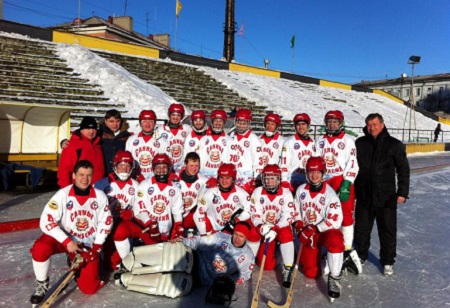
[edit]Bandy, similar to hockey, is one of the most popular sports in the city. Sayany-Khakassia[14] was playing in the top-tier Super League in the 2012–13 season but was relegated for the 2013–14 season and has been playing in the Russian Bandy Supreme League ever since. The Russian Government Cup was played here in 1988 and in 2012.
Climate
[edit]Abakan has a borderline dry-winter continental (Köppen climate classification Dwb)/cold semi-arid climate (Köppen BSk). Temperature differences between seasons are extreme, which is typical for Siberia. Precipitation is concentrated in the summer and is less common because of rain shadows from nearby mountains. Template:Weather box
Local government
[edit].jpg)
The structure of the local government in the city of Abakan is as follows:[15]
- council of deputies of the city of Abakan - a representative body of the municipality;
- the head of the city of Abakan - the head of the municipality;
- the administration of the city of Abakan - the executive and administrative body of the municipality;
- auditing commission of the municipality of the city of Abakan - the control and accounting body of the municipality.
- Council of Deputies
The council consists of 28 deputies. Deputies are elected in single-member constituencies and on party lists. Elections of deputies of the VI convocation were held on a single voting day in 2018.
| Party | Number of deputies | Result | |
|---|---|---|---|
| By okrug | By lists | ||
| United Russia | 11 | 5 (28.83%) | 16 |
| CPRF | 2 | 3 (23.97%) | 5 |
| LDPR | 0 | 3 (22.19%) | 3 |
| Party of Pensioners | 0 | 1 (7.11%) | 1 |
| A Just Russia – For Truth | 0 | 1 (6.93%) | 1 |
| Communists of Russia | 0 | 1 (6.83%) | 1 |
| Self-nominated | 1 | --- | 1 |
| 14 | 14 | 28 | |
- Head of the city (head of the municipality)
- Alexey Viktorovich Lyomin
- Chairman of the Council of Deputies
- Albert Yuryevich Tupikin
- Nikolai Bulakin Prize
In 2021, the annual Nikolai Bulakin Prize of Abakan was established for outstanding services and achievements in the city's development. The award includes a monetary reward of 200,000 rubles and a diploma.[18][19]
References
[edit]Notes
[edit]- ↑ Template:Ru-pop-ref
- ↑ Template:Ru-pop-ref
- ↑ Template:Ru-pop-ref
- ↑ 4.0 4.1 Энциклопедия Города России ["Cities and Towns of Russia" Encyclopedia]. Moscow: Большая Российская Энциклопедия. 2003. p. 13. ISBN 5-7107-7399-9.
- ↑ Resolution of April 30, 1931
- ↑ Yevtyukhova 1954[page needed]
- ↑ Kovalyov 2007, p. 148
- ↑ Juodvalkytė 2001[page needed]
- ↑ Goreva, Svetlana (2019). "Dzieje Szkoły polonijnej w Abakanie 1994–2019". In Leończyk, Sergiusz (ed.). Polacy na Syberii od XIX do XXI wieku (in Polish). Warszawa. p. 99. ISBN 978-83-64206-39-9.
- ↑ 10.0 10.1 Law #20
- ↑ Hoiberg 1993, p. 7
- ↑ Law #59
- ↑ Schofield 1993[page needed]
- ↑ Team picture of Sayany-Khakassia
- ↑ "Мэрия Абакана / Устав города Абакана" [City Hall of Abakan / Charter of the city of Abakan]. мэрия.абакан.рф. Archived from the original on December 8, 2019. Retrieved December 4, 2019.
- ↑ "Сведения о проводящихся выборах и референдумах" [Information about ongoing elections and referendums]. www.vybory.izbirkom.ru. Archived from the original on January 7, 2022. Retrieved January 7, 2022.
- ↑ "Состав Совета депутатов" [Composition of the Council of Deputies]. абакан.рф (in Russian). Archived from the original on January 7, 2022. Retrieved January 7, 2022.
- ↑ Applicants for the N. G. Bulakin Prize - Abakan. - 2021. - November 24. - p. 4.
- ↑ Новая муниципальная награда Archived December 4, 2021, at the Wayback Machine — IRTA Abakan, 15 October 2021.
Sources
[edit]- Template:RussiaAdmMunRef
- Template:RussiaAdmMunRef
- Template:RussiaBasicLawRef
- Template:Cite Soviet law
- Anon (2012a). "Abakan, Khakasia, Russia #29865". climatebase.ru. Archived from the original on April 7, 2014. Retrieved August 14, 2014.
- Anon (2011). "Russia Time Zones - Russia Current Times". TimeTemperature.com. Archived from the original on July 7, 2014. Retrieved August 13, 2014.
- Yevtyukhova, L. A. (1954). "Южная Сибирь в древности [Southern Siberia in Ancient Times]". По следам древних культур: от Волги до Тихого Океана [Tracing Ancient Cultures between the Volga and the Pacific] (in Russian). Moscow, Russia. pp. 195–224.
- Hoiberg, Dale H., ed. (1993). "The New Encyclopaedia Britannica". Encyclopædia Britannica. 1: A-ak Bayes (15th ed.). Chicago, Illinois: Encyclopædia Britannica, Inc. ISBN 0-85229-961-3. LCCN 2002113989.
- Juodvalkytė, Aldona (2001). "Abakan (Abakanas)". Universal Lithuanian Encyclopedia (in Lithuanian). I: A-Ar. Vilnius, Lithuania: Science and Encyclopedia Publishing Institute.
- Kovalyov, A. A. (2007). "Китайский император на Енисее? Ещё раз о хозяине ташебинского «дворца» [Chinese Emperor on the Yenisy? Once Again About the Owner of the Tashebik "Palace"]". Этноистория и археология Северной Евразии: теория, методология и практика исследования [The Ethnohistory and Archaeology of Northern Eurasia: Theory, Methods, and Practice] (PDF) (in Russian). Irkutsk, Russian. pp. 145–148. ISBN 978-5-8038-0430-7. Archived from the original (PDF) on August 14, 2014.
- Munro, David, ed. (1995). "Abakan". Oxford Dictionary of the World. Oxford, UK: Oxford University Press. ISBN 0-19-866184-3.
- Schofield, Carey (1993). The Russian Elite: Inside Spetsnaz and the Airborne Forces. Greenhill Press. pp. 249–251. ISBN 1-8536-7155-X.
External links
[edit] |
Wikivoyage has a travel guide for Abakan. |
 |
Wikisource has the text of the 1911 Encyclopædia Britannica article "Abakansk". |
- (in Russian) Official website of Abakan Archived October 28, 2021, at the Wayback Machine
- (in Russian) Unofficial website of Abakan
- (in Russian) Directory of organizations in Abakan
- Abakan city streets views
- (in Turkish) [1] Archived June 20, 2018, at the Wayback Machine Beyaz Arif Akbas, "Khakassia: The Lost Land", Portland State Center for Turkish Studies, 2007
Template:Republic of Khakassia Template:Russian republics capitals
- Wikipedia articles needing page number citations from August 2014
- CS1 Polish-language sources (pl)
- CS1 Russian-language sources (ru)
- Articles containing Khakas-language text
- Articles containing Russian-language text
- CS1 uses Russian-language script (ru)
- CS1 Lithuanian-language sources (lt)
- Articles with Russian-language sources (ru)
- Articles with Turkish-language sources (tr)
- Use mdy dates from May 2011
- Abakan
- Cities and towns in Khakassia
- Yeniseysk Governorate
- Populated places established in 1675
- 1675 establishments in Russia
- Populated places on the Yenisei River