BCH code
In coding theory, the Bose–Chaudhuri–Hocquenghem codes (BCH codes) form a class of cyclic error-correcting codes that are constructed using polynomials over a finite field (also called a Galois field). BCH codes were invented in 1959 by French mathematician Alexis Hocquenghem, and independently in 1960 by Raj Chandra Bose and D. K. Ray-Chaudhuri.[1][2][3] The name Bose–Chaudhuri–Hocquenghem (and the acronym BCH) arises from the initials of the inventors' surnames (mistakenly, in the case of Ray-Chaudhuri).
One of the key features of BCH codes is that during code design, there is a precise control over the number of symbol errors correctable by the code. In particular, it is possible to design binary BCH codes that can correct multiple bit errors. Another advantage of BCH codes is the ease with which they can be decoded, namely, via an algebraic method known as syndrome decoding. This simplifies the design of the decoder for these codes, using small low-power electronic hardware.
BCH codes are used in applications such as satellite communications,[4] compact disc players, DVDs, disk drives, USB flash drives, solid-state drives,[5] and two-dimensional bar codes.
Definition and illustration
[edit | edit source]Primitive narrow-sense BCH codes
[edit | edit source]Given a prime number q and prime power qm with positive integers m and d such that d ≤ qm − 1, a primitive narrow-sense BCH code over the finite field (or Galois field) GF(q) with code length n = qm − 1 and distance at least d is constructed by the following method.
Let α be a primitive element of GF(qm). For any positive integer i, let mi(x) be the minimal polynomial with coefficients in GF(q) of αi. The generator polynomial of the BCH code is defined as the least common multiple g(x) = lcm(m1(x),…,md − 1(x)). It can be seen that g(x) is a polynomial with coefficients in GF(q) and divides xn − 1. Therefore, the polynomial code defined by g(x) is a cyclic code.
Example
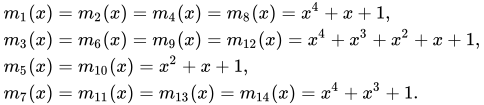
[edit | edit source]Let q = 2 and m = 4 (therefore n = 15). We will consider different values of d for GF(16) = GF(24) based on the reducing polynomial z4 + z + 1, using primitive element α(z) = z. There are fourteen minimum polynomials mi(x) with coefficients in GF(2) satisfying

The minimal polynomials are
The BCH code with has the generator polynomial


It has minimal Hamming distance at least 3 and corrects up to one error. Since the generator polynomial is of degree 4, this code has 11 data bits and 4 checksum bits. It is also denoted as: (15, 11) BCH code.
The BCH code with has the generator polynomial


It has minimal Hamming distance at least 5 and corrects up to two errors. Since the generator polynomial is of degree 8, this code has 7 data bits and 8 checksum bits. It is also denoted as: (15, 7) BCH code.
The BCH code with has the generator polynomial


It has minimal Hamming distance at least 7 and corrects up to three errors. Since the generator polynomial is of degree 10, this code has 5 data bits and 10 checksum bits. It is also denoted as: (15, 5) BCH code. (This particular generator polynomial has a real-world application, in the "format information" of the QR code.)
The BCH code with and higher has the generator polynomial


This code has minimal Hamming distance 15 and corrects 7 errors. It has 1 data bit and 14 checksum bits. It is also denoted as: (15, 1) BCH code. In fact, this code has only two codewords: 000000000000000 and 111111111111111 (a trivial repetition code).
General BCH codes
[edit | edit source]General BCH codes differ from primitive narrow-sense BCH codes in two respects.
First, the requirement that be a primitive element of can be relaxed. By relaxing this requirement, the code length changes from to the order of the element


Second, the consecutive roots of the generator polynomial may run from instead of
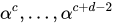

Definition. Fix a finite field where is a prime power. Choose positive integers such that and is the multiplicative order of modulo


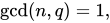


As before, let be a primitive th root of unity in and let be the minimal polynomial over of for all The generator polynomial of the BCH code is defined as the least common multiple



Note: if as in the simplified definition, then is 1, and the order of modulo is Therefore, the simplified definition is indeed a special case of the general one.


Special cases
[edit | edit source]- A BCH code with is called a narrow-sense BCH code.
- A BCH code with is called primitive.

The generator polynomial of a BCH code has coefficients from In general, a cyclic code over with as the generator polynomial is called a BCH code over The BCH code over and generator polynomial with successive powers of as roots is one type of Reed–Solomon code where the decoder (syndromes) alphabet is the same as the channel (data and generator polynomial) alphabet, all elements of .[6] The other type of Reed Solomon code is an original view Reed Solomon code which is not a BCH code.


Properties
[edit | edit source]The generator polynomial of a BCH code has degree at most . Moreover, if and , the generator polynomial has degree at most .


Proof
|
|---|
|
Each minimal polynomial has degree at most . Therefore, the least common multiple of of them has degree at most . Moreover, if then for all . Therefore, is the least common multiple of at most minimal polynomials for odd indices each of degree at most . |





A BCH code has minimal Hamming distance at least .

Proof
|
|---|
|
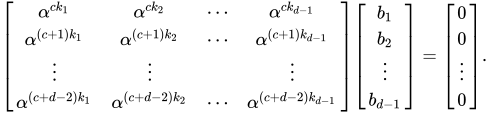
Suppose that is a code word with fewer than non-zero terms. Then Recall that are roots of hence of . This implies that satisfy the following equations, for each : In matrix form, we have The determinant of this matrix equals
The matrix Failed to parse (SVG (MathML can be enabled via browser plugin): Invalid response ("Math extension cannot connect to Restbase.") from server "https://wikimedia.org/api/rest_v1/":): {\displaystyle V} is seen to be a Vandermonde matrix, and its determinant is
which is non-zero. It therefore follows that Failed to parse (SVG (MathML can be enabled via browser plugin): Invalid response ("Math extension cannot connect to Restbase.") from server "https://wikimedia.org/api/rest_v1/":): {\displaystyle b_1,\ldots,b_{d-1}=0,} hence Failed to parse (SVG (MathML can be enabled via browser plugin): Invalid response ("Math extension cannot connect to Restbase.") from server "https://wikimedia.org/api/rest_v1/":): {\displaystyle p(x) = 0.} |






A BCH code is cyclic.
Proof
|
|---|
|
A polynomial code of length Failed to parse (SVG (MathML can be enabled via browser plugin): Invalid response ("Math extension cannot connect to Restbase.") from server "https://wikimedia.org/api/rest_v1/":): {\displaystyle n} is cyclic if and only if its generator polynomial divides Failed to parse (SVG (MathML can be enabled via browser plugin): Invalid response ("Math extension cannot connect to Restbase.") from server "https://wikimedia.org/api/rest_v1/":): {\displaystyle x^n-1.} Since Failed to parse (SVG (MathML can be enabled via browser plugin): Invalid response ("Math extension cannot connect to Restbase.") from server "https://wikimedia.org/api/rest_v1/":): {\displaystyle g(x)} is the minimal polynomial with roots Failed to parse (SVG (MathML can be enabled via browser plugin): Invalid response ("Math extension cannot connect to Restbase.") from server "https://wikimedia.org/api/rest_v1/":): {\displaystyle \alpha^c,\ldots,\alpha^{c+d-2},} it suffices to check that each of Failed to parse (SVG (MathML can be enabled via browser plugin): Invalid response ("Math extension cannot connect to Restbase.") from server "https://wikimedia.org/api/rest_v1/":): {\displaystyle \alpha^c,\ldots,\alpha^{c+d-2}} is a root of Failed to parse (SVG (MathML can be enabled via browser plugin): Invalid response ("Math extension cannot connect to Restbase.") from server "https://wikimedia.org/api/rest_v1/":): {\displaystyle x^n-1.} This follows immediately from the fact that Failed to parse (SVG (MathML can be enabled via browser plugin): Invalid response ("Math extension cannot connect to Restbase.") from server "https://wikimedia.org/api/rest_v1/":): {\displaystyle \alpha} is, by definition, an Failed to parse (SVG (MathML can be enabled via browser plugin): Invalid response ("Math extension cannot connect to Restbase.") from server "https://wikimedia.org/api/rest_v1/":): {\displaystyle n} th root of unity. |
Encoding
[edit | edit source]Because any polynomial that is a multiple of the generator polynomial is a valid BCH codeword, BCH encoding is merely the process of finding some polynomial that has the generator as a factor.
The BCH code itself is not prescriptive about the meaning of the coefficients of the polynomial; conceptually, a BCH decoding algorithm's sole concern is to find the valid codeword with the minimal Hamming distance to the received codeword. Therefore, the BCH code may be implemented either as a systematic code or not, depending on how the implementor chooses to embed the message in the encoded polynomial.
Non-systematic encoding: The message as a factor
[edit | edit source]The most straightforward way to find a polynomial that is a multiple of the generator is to compute the product of some arbitrary polynomial and the generator. In this case, the arbitrary polynomial can be chosen using the symbols of the message as coefficients.
- Failed to parse (SVG (MathML can be enabled via browser plugin): Invalid response ("Math extension cannot connect to Restbase.") from server "https://wikimedia.org/api/rest_v1/":): {\displaystyle s(x) = p(x)g(x)}
As an example, consider the generator polynomial Failed to parse (SVG (MathML can be enabled via browser plugin): Invalid response ("Math extension cannot connect to Restbase.") from server "https://wikimedia.org/api/rest_v1/":): {\displaystyle g(x)=x^{10}+x^9+x^8+x^6+x^5+x^3+1} , chosen for use in the (31, 21) binary BCH code used by POCSAG and others. To encode the 21-bit message {101101110111101111101}, we first represent it as a polynomial over Failed to parse (SVG (MathML can be enabled via browser plugin): Invalid response ("Math extension cannot connect to Restbase.") from server "https://wikimedia.org/api/rest_v1/":): {\displaystyle GF(2)} :
- Failed to parse (SVG (MathML can be enabled via browser plugin): Invalid response ("Math extension cannot connect to Restbase.") from server "https://wikimedia.org/api/rest_v1/":): {\displaystyle p(x) = x^{20}+x^{18}+x^{17}+x^{15}+x^{14}+x^{13}+x^{11}+x^{10}+x^9+x^8+x^6+x^5+x^4+x^3+x^2+1}
Then, compute (also over Failed to parse (SVG (MathML can be enabled via browser plugin): Invalid response ("Math extension cannot connect to Restbase.") from server "https://wikimedia.org/api/rest_v1/":): {\displaystyle GF(2)} ):
- Failed to parse (SVG (MathML can be enabled via browser plugin): Invalid response ("Math extension cannot connect to Restbase.") from server "https://wikimedia.org/api/rest_v1/":): {\displaystyle \begin{align} s(x) &= p(x)g(x)\\ &= \left(x^{20}+x^{18}+x^{17}+x^{15}+x^{14}+x^{13}+x^{11}+x^{10}+x^9+x^8+x^6+x^5+x^4+x^3+x^2+1\right)\left(x^{10}+x^9+x^8+x^6+x^5+x^3+1\right)\\ &= x^{30}+x^{29}+x^{26}+x^{25}+x^{24}+x^{22}+x^{19}+x^{17}+x^{16}+x^{15}+x^{14}+x^{12}+x^{10}+x^9+x^8+x^6+x^5+x^4+x^2+1 \end{align}}
Thus, the transmitted codeword is {1100111010010111101011101110101}.
The receiver can use these bits as coefficients in Failed to parse (SVG (MathML can be enabled via browser plugin): Invalid response ("Math extension cannot connect to Restbase.") from server "https://wikimedia.org/api/rest_v1/":): {\displaystyle s(x)} and, after error-correction to ensure a valid codeword, can recompute Failed to parse (SVG (MathML can be enabled via browser plugin): Invalid response ("Math extension cannot connect to Restbase.") from server "https://wikimedia.org/api/rest_v1/":): {\displaystyle p(x) = s(x)/g(x)}
Systematic encoding: The message as a prefix
[edit | edit source]A systematic code is one in which the message appears verbatim somewhere within the codeword. Therefore, systematic BCH encoding involves first embedding the message polynomial within the codeword polynomial, and then adjusting the coefficients of the remaining (non-message) terms to ensure that Failed to parse (SVG (MathML can be enabled via browser plugin): Invalid response ("Math extension cannot connect to Restbase.") from server "https://wikimedia.org/api/rest_v1/":): {\displaystyle s(x)} is divisible by Failed to parse (SVG (MathML can be enabled via browser plugin): Invalid response ("Math extension cannot connect to Restbase.") from server "https://wikimedia.org/api/rest_v1/":): {\displaystyle g(x)} .
This encoding method leverages the fact that subtracting the remainder from a dividend results in a multiple of the divisor. Hence, if we take our message polynomial Failed to parse (SVG (MathML can be enabled via browser plugin): Invalid response ("Math extension cannot connect to Restbase.") from server "https://wikimedia.org/api/rest_v1/":): {\displaystyle p(x)} as before and multiply it by Failed to parse (SVG (MathML can be enabled via browser plugin): Invalid response ("Math extension cannot connect to Restbase.") from server "https://wikimedia.org/api/rest_v1/":): {\displaystyle x^{n-k}} (to "shift" the message out of the way of the remainder), we can then use Euclidean division of polynomials to yield:
- Failed to parse (SVG (MathML can be enabled via browser plugin): Invalid response ("Math extension cannot connect to Restbase.") from server "https://wikimedia.org/api/rest_v1/":): {\displaystyle p(x)x^{n-k} = q(x)g(x) + r(x)}
Here, we see that Failed to parse (SVG (MathML can be enabled via browser plugin): Invalid response ("Math extension cannot connect to Restbase.") from server "https://wikimedia.org/api/rest_v1/":): {\displaystyle q(x)g(x)} is a valid codeword. As Failed to parse (SVG (MathML can be enabled via browser plugin): Invalid response ("Math extension cannot connect to Restbase.") from server "https://wikimedia.org/api/rest_v1/":): {\displaystyle r(x)} is always of degree less than Failed to parse (SVG (MathML can be enabled via browser plugin): Invalid response ("Math extension cannot connect to Restbase.") from server "https://wikimedia.org/api/rest_v1/":): {\displaystyle n-k} (which is the degree of Failed to parse (SVG (MathML can be enabled via browser plugin): Invalid response ("Math extension cannot connect to Restbase.") from server "https://wikimedia.org/api/rest_v1/":): {\displaystyle g(x)} ), we can safely subtract it from Failed to parse (SVG (MathML can be enabled via browser plugin): Invalid response ("Math extension cannot connect to Restbase.") from server "https://wikimedia.org/api/rest_v1/":): {\displaystyle p(x)x^{n-k}} without altering any of the message coefficients, hence we have our Failed to parse (SVG (MathML can be enabled via browser plugin): Invalid response ("Math extension cannot connect to Restbase.") from server "https://wikimedia.org/api/rest_v1/":): {\displaystyle s(x)} as
- Failed to parse (SVG (MathML can be enabled via browser plugin): Invalid response ("Math extension cannot connect to Restbase.") from server "https://wikimedia.org/api/rest_v1/":): {\displaystyle s(x) = q(x)g(x) = p(x)x^{n-k} - r(x)}
Over Failed to parse (SVG (MathML can be enabled via browser plugin): Invalid response ("Math extension cannot connect to Restbase.") from server "https://wikimedia.org/api/rest_v1/":): {\displaystyle GF(2)} (i.e. with binary BCH codes), this process is indistinguishable from appending a cyclic redundancy check, and if a systematic binary BCH code is used only for error-detection purposes, we see that BCH codes are just a generalization of the mathematics of cyclic redundancy checks.
The advantage to the systematic coding is that the receiver can recover the original message by discarding everything after the first Failed to parse (SVG (MathML can be enabled via browser plugin): Invalid response ("Math extension cannot connect to Restbase.") from server "https://wikimedia.org/api/rest_v1/":): {\displaystyle k} coefficients, after performing error correction.
Decoding
[edit | edit source]There are many algorithms for decoding BCH codes. The most common ones follow this general outline:
- Calculate the syndromes sj for the received vector
- Determine the number of errors t and the error locator polynomial Λ(x) from the syndromes
- Calculate the roots of the error location polynomial to find the error locations Xi
- Calculate the error values Yi at those error locations
- Correct the errors
During some of these steps, the decoding algorithm may determine that the received vector has too many errors and cannot be corrected. For example, if an appropriate value of t is not found, then the correction would fail. In a truncated (not primitive) code, an error location may be out of range. If the received vector has more errors than the code can correct, the decoder may unknowingly produce an apparently valid message that is not the one that was sent.
Calculate the syndromes
[edit | edit source]The received vector Failed to parse (SVG (MathML can be enabled via browser plugin): Invalid response ("Math extension cannot connect to Restbase.") from server "https://wikimedia.org/api/rest_v1/":): {\displaystyle R} is the sum of the correct codeword Failed to parse (SVG (MathML can be enabled via browser plugin): Invalid response ("Math extension cannot connect to Restbase.") from server "https://wikimedia.org/api/rest_v1/":): {\displaystyle C} and an unknown error vector Failed to parse (SVG (MathML can be enabled via browser plugin): Invalid response ("Math extension cannot connect to Restbase.") from server "https://wikimedia.org/api/rest_v1/":): {\displaystyle E.} The syndrome values are formed by considering Failed to parse (SVG (MathML can be enabled via browser plugin): Invalid response ("Math extension cannot connect to Restbase.") from server "https://wikimedia.org/api/rest_v1/":): {\displaystyle R} as a polynomial and evaluating it at Failed to parse (SVG (MathML can be enabled via browser plugin): Invalid response ("Math extension cannot connect to Restbase.") from server "https://wikimedia.org/api/rest_v1/":): {\displaystyle \alpha^c, \ldots, \alpha^{c+d-2}.} Thus the syndromes are[7]
- Failed to parse (SVG (MathML can be enabled via browser plugin): Invalid response ("Math extension cannot connect to Restbase.") from server "https://wikimedia.org/api/rest_v1/":): {\displaystyle s_j = R\left(\alpha^j\right) = C\left(\alpha^j\right) + E\left(\alpha^j\right)}
for Failed to parse (SVG (MathML can be enabled via browser plugin): Invalid response ("Math extension cannot connect to Restbase.") from server "https://wikimedia.org/api/rest_v1/":): {\displaystyle j = c} to Failed to parse (SVG (MathML can be enabled via browser plugin): Invalid response ("Math extension cannot connect to Restbase.") from server "https://wikimedia.org/api/rest_v1/":): {\displaystyle c + d - 2.}
Since Failed to parse (SVG (MathML can be enabled via browser plugin): Invalid response ("Math extension cannot connect to Restbase.") from server "https://wikimedia.org/api/rest_v1/":): {\displaystyle \alpha^{j}} are the zeros of Failed to parse (SVG (MathML can be enabled via browser plugin): Invalid response ("Math extension cannot connect to Restbase.") from server "https://wikimedia.org/api/rest_v1/":): {\displaystyle g(x),} of which Failed to parse (SVG (MathML can be enabled via browser plugin): Invalid response ("Math extension cannot connect to Restbase.") from server "https://wikimedia.org/api/rest_v1/":): {\displaystyle C(x)} is a multiple, Failed to parse (SVG (MathML can be enabled via browser plugin): Invalid response ("Math extension cannot connect to Restbase.") from server "https://wikimedia.org/api/rest_v1/":): {\displaystyle C\left(\alpha^j\right) = 0.} Examining the syndrome values thus isolates the error vector so one can begin to solve for it.
If there is no error, Failed to parse (SVG (MathML can be enabled via browser plugin): Invalid response ("Math extension cannot connect to Restbase.") from server "https://wikimedia.org/api/rest_v1/":): {\displaystyle s_j = 0} for all Failed to parse (SVG (MathML can be enabled via browser plugin): Invalid response ("Math extension cannot connect to Restbase.") from server "https://wikimedia.org/api/rest_v1/":): {\displaystyle j.} If the syndromes are all zero, then the decoding is done.
Calculate the error location polynomial
[edit | edit source]If there are nonzero syndromes, then there are errors. The decoder needs to figure out how many errors and the location of those errors.
If there is a single error, write this as Failed to parse (SVG (MathML can be enabled via browser plugin): Invalid response ("Math extension cannot connect to Restbase.") from server "https://wikimedia.org/api/rest_v1/":): {\displaystyle E(x) = e\,x^i,} where Failed to parse (SVG (MathML can be enabled via browser plugin): Invalid response ("Math extension cannot connect to Restbase.") from server "https://wikimedia.org/api/rest_v1/":): {\displaystyle i} is the location of the error and Failed to parse (SVG (MathML can be enabled via browser plugin): Invalid response ("Math extension cannot connect to Restbase.") from server "https://wikimedia.org/api/rest_v1/":): {\displaystyle e} is its magnitude. Then the first two syndromes are
- Failed to parse (SVG (MathML can be enabled via browser plugin): Invalid response ("Math extension cannot connect to Restbase.") from server "https://wikimedia.org/api/rest_v1/":): {\displaystyle \begin{align} s_c &= e\,\alpha^{c\,i} \\ s_{c+1} &= e\,\alpha^{(c+1)\,i} = \alpha^i s_c \end{align}}
so together they allow us to calculate Failed to parse (SVG (MathML can be enabled via browser plugin): Invalid response ("Math extension cannot connect to Restbase.") from server "https://wikimedia.org/api/rest_v1/":): {\displaystyle e} and provide some information about Failed to parse (SVG (MathML can be enabled via browser plugin): Invalid response ("Math extension cannot connect to Restbase.") from server "https://wikimedia.org/api/rest_v1/":): {\displaystyle i} (completely determining it in the case of Reed–Solomon codes).
If there are two or more errors,
- Failed to parse (SVG (MathML can be enabled via browser plugin): Invalid response ("Math extension cannot connect to Restbase.") from server "https://wikimedia.org/api/rest_v1/":): {\displaystyle E(x) = e_1 x^{i_1} + e_2 x^{i_2} + \cdots \, }
It is not immediately obvious how to begin solving the resulting syndromes for the unknowns Failed to parse (SVG (MathML can be enabled via browser plugin): Invalid response ("Math extension cannot connect to Restbase.") from server "https://wikimedia.org/api/rest_v1/":): {\displaystyle e_k} and Failed to parse (SVG (MathML can be enabled via browser plugin): Invalid response ("Math extension cannot connect to Restbase.") from server "https://wikimedia.org/api/rest_v1/":): {\displaystyle i_k.}
The first step is finding, compatible with computed syndromes and with minimal possible Failed to parse (SVG (MathML can be enabled via browser plugin): Invalid response ("Math extension cannot connect to Restbase.") from server "https://wikimedia.org/api/rest_v1/":): {\displaystyle t,} locator polynomial:
- Failed to parse (SVG (MathML can be enabled via browser plugin): Invalid response ("Math extension cannot connect to Restbase.") from server "https://wikimedia.org/api/rest_v1/":): {\displaystyle \Lambda(x) = \prod_{j=1}^t \left(x\alpha^{i_j} - 1\right)}
Three popular algorithms for this task are:
Peterson–Gorenstein–Zierler algorithm
[edit | edit source]Peterson's algorithm is the step 2 of the generalized BCH decoding procedure. Peterson's algorithm is used to calculate the error locator polynomial coefficients Failed to parse (SVG (MathML can be enabled via browser plugin): Invalid response ("Math extension cannot connect to Restbase.") from server "https://wikimedia.org/api/rest_v1/":): {\displaystyle \lambda_1 , \lambda_2, \dots, \lambda_{v} } of a polynomial
- Failed to parse (SVG (MathML can be enabled via browser plugin): Invalid response ("Math extension cannot connect to Restbase.") from server "https://wikimedia.org/api/rest_v1/":): {\displaystyle \Lambda(x) = 1 + \lambda_1 x + \lambda_2 x^2 + \cdots + \lambda_v x^v .}
Now the procedure of the Peterson–Gorenstein–Zierler algorithm.[8] Expect we have at least 2t syndromes sc, ..., sc+2t−1. Let v = t.
- Start by generating the Failed to parse (SVG (MathML can be enabled via browser plugin): Invalid response ("Math extension cannot connect to Restbase.") from server "https://wikimedia.org/api/rest_v1/":): {\displaystyle S_{v\times v}}
matrix with elements that are syndrome values
- Failed to parse (SVG (MathML can be enabled via browser plugin): Invalid response ("Math extension cannot connect to Restbase.") from server "https://wikimedia.org/api/rest_v1/":): {\displaystyle S_{v \times v}=\begin{bmatrix}s_c&s_{c+1}&\dots&s_{c+v-1}\\ s_{c+1}&s_{c+2}&\dots&s_{c+v}\\ \vdots&\vdots&\ddots&\vdots\\ s_{c+v-1}&s_{c+v}&\dots&s_{c+2v-2}\end{bmatrix}. }
- Generate a Failed to parse (SVG (MathML can be enabled via browser plugin): Invalid response ("Math extension cannot connect to Restbase.") from server "https://wikimedia.org/api/rest_v1/":): {\displaystyle c_{v \times 1}}
vector with elements
- Failed to parse (SVG (MathML can be enabled via browser plugin): Invalid response ("Math extension cannot connect to Restbase.") from server "https://wikimedia.org/api/rest_v1/":): {\displaystyle C_{v \times 1}=\begin{bmatrix}s_{c+v}\\ s_{c+v+1}\\ \vdots\\ s_{c+2v-1}\end{bmatrix}. }
- Let Failed to parse (SVG (MathML can be enabled via browser plugin): Invalid response ("Math extension cannot connect to Restbase.") from server "https://wikimedia.org/api/rest_v1/":): {\displaystyle \Lambda}
denote the unknown polynomial coefficients, which are given by
- Failed to parse (SVG (MathML can be enabled via browser plugin): Invalid response ("Math extension cannot connect to Restbase.") from server "https://wikimedia.org/api/rest_v1/":): {\displaystyle \Lambda_{v \times 1} = \begin{bmatrix}\lambda_{v}\\ \lambda_{v-1}\\ \vdots\\ \lambda_{1}\end{bmatrix}. }
- Form the matrix equation
- Failed to parse (SVG (MathML can be enabled via browser plugin): Invalid response ("Math extension cannot connect to Restbase.") from server "https://wikimedia.org/api/rest_v1/":): {\displaystyle S_{v \times v} \Lambda_{v \times 1} = -C_{v \times 1\,} .}
- If the determinant of matrix Failed to parse (SVG (MathML can be enabled via browser plugin): Invalid response ("Math extension cannot connect to Restbase.") from server "https://wikimedia.org/api/rest_v1/":): {\displaystyle S_{v \times v}} is nonzero, then we can actually find an inverse of this matrix and solve for the values of unknown Failed to parse (SVG (MathML can be enabled via browser plugin): Invalid response ("Math extension cannot connect to Restbase.") from server "https://wikimedia.org/api/rest_v1/":): {\displaystyle \Lambda} values.
- If Failed to parse (SVG (MathML can be enabled via browser plugin): Invalid response ("Math extension cannot connect to Restbase.") from server "https://wikimedia.org/api/rest_v1/":): {\displaystyle \det\left(S_{v \times v}\right) = 0,}
then follow
if Failed to parse (SVG (MathML can be enabled via browser plugin): Invalid response ("Math extension cannot connect to Restbase.") from server "https://wikimedia.org/api/rest_v1/":): {\displaystyle v = 0} then declare an empty error locator polynomial stop Peterson procedure. end setcontinue from the beginning of Peterson's decoding by making smaller - After you have values of , you have the error locator polynomial.
- Stop Peterson procedure.


Factor error locator polynomial
[edit | edit source]Now that you have the polynomial, its roots can be found in the form by brute force for example using the Chien search algorithm. The exponential powers of the primitive element will yield the positions where errors occur in the received word; hence the name 'error locator' polynomial.


The zeros of Λ(x) are α−i1, ..., α−iv.
Calculate error values
[edit | edit source]Once the error locations are known, the next step is to determine the error values at those locations. The error values are then used to correct the received values at those locations to recover the original codeword.
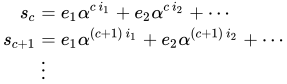
For the case of binary BCH, (with all characters readable) this is trivial; just flip the bits for the received word at these positions, and we have the corrected code word. In the more general case, the error weights can be determined by solving the linear system

Forney algorithm
[edit | edit source]However, there is a more efficient method known as the Forney algorithm.
Let


And the error evaluator polynomial[9]

Finally:

where

Than if syndromes could be explained by an error word, which could be nonzero only on positions , then error values are

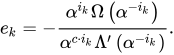
For narrow-sense BCH codes, c = 1, so the expression simplifies to:
- Failed to parse (SVG (MathML can be enabled via browser plugin): Invalid response ("Math extension cannot connect to Restbase.") from server "https://wikimedia.org/api/rest_v1/":): {\displaystyle e_k = -{\Omega\left(\alpha^{-i_k}\right) \over \Lambda'\left(\alpha^{-i_k}\right)}.}
Explanation of Forney algorithm computation
[edit | edit source]It is based on Lagrange interpolation and techniques of generating functions.
Consider Failed to parse (SVG (MathML can be enabled via browser plugin): Invalid response ("Math extension cannot connect to Restbase.") from server "https://wikimedia.org/api/rest_v1/":): {\displaystyle S(x)\Lambda(x),} and for the sake of simplicity suppose Failed to parse (SVG (MathML can be enabled via browser plugin): Invalid response ("Math extension cannot connect to Restbase.") from server "https://wikimedia.org/api/rest_v1/":): {\displaystyle \lambda_k = 0} for Failed to parse (SVG (MathML can be enabled via browser plugin): Invalid response ("Math extension cannot connect to Restbase.") from server "https://wikimedia.org/api/rest_v1/":): {\displaystyle k > v,} and Failed to parse (SVG (MathML can be enabled via browser plugin): Invalid response ("Math extension cannot connect to Restbase.") from server "https://wikimedia.org/api/rest_v1/":): {\displaystyle s_k = 0} for Failed to parse (SVG (MathML can be enabled via browser plugin): Invalid response ("Math extension cannot connect to Restbase.") from server "https://wikimedia.org/api/rest_v1/":): {\displaystyle k > c + d - 2.} Then
- Failed to parse (SVG (MathML can be enabled via browser plugin): Invalid response ("Math extension cannot connect to Restbase.") from server "https://wikimedia.org/api/rest_v1/":): {\displaystyle S(x)\Lambda(x) = \sum_{j=0}^{\infty}\sum_{i=0}^j s_{j-i+1}\lambda_i x^j.}
- Failed to parse (SVG (MathML can be enabled via browser plugin): Invalid response ("Math extension cannot connect to Restbase.") from server "https://wikimedia.org/api/rest_v1/":): {\displaystyle \begin{align} S(x)\Lambda(x) &= S(x) \left \{ \lambda_0\prod_{\ell=1}^v \left (\alpha^{i_\ell}x-1 \right ) \right \} \\ &= \left \{ \sum_{i=0}^{d-2}\sum_{j=1}^v e_j\alpha^{(c+i)\cdot i_j} x^i \right \} \left \{ \lambda_0\prod_{\ell=1}^v \left (\alpha^{i_\ell}x-1 \right ) \right \} \\ &= \left \{ \sum_{j=1}^v e_j \alpha^{c i_j}\sum_{i=0}^{d-2} \left (\alpha^{i_j} \right )^i x^i \right \} \left \{ \lambda_0\prod_{\ell=1}^v \left (\alpha^{i_\ell}x-1 \right ) \right \} \\ &= \left \{ \sum_{j=1}^v e_j \alpha^{c i_j} \frac{\left (x \alpha^{i_j} \right )^{d-1}-1}{x \alpha^{i_j}-1} \right \} \left \{ \lambda_0 \prod_{\ell=1}^v \left (\alpha^{i_\ell}x-1 \right ) \right \} \\ &= \lambda_0 \sum_{j=1}^v e_j\alpha^{c i_j} \frac{ \left (x\alpha^{i_j} \right)^{d-1}-1}{x\alpha^{i_j}-1} \prod_{\ell=1}^v \left (\alpha^{i_\ell}x-1 \right ) \\ &= \lambda_0 \sum_{j=1}^v e_j\alpha^{c i_j} \left ( \left (x\alpha^{i_j} \right)^{d-1}-1 \right ) \prod_{\ell\in\{1,\cdots,v\}\setminus\{j\}} \left (\alpha^{i_\ell}x-1 \right ) \end{align}}
We want to compute unknowns Failed to parse (SVG (MathML can be enabled via browser plugin): Invalid response ("Math extension cannot connect to Restbase.") from server "https://wikimedia.org/api/rest_v1/":): {\displaystyle e_j,} and we could simplify the context by removing the Failed to parse (SVG (MathML can be enabled via browser plugin): Invalid response ("Math extension cannot connect to Restbase.") from server "https://wikimedia.org/api/rest_v1/":): {\displaystyle \left(x\alpha^{i_j}\right)^{d-1}} terms. This leads to the error evaluator polynomial
- Failed to parse (SVG (MathML can be enabled via browser plugin): Invalid response ("Math extension cannot connect to Restbase.") from server "https://wikimedia.org/api/rest_v1/":): {\displaystyle \Omega(x) \equiv S(x) \Lambda(x) \bmod{x^{d-1}}.}
Thanks to Failed to parse (SVG (MathML can be enabled via browser plugin): Invalid response ("Math extension cannot connect to Restbase.") from server "https://wikimedia.org/api/rest_v1/":): {\displaystyle v\leqslant d-1} we have
- Failed to parse (SVG (MathML can be enabled via browser plugin): Invalid response ("Math extension cannot connect to Restbase.") from server "https://wikimedia.org/api/rest_v1/":): {\displaystyle \Omega(x) = -\lambda_0\sum_{j=1}^v e_j\alpha^{c i_j} \prod_{\ell\in\{1,\cdots,v\}\setminus\{j\}} \left(\alpha^{i_\ell}x - 1\right).}
Thanks to Failed to parse (SVG (MathML can be enabled via browser plugin): Invalid response ("Math extension cannot connect to Restbase.") from server "https://wikimedia.org/api/rest_v1/":): {\displaystyle \Lambda} (the Lagrange interpolation trick) the sum degenerates to only one summand for Failed to parse (SVG (MathML can be enabled via browser plugin): Invalid response ("Math extension cannot connect to Restbase.") from server "https://wikimedia.org/api/rest_v1/":): {\displaystyle x = \alpha^{-i_k}}
- Failed to parse (SVG (MathML can be enabled via browser plugin): Invalid response ("Math extension cannot connect to Restbase.") from server "https://wikimedia.org/api/rest_v1/":): {\displaystyle \Omega \left(\alpha^{-i_k}\right) = -\lambda_0 e_k\alpha^{c\cdot i_k}\prod_{\ell\in\{1,\cdots,v\}\setminus\{k\}} \left(\alpha^{i_\ell}\alpha^{-i_k} - 1\right).}
To get Failed to parse (SVG (MathML can be enabled via browser plugin): Invalid response ("Math extension cannot connect to Restbase.") from server "https://wikimedia.org/api/rest_v1/":): {\displaystyle e_k} we just should get rid of the product. We could compute the product directly from already computed roots Failed to parse (SVG (MathML can be enabled via browser plugin): Invalid response ("Math extension cannot connect to Restbase.") from server "https://wikimedia.org/api/rest_v1/":): {\displaystyle \alpha^{-i_j}} of Failed to parse (SVG (MathML can be enabled via browser plugin): Invalid response ("Math extension cannot connect to Restbase.") from server "https://wikimedia.org/api/rest_v1/":): {\displaystyle \Lambda,} but we could use simpler form.
- Failed to parse (SVG (MathML can be enabled via browser plugin): Invalid response ("Math extension cannot connect to Restbase.") from server "https://wikimedia.org/api/rest_v1/":): {\displaystyle \Lambda'(x) = \lambda_0\sum_{j=1}^v \alpha^{i_j}\prod_{\ell\in\{1,\cdots,v\}\setminus\{j\}} \left(\alpha^{i_\ell}x - 1\right),}
we get again only one summand in
- Failed to parse (SVG (MathML can be enabled via browser plugin): Invalid response ("Math extension cannot connect to Restbase.") from server "https://wikimedia.org/api/rest_v1/":): {\displaystyle \Lambda'\left(\alpha^{-i_k}\right) = \lambda_0\alpha^{i_k}\prod_{\ell\in\{1,\cdots,v\}\setminus\{k\}} \left(\alpha^{i_\ell}\alpha^{-i_k} - 1\right).}
So finally
- Failed to parse (SVG (MathML can be enabled via browser plugin): Invalid response ("Math extension cannot connect to Restbase.") from server "https://wikimedia.org/api/rest_v1/":): {\displaystyle e_k = -\frac{\alpha^{i_k}\Omega \left(\alpha^{-i_k}\right)}{\alpha^{c\cdot i_k}\Lambda' \left(\alpha^{-i_k}\right)}.}
This formula is advantageous when one computes the formal derivative of Failed to parse (SVG (MathML can be enabled via browser plugin): Invalid response ("Math extension cannot connect to Restbase.") from server "https://wikimedia.org/api/rest_v1/":): {\displaystyle \Lambda} form
- Failed to parse (SVG (MathML can be enabled via browser plugin): Invalid response ("Math extension cannot connect to Restbase.") from server "https://wikimedia.org/api/rest_v1/":): {\displaystyle \Lambda(x) = \sum_{i=1}^v \lambda_i x^i}
yielding:
- Failed to parse (SVG (MathML can be enabled via browser plugin): Invalid response ("Math extension cannot connect to Restbase.") from server "https://wikimedia.org/api/rest_v1/":): {\displaystyle \Lambda'(x) = \sum_{i=1}^v i \cdot \lambda_i x^{i-1},}
where
- Failed to parse (SVG (MathML can be enabled via browser plugin): Invalid response ("Math extension cannot connect to Restbase.") from server "https://wikimedia.org/api/rest_v1/":): {\displaystyle i\cdot x := \sum_{k=1}^i x.}
Decoding based on extended Euclidean algorithm
[edit | edit source]An alternate process of finding both the polynomial Λ and the error locator polynomial is based on Yasuo Sugiyama's adaptation of the Extended Euclidean algorithm.[10] Correction of unreadable characters could be incorporated to the algorithm easily as well.
Let Failed to parse (SVG (MathML can be enabled via browser plugin): Invalid response ("Math extension cannot connect to Restbase.") from server "https://wikimedia.org/api/rest_v1/":): {\displaystyle k_1, ..., k_k} be positions of unreadable characters. One creates polynomial localising these positions Failed to parse (SVG (MathML can be enabled via browser plugin): Invalid response ("Math extension cannot connect to Restbase.") from server "https://wikimedia.org/api/rest_v1/":): {\displaystyle \Gamma(x) = \prod_{i=1}^k\left(x\alpha^{k_i} - 1\right).} Set values on unreadable positions to 0 and compute the syndromes.
As we have already defined for the Forney formula let Failed to parse (SVG (MathML can be enabled via browser plugin): Invalid response ("Math extension cannot connect to Restbase.") from server "https://wikimedia.org/api/rest_v1/":): {\displaystyle S(x)=\sum_{i=0}^{d-2}s_{c+i}x^i.}
Let us run extended Euclidean algorithm for locating least common divisor of polynomials Failed to parse (SVG (MathML can be enabled via browser plugin): Invalid response ("Math extension cannot connect to Restbase.") from server "https://wikimedia.org/api/rest_v1/":): {\displaystyle S(x)\Gamma(x)} and Failed to parse (SVG (MathML can be enabled via browser plugin): Invalid response ("Math extension cannot connect to Restbase.") from server "https://wikimedia.org/api/rest_v1/":): {\displaystyle x^{d-1}.} The goal is not to find the least common divisor, but a polynomial Failed to parse (SVG (MathML can be enabled via browser plugin): Invalid response ("Math extension cannot connect to Restbase.") from server "https://wikimedia.org/api/rest_v1/":): {\displaystyle r(x)} of degree at most Failed to parse (SVG (MathML can be enabled via browser plugin): Invalid response ("Math extension cannot connect to Restbase.") from server "https://wikimedia.org/api/rest_v1/":): {\displaystyle \lfloor (d+k-3)/2\rfloor} and polynomials Failed to parse (SVG (MathML can be enabled via browser plugin): Invalid response ("Math extension cannot connect to Restbase.") from server "https://wikimedia.org/api/rest_v1/":): {\displaystyle a(x), b(x)} such that Failed to parse (SVG (MathML can be enabled via browser plugin): Invalid response ("Math extension cannot connect to Restbase.") from server "https://wikimedia.org/api/rest_v1/":): {\displaystyle r(x)=a(x)S(x)\Gamma(x)+b(x)x^{d-1}.} Low degree of Failed to parse (SVG (MathML can be enabled via browser plugin): Invalid response ("Math extension cannot connect to Restbase.") from server "https://wikimedia.org/api/rest_v1/":): {\displaystyle r(x)} guarantees, that Failed to parse (SVG (MathML can be enabled via browser plugin): Invalid response ("Math extension cannot connect to Restbase.") from server "https://wikimedia.org/api/rest_v1/":): {\displaystyle a(x)} would satisfy extended (by Failed to parse (SVG (MathML can be enabled via browser plugin): Invalid response ("Math extension cannot connect to Restbase.") from server "https://wikimedia.org/api/rest_v1/":): {\displaystyle \Gamma} ) defining conditions for Failed to parse (SVG (MathML can be enabled via browser plugin): Invalid response ("Math extension cannot connect to Restbase.") from server "https://wikimedia.org/api/rest_v1/":): {\displaystyle \Lambda.}
Defining Failed to parse (SVG (MathML can be enabled via browser plugin): Invalid response ("Math extension cannot connect to Restbase.") from server "https://wikimedia.org/api/rest_v1/":): {\displaystyle \Xi(x)=a(x)\Gamma(x)} and using Failed to parse (SVG (MathML can be enabled via browser plugin): Invalid response ("Math extension cannot connect to Restbase.") from server "https://wikimedia.org/api/rest_v1/":): {\displaystyle \Xi} on the place of Failed to parse (SVG (MathML can be enabled via browser plugin): Invalid response ("Math extension cannot connect to Restbase.") from server "https://wikimedia.org/api/rest_v1/":): {\displaystyle \Lambda(x)} in the Fourney formula will give us error values.
The main advantage of the algorithm is that it meanwhile computes Failed to parse (SVG (MathML can be enabled via browser plugin): Invalid response ("Math extension cannot connect to Restbase.") from server "https://wikimedia.org/api/rest_v1/":): {\displaystyle \Omega(x)=S(x)\Xi(x)\bmod x^{d-1}=r(x)} required in the Forney formula.
Explanation of the decoding process
[edit | edit source]The goal is to find a codeword which differs from the received word minimally as possible on readable positions. When expressing the received word as a sum of nearest codeword and error word, we are trying to find error word with minimal number of non-zeros on readable positions. Syndrom Failed to parse (SVG (MathML can be enabled via browser plugin): Invalid response ("Math extension cannot connect to Restbase.") from server "https://wikimedia.org/api/rest_v1/":): {\displaystyle s_i} restricts error word by condition
- Failed to parse (SVG (MathML can be enabled via browser plugin): Invalid response ("Math extension cannot connect to Restbase.") from server "https://wikimedia.org/api/rest_v1/":): {\displaystyle s_i=\sum_{j=0}^{n-1}e_j\alpha^{ij}.}
We could write these conditions separately or we could create polynomial
- Failed to parse (SVG (MathML can be enabled via browser plugin): Invalid response ("Math extension cannot connect to Restbase.") from server "https://wikimedia.org/api/rest_v1/":): {\displaystyle S(x)=\sum_{i=0}^{d-2}s_{c+i}x^i}
and compare coefficients near powers Failed to parse (SVG (MathML can be enabled via browser plugin): Invalid response ("Math extension cannot connect to Restbase.") from server "https://wikimedia.org/api/rest_v1/":): {\displaystyle 0} to Failed to parse (SVG (MathML can be enabled via browser plugin): Invalid response ("Math extension cannot connect to Restbase.") from server "https://wikimedia.org/api/rest_v1/":): {\displaystyle d-2.}
- Failed to parse (SVG (MathML can be enabled via browser plugin): Invalid response ("Math extension cannot connect to Restbase.") from server "https://wikimedia.org/api/rest_v1/":): {\displaystyle S(x) \stackrel{\{0,\cdots,\,d-2\}}{=} E(x)=\sum_{i=0}^{d-2}\sum_{j=0}^{n-1}e_j\alpha^{ij}\alpha^{cj}x^i.}
Suppose there is unreadable letter on position Failed to parse (SVG (MathML can be enabled via browser plugin): Invalid response ("Math extension cannot connect to Restbase.") from server "https://wikimedia.org/api/rest_v1/":): {\displaystyle k_1,} we could replace set of syndromes Failed to parse (SVG (MathML can be enabled via browser plugin): Invalid response ("Math extension cannot connect to Restbase.") from server "https://wikimedia.org/api/rest_v1/":): {\displaystyle \{s_c,\cdots,s_{c+d-2}\}} by set of syndromes Failed to parse (SVG (MathML can be enabled via browser plugin): Invalid response ("Math extension cannot connect to Restbase.") from server "https://wikimedia.org/api/rest_v1/":): {\displaystyle \{t_c,\cdots,t_{c+d-3}\}} defined by equation Failed to parse (SVG (MathML can be enabled via browser plugin): Invalid response ("Math extension cannot connect to Restbase.") from server "https://wikimedia.org/api/rest_v1/":): {\displaystyle t_i=\alpha^{k_1}s_i-s_{i+1}.} Suppose for an error word all restrictions by original set Failed to parse (SVG (MathML can be enabled via browser plugin): Invalid response ("Math extension cannot connect to Restbase.") from server "https://wikimedia.org/api/rest_v1/":): {\displaystyle \{s_c,\cdots,s_{c+d-2}\}} of syndromes hold, than
- Failed to parse (SVG (MathML can be enabled via browser plugin): Invalid response ("Math extension cannot connect to Restbase.") from server "https://wikimedia.org/api/rest_v1/":): {\displaystyle t_i=\alpha^{k_1}s_i-s_{i+1}=\alpha^{k_1}\sum_{j=0}^{n-1}e_j\alpha^{ij}-\sum_{j=0}^{n-1}e_j\alpha^j\alpha^{ij}=\sum_{j=0}^{n-1}e_j\left(\alpha^{k_1} - \alpha^j\right)\alpha^{ij}.}
New set of syndromes restricts error vector
- Failed to parse (SVG (MathML can be enabled via browser plugin): Invalid response ("Math extension cannot connect to Restbase.") from server "https://wikimedia.org/api/rest_v1/":): {\displaystyle f_j=e_j\left(\alpha^{k_1} - \alpha^j\right)}
the same way the original set of syndromes restricted the error vector Failed to parse (SVG (MathML can be enabled via browser plugin): Invalid response ("Math extension cannot connect to Restbase.") from server "https://wikimedia.org/api/rest_v1/":): {\displaystyle e_j.} Except the coordinate Failed to parse (SVG (MathML can be enabled via browser plugin): Invalid response ("Math extension cannot connect to Restbase.") from server "https://wikimedia.org/api/rest_v1/":): {\displaystyle k_1,} where we have Failed to parse (SVG (MathML can be enabled via browser plugin): Invalid response ("Math extension cannot connect to Restbase.") from server "https://wikimedia.org/api/rest_v1/":): {\displaystyle f_{k_1}=0,} an Failed to parse (SVG (MathML can be enabled via browser plugin): Invalid response ("Math extension cannot connect to Restbase.") from server "https://wikimedia.org/api/rest_v1/":): {\displaystyle f_j} is zero, if Failed to parse (SVG (MathML can be enabled via browser plugin): Invalid response ("Math extension cannot connect to Restbase.") from server "https://wikimedia.org/api/rest_v1/":): {\displaystyle e_j = 0.} For the goal of locating error positions we could change the set of syndromes in the similar way to reflect all unreadable characters. This shortens the set of syndromes by Failed to parse (SVG (MathML can be enabled via browser plugin): Invalid response ("Math extension cannot connect to Restbase.") from server "https://wikimedia.org/api/rest_v1/":): {\displaystyle k.}
In polynomial formulation, the replacement of syndromes set Failed to parse (SVG (MathML can be enabled via browser plugin): Invalid response ("Math extension cannot connect to Restbase.") from server "https://wikimedia.org/api/rest_v1/":): {\displaystyle \{s_c,\cdots,s_{c+d-2}\}} by syndromes set Failed to parse (SVG (MathML can be enabled via browser plugin): Invalid response ("Math extension cannot connect to Restbase.") from server "https://wikimedia.org/api/rest_v1/":): {\displaystyle \{t_c,\cdots,t_{c+d-3}\}} leads to
- Failed to parse (SVG (MathML can be enabled via browser plugin): Invalid response ("Math extension cannot connect to Restbase.") from server "https://wikimedia.org/api/rest_v1/":): {\displaystyle T(x) = \sum_{i=0}^{d-3}t_{c+i}x^i=\alpha^{k_1}\sum_{i=0}^{d-3}s_{c+i}x^i-\sum_{i=1}^{d-2}s_{c+i}x^{i-1}.}
Therefore,
- Failed to parse (SVG (MathML can be enabled via browser plugin): Invalid response ("Math extension cannot connect to Restbase.") from server "https://wikimedia.org/api/rest_v1/":): {\displaystyle xT(x) \stackrel{\{1,\cdots,\,d-2\}}{=} \left(x\alpha^{k_1} - 1\right)S(x).}
After replacement of Failed to parse (SVG (MathML can be enabled via browser plugin): Invalid response ("Math extension cannot connect to Restbase.") from server "https://wikimedia.org/api/rest_v1/":): {\displaystyle S(x)} by Failed to parse (SVG (MathML can be enabled via browser plugin): Invalid response ("Math extension cannot connect to Restbase.") from server "https://wikimedia.org/api/rest_v1/":): {\displaystyle S(x)\Gamma(x)} , one would require equation for coefficients near powers Failed to parse (SVG (MathML can be enabled via browser plugin): Invalid response ("Math extension cannot connect to Restbase.") from server "https://wikimedia.org/api/rest_v1/":): {\displaystyle k,\cdots,d-2.}
One could consider looking for error positions from the point of view of eliminating influence of given positions similarly as for unreadable characters. If we found Failed to parse (SVG (MathML can be enabled via browser plugin): Invalid response ("Math extension cannot connect to Restbase.") from server "https://wikimedia.org/api/rest_v1/":): {\displaystyle v} positions such that eliminating their influence leads to obtaining set of syndromes consisting of all zeros, than there exists error vector with errors only on these coordinates. If Failed to parse (SVG (MathML can be enabled via browser plugin): Invalid response ("Math extension cannot connect to Restbase.") from server "https://wikimedia.org/api/rest_v1/":): {\displaystyle \Lambda(x)} denotes the polynomial eliminating the influence of these coordinates, we obtain
- Failed to parse (SVG (MathML can be enabled via browser plugin): Invalid response ("Math extension cannot connect to Restbase.") from server "https://wikimedia.org/api/rest_v1/":): {\displaystyle S(x)\Gamma(x)\Lambda(x) \stackrel{\{k+v, \cdots, d-2\}}{=} 0.}
In Euclidean algorithm, we try to correct at most Failed to parse (SVG (MathML can be enabled via browser plugin): Invalid response ("Math extension cannot connect to Restbase.") from server "https://wikimedia.org/api/rest_v1/":): {\displaystyle \tfrac{1}{2}(d-1-k)} errors (on readable positions), because with bigger error count there could be more codewords in the same distance from the received word. Therefore, for Failed to parse (SVG (MathML can be enabled via browser plugin): Invalid response ("Math extension cannot connect to Restbase.") from server "https://wikimedia.org/api/rest_v1/":): {\displaystyle \Lambda(x)} we are looking for, the equation must hold for coefficients near powers starting from
- Failed to parse (SVG (MathML can be enabled via browser plugin): Invalid response ("Math extension cannot connect to Restbase.") from server "https://wikimedia.org/api/rest_v1/":): {\displaystyle k + \left\lfloor \frac{1}{2} (d-1-k) \right\rfloor.}
In Forney formula, Failed to parse (SVG (MathML can be enabled via browser plugin): Invalid response ("Math extension cannot connect to Restbase.") from server "https://wikimedia.org/api/rest_v1/":): {\displaystyle \Lambda(x)} could be multiplied by a scalar giving the same result.
It could happen that the Euclidean algorithm finds Failed to parse (SVG (MathML can be enabled via browser plugin): Invalid response ("Math extension cannot connect to Restbase.") from server "https://wikimedia.org/api/rest_v1/":): {\displaystyle \Lambda(x)} of degree higher than Failed to parse (SVG (MathML can be enabled via browser plugin): Invalid response ("Math extension cannot connect to Restbase.") from server "https://wikimedia.org/api/rest_v1/":): {\displaystyle \tfrac{1}{2}(d-1-k)} having number of different roots equal to its degree, where the Fourney formula would be able to correct errors in all its roots, anyway correcting such many errors could be risky (especially with no other restrictions on received word). Usually after getting Failed to parse (SVG (MathML can be enabled via browser plugin): Invalid response ("Math extension cannot connect to Restbase.") from server "https://wikimedia.org/api/rest_v1/":): {\displaystyle \Lambda(x)} of higher degree, we decide not to correct the errors. Correction could fail in the case Failed to parse (SVG (MathML can be enabled via browser plugin): Invalid response ("Math extension cannot connect to Restbase.") from server "https://wikimedia.org/api/rest_v1/":): {\displaystyle \Lambda(x)} has roots with higher multiplicity or the number of roots is smaller than its degree. Fail could be detected as well by Forney formula returning error outside the transmitted alphabet.
Correct the errors
[edit | edit source]Using the error values and error location, correct the errors and form a corrected code vector by subtracting error values at error locations.
Decoding examples
[edit | edit source]Decoding of binary code without unreadable characters
[edit | edit source]Consider a BCH code in GF(24) with Failed to parse (SVG (MathML can be enabled via browser plugin): Invalid response ("Math extension cannot connect to Restbase.") from server "https://wikimedia.org/api/rest_v1/":): {\displaystyle d=7} and Failed to parse (SVG (MathML can be enabled via browser plugin): Invalid response ("Math extension cannot connect to Restbase.") from server "https://wikimedia.org/api/rest_v1/":): {\displaystyle g(x) = x^{10} + x^8 + x^5 + x^4 + x^2 + x + 1} . (This is used in QR codes.) Let the message to be transmitted be [1 1 0 1 1], or in polynomial notation, Failed to parse (SVG (MathML can be enabled via browser plugin): Invalid response ("Math extension cannot connect to Restbase.") from server "https://wikimedia.org/api/rest_v1/":): {\displaystyle M(x) = x^4 + x^3 + x + 1.} The "checksum" symbols are calculated by dividing Failed to parse (SVG (MathML can be enabled via browser plugin): Invalid response ("Math extension cannot connect to Restbase.") from server "https://wikimedia.org/api/rest_v1/":): {\displaystyle x^{10} M(x)} by and taking the remainder, resulting in or [ 1 0 0 0 0 1 0 1 0 0 ]. These are appended to the message, so the transmitted codeword is [ 1 1 0 1 1 1 0 0 0 0 1 0 1 0 0 ].
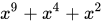
Now, imagine that there are two bit-errors in the transmission, so the received codeword is [ 1 0 0 1 1 1 0 0 0 1 1 0 1 0 0 ]. In polynomial notation:

In order to correct the errors, first calculate the syndromes. Taking we have and Failed to parse (SVG (MathML can be enabled via browser plugin): Invalid response ("Math extension cannot connect to Restbase.") from server "https://wikimedia.org/api/rest_v1/":): {\displaystyle s_6 = 1001.} Next, apply the Peterson procedure by row-reducing the following augmented matrix.


- Failed to parse (SVG (MathML can be enabled via browser plugin): Invalid response ("Math extension cannot connect to Restbase.") from server "https://wikimedia.org/api/rest_v1/":): {\displaystyle \left [ S_{3 \times 3} | C_{3 \times 1} \right ] = \begin{bmatrix}s_1&s_2&s_3&s_4\\ s_2&s_3&s_4&s_5\\ s_3&s_4&s_5&s_6\end{bmatrix} = \begin{bmatrix}1011&1001&1011&1101\\ 1001&1011&1101&0001\\ 1011&1101&0001&1001\end{bmatrix} \Rightarrow \begin{bmatrix}0001&0000&1000&0111\\ 0000&0001&1011&0001\\ 0000&0000&0000&0000 \end{bmatrix}}
Due to the zero row, S3×3 is singular, which is no surprise since only two errors were introduced into the codeword. However, the upper-left corner of the matrix is identical to [S2×2 | C2×1], which gives rise to the solution Failed to parse (SVG (MathML can be enabled via browser plugin): Invalid response ("Math extension cannot connect to Restbase.") from server "https://wikimedia.org/api/rest_v1/":): {\displaystyle \lambda_2 = 1000,} Failed to parse (SVG (MathML can be enabled via browser plugin): Invalid response ("Math extension cannot connect to Restbase.") from server "https://wikimedia.org/api/rest_v1/":): {\displaystyle \lambda_1 = 1011.} The resulting error locator polynomial is Failed to parse (SVG (MathML can be enabled via browser plugin): Invalid response ("Math extension cannot connect to Restbase.") from server "https://wikimedia.org/api/rest_v1/":): {\displaystyle \Lambda(x) = 1000 x^2 + 1011 x + 0001,} which has zeros at Failed to parse (SVG (MathML can be enabled via browser plugin): Invalid response ("Math extension cannot connect to Restbase.") from server "https://wikimedia.org/api/rest_v1/":): {\displaystyle 0100 = \alpha^{-13}} and Failed to parse (SVG (MathML can be enabled via browser plugin): Invalid response ("Math extension cannot connect to Restbase.") from server "https://wikimedia.org/api/rest_v1/":): {\displaystyle 0111 = \alpha^{-5}.} The exponents of Failed to parse (SVG (MathML can be enabled via browser plugin): Invalid response ("Math extension cannot connect to Restbase.") from server "https://wikimedia.org/api/rest_v1/":): {\displaystyle \alpha} correspond to the error locations. There is no need to calculate the error values in this example, as the only possible value is 1.
Decoding with unreadable characters
[edit | edit source]Suppose the same scenario, but the received word has two unreadable characters [ 1 0 0 ? 1 1 ? 0 0 1 1 0 1 0 0 ]. We replace the unreadable characters by zeros while creating the polynomial reflecting their positions Failed to parse (SVG (MathML can be enabled via browser plugin): Invalid response ("Math extension cannot connect to Restbase.") from server "https://wikimedia.org/api/rest_v1/":): {\displaystyle \Gamma(x) = \left(\alpha^8x - 1\right)\left(\alpha^{11}x - 1\right).} We compute the syndromes Failed to parse (SVG (MathML can be enabled via browser plugin): Invalid response ("Math extension cannot connect to Restbase.") from server "https://wikimedia.org/api/rest_v1/":): {\displaystyle s_1=\alpha^{-7}, s_2=\alpha^{1}, s_3=\alpha^{4}, s_4=\alpha^{2}, s_5=\alpha^{5},} and Failed to parse (SVG (MathML can be enabled via browser plugin): Invalid response ("Math extension cannot connect to Restbase.") from server "https://wikimedia.org/api/rest_v1/":): {\displaystyle s_6=\alpha^{-7}.} (Using log notation which is independent on GF(24) isomorphisms. For computation checking we can use the same representation for addition as was used in previous example. Hexadecimal description of the powers of Failed to parse (SVG (MathML can be enabled via browser plugin): Invalid response ("Math extension cannot connect to Restbase.") from server "https://wikimedia.org/api/rest_v1/":): {\displaystyle \alpha} are consecutively 1,2,4,8,3,6,C,B,5,A,7,E,F,D,9 with the addition based on bitwise xor.)
Let us make syndrome polynomial
- Failed to parse (SVG (MathML can be enabled via browser plugin): Invalid response ("Math extension cannot connect to Restbase.") from server "https://wikimedia.org/api/rest_v1/":): {\displaystyle S(x)=\alpha^{-7}+\alpha^{1}x+\alpha^{4}x^2+\alpha^{2}x^3+\alpha^{5}x^4+\alpha^{-7}x^5,}
compute
- Failed to parse (SVG (MathML can be enabled via browser plugin): Invalid response ("Math extension cannot connect to Restbase.") from server "https://wikimedia.org/api/rest_v1/":): {\displaystyle S(x)\Gamma(x)=\alpha^{-7}+\alpha^{4}x+\alpha^{-1}x^2+\alpha^{6}x^3+\alpha^{-1}x^4+\alpha^{5}x^5+\alpha^{7}x^6+\alpha^{-3}x^7.}
Run the extended Euclidean algorithm:
- Failed to parse (SVG (MathML can be enabled via browser plugin): Invalid response ("Math extension cannot connect to Restbase.") from server "https://wikimedia.org/api/rest_v1/":): {\displaystyle \begin{align} &\begin{pmatrix}S(x)\Gamma(x)\\ x^6\end{pmatrix} \\ [6pt] ={} &\begin{pmatrix}\alpha^{-7} +\alpha^{4}x+ \alpha^{-1}x^2+ \alpha^{6}x^3+ \alpha^{-1}x^4+ \alpha^{5}x^5 +\alpha^{7}x^6+ \alpha^{-3}x^7 \\ x^6\end{pmatrix} \\ [6pt] ={} &\begin{pmatrix}\alpha^{7}+ \alpha^{-3}x & 1\\ 1 & 0\end{pmatrix} \begin{pmatrix}x^6\\ \alpha^{-7} +\alpha^{4}x +\alpha^{-1}x^2 +\alpha^{6}x^3 +\alpha^{-1}x^4 +\alpha^{5}x^5 +2\alpha^{7}x^6 +2\alpha^{-3}x^7\end{pmatrix} \\ [6pt] ={} &\begin{pmatrix}\alpha^{7}+ \alpha^{-3}x & 1\\ 1 & 0\end{pmatrix} \begin{pmatrix}\alpha^4 + \alpha^{-5}x & 1\\ 1 & 0\end{pmatrix} \\ &\qquad \begin{pmatrix}\alpha^{-7}+ \alpha^{4}x+ \alpha^{-1}x^2+ \alpha^{6}x^3+ \alpha^{-1}x^4+ \alpha^{5}x^5\\ \alpha^{-3} +\left(\alpha^{-7}+ \alpha^{3}\right)x+ \left(\alpha^{3}+ \alpha^{-1}\right)x^2+ \left(\alpha^{-5}+ \alpha^{-6}\right)x^3+ \left(\alpha^3+ \alpha^{1}\right)x^4+ 2\alpha^{-6}x^5+ 2x^6\end{pmatrix} \\ [6pt] ={} &\begin{pmatrix}\left(1+ \alpha^{-4}\right)+ \left(\alpha^{1}+ \alpha^{2}\right)x+ \alpha^{7}x^2 & \alpha^{7}+ \alpha^{-3}x \\ \alpha^4+ \alpha^{-5}x & 1\end{pmatrix} \begin{pmatrix}\alpha^{-7}+ \alpha^{4}x+ \alpha^{-1}x^2+ \alpha^{6}x^3+ \alpha^{-1}x^4+ \alpha^{5}x^5\\ \alpha^{-3}+ \alpha^{-2}x+ \alpha^{0}x^2+ \alpha^{-2}x^3+ \alpha^{-6}x^4\end{pmatrix} \\ [6pt] ={} &\begin{pmatrix}\alpha^{-3}+ \alpha^{5}x+ \alpha^{7}x^2 & \alpha^{7}+ \alpha^{-3}x \\ \alpha^4+ \alpha^{-5}x & 1\end{pmatrix} \begin{pmatrix}\alpha^{-5}+ \alpha^{-4}x & 1\\ 1 & 0 \end{pmatrix} \\ &\qquad \begin{pmatrix}\alpha^{-3}+ \alpha^{-2}x+ \alpha^{0}x^2+ \alpha^{-2}x^3+ \alpha^{-6}x^4\\ \left(\alpha^{7}+ \alpha^{-7}\right)+ \left(2\alpha^{-7}+ \alpha^{4}\right)x+ \left(\alpha^{-5}+ \alpha^{-6}+ \alpha^{-1}\right)x^2+ \left(\alpha^{-7}+ \alpha^{-4}+ \alpha^{6}\right)x^3+ \left(\alpha^{4}+ \alpha^{-6}+ \alpha^{-1}\right)x^4+ 2\alpha^{5}x^5\end{pmatrix} \\ [6pt] ={} &\begin{pmatrix}\alpha^{7}x+ \alpha^{5}x^2+ \alpha^{3}x^3 & \alpha^{-3}+ \alpha^{5}x+ \alpha^{7}x^2\\ \alpha^{3}+ \alpha^{-5}x+ \alpha^{6}x^2 & \alpha^4+ \alpha^{-5}x\end{pmatrix} \begin{pmatrix}\alpha^{-3}+ \alpha^{-2}x+ \alpha^{0}x^2+ \alpha^{-2}x^3+ \alpha^{-6}x^4\\ \alpha^{-4}+ \alpha^{4}x+ \alpha^{2}x^2+ \alpha^{-5}x^3\end{pmatrix}. \end{align}}
We have reached polynomial of degree at most 3, and as
- Failed to parse (SVG (MathML can be enabled via browser plugin): Invalid response ("Math extension cannot connect to Restbase.") from server "https://wikimedia.org/api/rest_v1/":): {\displaystyle \begin{pmatrix}-\left(\alpha^4+ \alpha^{-5}x\right) & \alpha^{-3}+ \alpha^{5}x+ \alpha^{7}x^2\\ \alpha^{3}+ \alpha^{-5}x+ \alpha^{6}x^2 & -\left(\alpha^{7}x+ \alpha^{5}x^2+ \alpha^{3}x^3\right)\end{pmatrix} \begin{pmatrix}\alpha^{7}x+ \alpha^{5}x^2+ \alpha^{3}x^3 & \alpha^{-3} + \alpha^{5}x + \alpha^{7}x^2\\ \alpha^{3} + \alpha^{-5}x + \alpha^{6}x^2 & \alpha^4 + \alpha^{-5}x\end{pmatrix} = \begin{pmatrix}1 & 0\\ 0 & 1\end{pmatrix},}
we get
- Failed to parse (SVG (MathML can be enabled via browser plugin): Invalid response ("Math extension cannot connect to Restbase.") from server "https://wikimedia.org/api/rest_v1/":): {\displaystyle \begin{pmatrix}-\left(\alpha^4+ \alpha^{-5}x\right) & \alpha^{-3}+ \alpha^{5}x+ \alpha^{7}x^2\\ \alpha^{3}+ \alpha^{-5}x+ \alpha^{6}x^2 & -\left(\alpha^{7}x+ \alpha^{5}x^2+ \alpha^{3}x^3\right)\end{pmatrix} \begin{pmatrix}S(x)\Gamma(x)\\ x^6\end{pmatrix} = \begin{pmatrix}\alpha^{-3}+ \alpha^{-2}x+ \alpha^{0}x^2+ \alpha^{-2}x^3+ \alpha^{-6}x^4\\ \alpha^{-4}+ \alpha^{4}x+ \alpha^{2}x^2+ \alpha^{-5}x^3\end{pmatrix}. }
Therefore,
- Failed to parse (SVG (MathML can be enabled via browser plugin): Invalid response ("Math extension cannot connect to Restbase.") from server "https://wikimedia.org/api/rest_v1/":): {\displaystyle S(x)\Gamma(x)\left(\alpha^{3} + \alpha^{-5}x + \alpha^{6}x^2\right) - \left(\alpha^{7}x + \alpha^{5}x^2 + \alpha^{3}x^3\right)x^6 = \alpha^{-4} + \alpha^{4}x + \alpha^{2}x^2 + \alpha^{-5}x^3.}
Let Failed to parse (SVG (MathML can be enabled via browser plugin): Invalid response ("Math extension cannot connect to Restbase.") from server "https://wikimedia.org/api/rest_v1/":): {\displaystyle \Lambda(x) = \alpha^{3}+ \alpha^{-5}x+ \alpha^{6}x^2.} Don't worry that Failed to parse (SVG (MathML can be enabled via browser plugin): Invalid response ("Math extension cannot connect to Restbase.") from server "https://wikimedia.org/api/rest_v1/":): {\displaystyle \lambda_0\neq 1.} Find by brute force a root of Failed to parse (SVG (MathML can be enabled via browser plugin): Invalid response ("Math extension cannot connect to Restbase.") from server "https://wikimedia.org/api/rest_v1/":): {\displaystyle \Lambda.} The roots are Failed to parse (SVG (MathML can be enabled via browser plugin): Invalid response ("Math extension cannot connect to Restbase.") from server "https://wikimedia.org/api/rest_v1/":): {\displaystyle \alpha^2,} and Failed to parse (SVG (MathML can be enabled via browser plugin): Invalid response ("Math extension cannot connect to Restbase.") from server "https://wikimedia.org/api/rest_v1/":): {\displaystyle \alpha^{10}} (after finding for example Failed to parse (SVG (MathML can be enabled via browser plugin): Invalid response ("Math extension cannot connect to Restbase.") from server "https://wikimedia.org/api/rest_v1/":): {\displaystyle \alpha^2} we can divide Failed to parse (SVG (MathML can be enabled via browser plugin): Invalid response ("Math extension cannot connect to Restbase.") from server "https://wikimedia.org/api/rest_v1/":): {\displaystyle \Lambda} by corresponding monom Failed to parse (SVG (MathML can be enabled via browser plugin): Invalid response ("Math extension cannot connect to Restbase.") from server "https://wikimedia.org/api/rest_v1/":): {\displaystyle \left(x - \alpha^2\right)} and the root of resulting monom could be found easily).
Let
- Failed to parse (SVG (MathML can be enabled via browser plugin): Invalid response ("Math extension cannot connect to Restbase.") from server "https://wikimedia.org/api/rest_v1/":): {\displaystyle \begin{align} \Xi(x) &= \Gamma(x)\Lambda(x) = \alpha^3 + \alpha^4x^2 + \alpha^2x^3 + \alpha^{-5}x^4 \\ \Omega(x) &= S(x)\Xi(x) \equiv \alpha^{-4} + \alpha^4x + \alpha^2x^2 + \alpha^{-5}x^3 \bmod{x^6} \end{align}}
Let us look for error values using formula
- Failed to parse (SVG (MathML can be enabled via browser plugin): Invalid response ("Math extension cannot connect to Restbase.") from server "https://wikimedia.org/api/rest_v1/":): {\displaystyle e_j = -\frac{\Omega \left(\alpha^{-i_j} \right)}{\Xi' \left(\alpha^{-i_j} \right)},}
where Failed to parse (SVG (MathML can be enabled via browser plugin): Invalid response ("Math extension cannot connect to Restbase.") from server "https://wikimedia.org/api/rest_v1/":): {\displaystyle \alpha^{-i_j}} are roots of Failed to parse (SVG (MathML can be enabled via browser plugin): Invalid response ("Math extension cannot connect to Restbase.") from server "https://wikimedia.org/api/rest_v1/":): {\displaystyle \Xi(x).} Failed to parse (SVG (MathML can be enabled via browser plugin): Invalid response ("Math extension cannot connect to Restbase.") from server "https://wikimedia.org/api/rest_v1/":): {\displaystyle \Xi'(x)=\alpha^{2}x^2.} We get
- Failed to parse (SVG (MathML can be enabled via browser plugin): Invalid response ("Math extension cannot connect to Restbase.") from server "https://wikimedia.org/api/rest_v1/":): {\displaystyle \begin{align} e_1 &=-\frac{\Omega(\alpha^4)}{\Xi'(\alpha^{4})} = \frac{\alpha^{-4}+\alpha^{-7}+\alpha^{-5}+\alpha^{7}}{\alpha^{-5}} =\frac{\alpha^{-5}}{\alpha^{-5}}=1 \\ e_2 &=-\frac{\Omega(\alpha^7)}{\Xi'(\alpha^{7})} = \frac{\alpha^{-4}+\alpha^{-4}+\alpha^{1}+\alpha^{1}}{\alpha^{1}}=0 \\ e_3 &=-\frac{\Omega(\alpha^{10})}{\Xi'(\alpha^{10})} = \frac{\alpha^{-4}+\alpha^{-1}+\alpha^{7}+\alpha^{-5}}{\alpha^{7}}=\frac{\alpha^{7}}{\alpha^{7}}=1 \\ e_4 &=-\frac{\Omega(\alpha^{2})}{\Xi'(\alpha^{2})} = \frac{\alpha^{-4}+\alpha^{6}+\alpha^{6}+\alpha^{1}}{\alpha^{6}}=\frac{\alpha^{6}}{\alpha^{6}}=1 \end{align}}
Fact, that Failed to parse (SVG (MathML can be enabled via browser plugin): Invalid response ("Math extension cannot connect to Restbase.") from server "https://wikimedia.org/api/rest_v1/":): {\displaystyle e_3=e_4=1,} should not be surprising.
Corrected code is therefore [ 1 1 0 1 1 1 0 0 0 0 1 0 1 0 0].
Decoding with unreadable characters with a small number of errors
[edit | edit source]Let us show the algorithm behaviour for the case with small number of errors. Let the received word is [ 1 0 0 ? 1 1 ? 0 0 0 1 0 1 0 0 ].
Again, replace the unreadable characters by zeros while creating the polynomial reflecting their positions Failed to parse (SVG (MathML can be enabled via browser plugin): Invalid response ("Math extension cannot connect to Restbase.") from server "https://wikimedia.org/api/rest_v1/":): {\displaystyle \Gamma(x) = \left(\alpha^{8}x - 1\right)\left(\alpha^{11}x - 1\right).} Compute the syndromes Failed to parse (SVG (MathML can be enabled via browser plugin): Invalid response ("Math extension cannot connect to Restbase.") from server "https://wikimedia.org/api/rest_v1/":): {\displaystyle s_1 = \alpha^{4}, s_2 = \alpha^{-7}, s_3 = \alpha^{1}, s_4 = \alpha^{1}, s_5 = \alpha^{0},} and Failed to parse (SVG (MathML can be enabled via browser plugin): Invalid response ("Math extension cannot connect to Restbase.") from server "https://wikimedia.org/api/rest_v1/":): {\displaystyle s_6 = \alpha^{2}.} Create syndrome polynomial
- Failed to parse (SVG (MathML can be enabled via browser plugin): Invalid response ("Math extension cannot connect to Restbase.") from server "https://wikimedia.org/api/rest_v1/":): {\displaystyle \begin{align} S(x) &= \alpha^{4} + \alpha^{-7}x + \alpha^{1}x^2 + \alpha^{1}x^3 + \alpha^{0}x^4 + \alpha^{2}x^5, \\ S(x)\Gamma(x) &= \alpha^{4} + \alpha^{7}x + \alpha^{5}x^2 + \alpha^{3}x^3 + \alpha^{1}x^4 + \alpha^{-1}x^5 + \alpha^{-1}x^6 + \alpha^{6}x^7. \end{align}}
Let us run the extended Euclidean algorithm:
- Failed to parse (SVG (MathML can be enabled via browser plugin): Invalid response ("Math extension cannot connect to Restbase.") from server "https://wikimedia.org/api/rest_v1/":): {\displaystyle \begin{align} \begin{pmatrix} S(x)\Gamma(x) \\ x^6 \end{pmatrix} &= \begin{pmatrix} \alpha^{4} + \alpha^{7}x + \alpha^{5}x^2 + \alpha^{3}x^3 + \alpha^{1}x^4 + \alpha^{-1}x^5 + \alpha^{-1}x^6 + \alpha^{6}x^7 \\ x^6 \end{pmatrix} \\ &= \begin{pmatrix} \alpha^{-1} + \alpha^{6}x & 1 \\ 1 & 0 \end{pmatrix} \begin{pmatrix} x^6 \\ \alpha^{4} + \alpha^{7}x + \alpha^{5}x^2 + \alpha^{3}x^3 + \alpha^{1}x^4 + \alpha^{-1}x^5 + 2\alpha^{-1}x^6 + 2\alpha^{6}x^7 \end{pmatrix} \\ &= \begin{pmatrix} \alpha^{-1} + \alpha^{6}x & 1 \\ 1 & 0 \end{pmatrix} \begin{pmatrix} \alpha^{3} + \alpha^{1}x & 1 \\ 1 & 0 \end{pmatrix} \begin{pmatrix} \alpha^{4} + \alpha^{7}x + \alpha^{5}x^2 + \alpha^{3}x^3 + \alpha^{1}x^4 + \alpha^{-1}x^5 \\ \alpha^{7} + \left(\alpha^{-5} + \alpha^{5}\right)x + 2\alpha^{-7}x^2 + 2\alpha^{6}x^3 + 2\alpha^{4}x^4 + 2\alpha^{2}x^5 + 2x^6 \end{pmatrix} \\ &= \begin{pmatrix} \left(1 + \alpha^{2}\right) + \left(\alpha^{0} + \alpha^{-6}\right)x + \alpha^{7}x^2 & \alpha^{-1} + \alpha^{6}x \\ \alpha^{3} + \alpha^{1}x & 1 \end{pmatrix} \begin{pmatrix} \alpha^{4} + \alpha^{7}x + \alpha^{5}x^2 + \alpha^{3}x^3 + \alpha^{1}x^4 + \alpha^{-1}x^5 \\ \alpha^{7} + \alpha^{0}x \end{pmatrix} \end{align}}
We have reached polynomial of degree at most 3, and as
- Failed to parse (SVG (MathML can be enabled via browser plugin): Invalid response ("Math extension cannot connect to Restbase.") from server "https://wikimedia.org/api/rest_v1/":): {\displaystyle \begin{pmatrix} -1 & \alpha^{-1} + \alpha^{6}x \\ \alpha^{3} + \alpha^{1}x & -\left(\alpha^{-7} + \alpha^{7}x + \alpha^{7}x^2\right) \end{pmatrix} \begin{pmatrix} \alpha^{-7} + \alpha^{7}x + \alpha^{7}x^2 & \alpha^{-1} + \alpha^{6}x \\ \alpha^{3} + \alpha^{1}x & 1 \end{pmatrix} = \begin{pmatrix} 1 & 0 \\ 0 & 1 \end{pmatrix}, }
we get
- Failed to parse (SVG (MathML can be enabled via browser plugin): Invalid response ("Math extension cannot connect to Restbase.") from server "https://wikimedia.org/api/rest_v1/":): {\displaystyle \begin{pmatrix} -1 & \alpha^{-1} + \alpha^{6}x \\ \alpha^{3} + \alpha^{1}x & -\left(\alpha^{-7} + \alpha^{7}x + \alpha^{7}x^2\right) \end{pmatrix}\begin{pmatrix} S(x)\Gamma(x) \\ x^6 \end{pmatrix} = \begin{pmatrix} \alpha^{4} + \alpha^{7}x + \alpha^{5}x^2 + \alpha^{3}x^3 + \alpha^{1}x^4 + \alpha^{-1}x^5 \\ \alpha^{7} + \alpha^{0}x \end{pmatrix}. }
Therefore,
- Failed to parse (SVG (MathML can be enabled via browser plugin): Invalid response ("Math extension cannot connect to Restbase.") from server "https://wikimedia.org/api/rest_v1/":): {\displaystyle S(x)\Gamma(x)\left(\alpha^{3} + \alpha^{1}x\right) - \left(\alpha^{-7} + \alpha^{7}x + \alpha^{7}x^2\right)x^6 = \alpha^{7} + \alpha^{0}x.}
Let Failed to parse (SVG (MathML can be enabled via browser plugin): Invalid response ("Math extension cannot connect to Restbase.") from server "https://wikimedia.org/api/rest_v1/":): {\displaystyle \Lambda(x) = \alpha^{3} + \alpha^{1}x.} Don't worry that Failed to parse (SVG (MathML can be enabled via browser plugin): Invalid response ("Math extension cannot connect to Restbase.") from server "https://wikimedia.org/api/rest_v1/":): {\displaystyle \lambda_0 \neq 1.} The root of Failed to parse (SVG (MathML can be enabled via browser plugin): Invalid response ("Math extension cannot connect to Restbase.") from server "https://wikimedia.org/api/rest_v1/":): {\displaystyle \Lambda(x)} is Failed to parse (SVG (MathML can be enabled via browser plugin): Invalid response ("Math extension cannot connect to Restbase.") from server "https://wikimedia.org/api/rest_v1/":): {\displaystyle \alpha^{3-1}.}
Let
- Failed to parse (SVG (MathML can be enabled via browser plugin): Invalid response ("Math extension cannot connect to Restbase.") from server "https://wikimedia.org/api/rest_v1/":): {\displaystyle \begin{align} \Xi(x) &= \Gamma(x)\Lambda(x) = \alpha^{3} + \alpha^{-7}x + \alpha^{-4}x^2 + \alpha^{5}x^3, \\ \Omega(x) &= S(x)\Xi(x) \equiv \alpha^{7} + \alpha^{0}x \bmod{x^6} \end{align}}
Let us look for error values using formula Failed to parse (SVG (MathML can be enabled via browser plugin): Invalid response ("Math extension cannot connect to Restbase.") from server "https://wikimedia.org/api/rest_v1/":): {\displaystyle e_j = -\Omega\left(\alpha^{-i_j}\right)/\Xi'\left(\alpha^{-i_j}\right),} where Failed to parse (SVG (MathML can be enabled via browser plugin): Invalid response ("Math extension cannot connect to Restbase.") from server "https://wikimedia.org/api/rest_v1/":): {\displaystyle \alpha^{-i_j}} are roots of polynomial Failed to parse (SVG (MathML can be enabled via browser plugin): Invalid response ("Math extension cannot connect to Restbase.") from server "https://wikimedia.org/api/rest_v1/":): {\displaystyle \Xi(x).}
- Failed to parse (SVG (MathML can be enabled via browser plugin): Invalid response ("Math extension cannot connect to Restbase.") from server "https://wikimedia.org/api/rest_v1/":): {\displaystyle \Xi'(x) = \alpha^{-7} + \alpha^{5}x^2.}
We get
- Failed to parse (SVG (MathML can be enabled via browser plugin): Invalid response ("Math extension cannot connect to Restbase.") from server "https://wikimedia.org/api/rest_v1/":): {\displaystyle \begin{align} e_1 &= -\frac{\Omega\left(\alpha^4\right)}{\Xi'\left(\alpha^{4}\right)} = \frac{\alpha^{7} + \alpha^{4}}{\alpha^{-7} + \alpha^{-2}} = \frac{\alpha^{3}}{\alpha^{3}} = 1 \\ e_2 &= -\frac{\Omega\left(\alpha^7\right)}{\Xi'\left(\alpha^{7}\right)} = \frac{\alpha^{7} + \alpha^{7}}{\alpha^{-7} + \alpha^{4}} = 0 \\ e_3 &= -\frac{\Omega\left(\alpha^2\right)}{\Xi'\left(\alpha^2\right)} = \frac{\alpha^{7} + \alpha^{2}}{\alpha^{-7} + \alpha^{-6}} = \frac{\alpha^{-3}}{\alpha^{-3}} = 1 \end{align}}
The fact that Failed to parse (SVG (MathML can be enabled via browser plugin): Invalid response ("Math extension cannot connect to Restbase.") from server "https://wikimedia.org/api/rest_v1/":): {\displaystyle e_3 = 1} should not be surprising.
Corrected code is therefore [ 1 1 0 1 1 1 0 0 0 0 1 0 1 0 0].
Citations
[edit | edit source]- ↑ Reed & Chen 1999, p. 189
- ↑ Hocquenghem 1959
- ↑ Bose & Ray-Chaudhuri 1960
- ↑ "Phobos Lander Coding System: Software and Analysis" (PDF). Archived (PDF) from the original on 2022-10-09. Retrieved 25 February 2012.
- ↑ Marelli, Alessia; Micheloni, Rino (2018). "BCH Codes for Solid-State-Drives". Inside Solid State Drives (SSDS). Springer Series in Advanced Microelectronics. 37. pp. 369–406. doi:10.1007/978-981-13-0599-3_11. ISBN 978-981-13-0598-6. Retrieved 23 September 2023.
- ↑ Gill n.d., p. 3
- ↑ Lidl & Pilz 1999, p. 229
- ↑ Gorenstein, Peterson & Zierler 1960
- ↑ Gill n.d., p. 47
- ↑ Yasuo Sugiyama, Masao Kasahara, Shigeichi Hirasawa, and Toshihiko Namekawa. A method for solving key equation for decoding Goppa codes. Information and Control, 27:87–99, 1975.
References
[edit | edit source]Primary sources
[edit | edit source]- Hocquenghem, A. (September 1959), "Codes correcteurs d'erreurs", Chiffres (in French), Paris, 2: 147–156
- Bose, R. C.; Ray-Chaudhuri, D. K. (March 1960), "On A Class of Error Correcting Binary Group Codes" (PDF), Information and Control, 3 (1): 68–79, Bibcode:1960InfCo...3...68B, doi:10.1016/s0019-9958(60)90287-4, ISSN 0890-5401, archived (PDF) from the original on 2022-10-09
Secondary sources
[edit | edit source]- Gill, John (n.d.), EE387 Notes #7, Handout #28 (PDF), Stanford University, pp. 42–45, archived (PDF) from the original on 2022-10-09, retrieved April 21, 2010[dead link] Course notes are apparently being redone for 2012: http://www.stanford.edu/class/ee387/ Archived 2013-06-05 at the Wayback Machine
- Gorenstein, Daniel; Peterson, W. Wesley; Zierler, Neal (1960), "Two-Error Correcting Bose-Chaudhuri Codes are Quasi-Perfect", Information and Control, 3 (3): 291–294, doi:10.1016/s0019-9958(60)90877-9
- Lidl, Rudolf; Pilz, Günter (1999), Applied Abstract Algebra (2nd ed.), John Wiley
- Reed, Irving S.; Chen, Xuemin (1999), Error-Control Coding for Data Networks, Boston, MA: Kluwer Academic Publishers, ISBN 0-7923-8528-4
Further reading
[edit | edit source]- Blahut, Richard E. (2003), Algebraic Codes for Data Transmission (2nd ed.), Cambridge University Press, ISBN 0-521-55374-1
- Gilbert, W. J.; Nicholson, W. K. (2004), Modern Algebra with Applications (2nd ed.), John Wiley
- Lin, S.; Costello, D. (2004), Error Control Coding: Fundamentals and Applications, Englewood Cliffs, NJ: Prentice-Hall
- MacWilliams, F. J.; Sloane, N. J. A. (1977), The Theory of Error-Correcting Codes, New York, NY: North-Holland Publishing Company
- Rudra, Atri, CSE 545, Error Correcting Codes: Combinatorics, Algorithms and Applications, University at Buffalo, archived from the original on 2012-12-18, retrieved 2009-05-11