Context-free language
In formal language theory, a context-free language (CFL), also called a Chomsky type-2 language, is a language generated by a context-free grammar (CFG).
Context-free languages have many applications in programming languages, in particular, most arithmetic expressions are generated by context-free grammars.
Background
[edit | edit source]Context-free grammar
[edit | edit source]Different context-free grammars can generate the same context-free language. Intrinsic properties of the language can be distinguished from extrinsic properties of a particular grammar by comparing multiple grammars that describe the language.
Automata
[edit | edit source]The set of all context-free languages is identical to the set of languages accepted by pushdown automata, which makes these languages amenable to parsing. Further, for a given CFG, there is a direct way to produce a pushdown automaton for the grammar (and thereby the corresponding language), though going the other way (producing a grammar given an automaton) is not as direct.
Examples
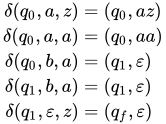
[edit | edit source]An example context-free language is , the language of all non-empty even-length strings, the entire first halves of which are a's, and the entire second halves of which are b's. L is generated by the grammar . This language is not regular. It is accepted by the pushdown automaton where is defined as follows:[note 1]


Unambiguous CFLs are a proper subset of all CFLs: there are inherently ambiguous CFLs. An example of an inherently ambiguous CFL is the union of Failed to parse (SVG (MathML can be enabled via browser plugin): Invalid response ("Math extension cannot connect to Restbase.") from server "https://wikimedia.org/api/rest_v1/":): {\displaystyle \{a^n b^m c^m d^n | n, m > 0\}} with Failed to parse (SVG (MathML can be enabled via browser plugin): Invalid response ("Math extension cannot connect to Restbase.") from server "https://wikimedia.org/api/rest_v1/":): {\displaystyle \{a^n b^n c^m d^m | n, m > 0\}} . This set is context-free, since the union of two context-free languages is always context-free. But there is no way to unambiguously parse strings in the (non-context-free) subset Failed to parse (SVG (MathML can be enabled via browser plugin): Invalid response ("Math extension cannot connect to Restbase.") from server "https://wikimedia.org/api/rest_v1/":): {\displaystyle \{a^n b^n c^n d^n | n > 0\}} which is the intersection of these two languages.[1]
Dyck language
[edit | edit source]The language of all properly matched parentheses is generated by the grammar Failed to parse (SVG (MathML can be enabled via browser plugin): Invalid response ("Math extension cannot connect to Restbase.") from server "https://wikimedia.org/api/rest_v1/":): {\displaystyle S\to SS ~|~ (S) ~|~ \varepsilon} .
Properties
[edit | edit source]Context-free parsing
[edit | edit source]The context-free nature of the language makes it simple to parse with a pushdown automaton.
Determining an instance of the membership problem; i.e. given a string Failed to parse (SVG (MathML can be enabled via browser plugin): Invalid response ("Math extension cannot connect to Restbase.") from server "https://wikimedia.org/api/rest_v1/":): {\displaystyle w} , determine whether Failed to parse (SVG (MathML can be enabled via browser plugin): Invalid response ("Math extension cannot connect to Restbase.") from server "https://wikimedia.org/api/rest_v1/":): {\displaystyle w \in L(G)} where Failed to parse (SVG (MathML can be enabled via browser plugin): Invalid response ("Math extension cannot connect to Restbase.") from server "https://wikimedia.org/api/rest_v1/":): {\displaystyle L} is the language generated by a given grammar Failed to parse (SVG (MathML can be enabled via browser plugin): Invalid response ("Math extension cannot connect to Restbase.") from server "https://wikimedia.org/api/rest_v1/":): {\displaystyle G} ; is also known as recognition. Context-free recognition for Chomsky normal form grammars was shown by Leslie G. Valiant to be reducible to Boolean matrix multiplication, thus inheriting its complexity upper bound of O(n2.3728596).[2][note 2] Conversely, Lillian Lee has shown O(n3−ε) Boolean matrix multiplication to be reducible to O(n3−3ε) CFG parsing, thus establishing some kind of lower bound for the latter.[3]
Practical uses of context-free languages require also to produce a derivation tree that exhibits the structure that the grammar associates with the given string. The process of producing this tree is called parsing. Known parsers have a time complexity that is cubic in the size of the string that is parsed.
Formally, the set of all context-free languages is identical to the set of languages accepted by pushdown automata (PDA). Parser algorithms for context-free languages include the CYK algorithm and Earley's Algorithm.
A special subclass of context-free languages are the deterministic context-free languages which are defined as the set of languages accepted by a deterministic pushdown automaton and can be parsed by a LR(k) parser.[4]
See also parsing expression grammar as an alternative approach to grammar and parser.
Closure properties
[edit | edit source]The class of context-free languages is closed under the following operations. That is, if L and P are context-free languages, the following languages are context-free as well:
- the union Failed to parse (SVG (MathML can be enabled via browser plugin): Invalid response ("Math extension cannot connect to Restbase.") from server "https://wikimedia.org/api/rest_v1/":): {\displaystyle L \cup P} of L and P[5]
- the reversal of L[6]
- the concatenation Failed to parse (SVG (MathML can be enabled via browser plugin): Invalid response ("Math extension cannot connect to Restbase.") from server "https://wikimedia.org/api/rest_v1/":): {\displaystyle L \cdot P} of L and P[5]
- the Kleene star Failed to parse (SVG (MathML can be enabled via browser plugin): Invalid response ("Math extension cannot connect to Restbase.") from server "https://wikimedia.org/api/rest_v1/":): {\displaystyle L^*} of L[5]
- the image Failed to parse (SVG (MathML can be enabled via browser plugin): Invalid response ("Math extension cannot connect to Restbase.") from server "https://wikimedia.org/api/rest_v1/":): {\displaystyle \varphi(L)} of L under a homomorphism Failed to parse (SVG (MathML can be enabled via browser plugin): Invalid response ("Math extension cannot connect to Restbase.") from server "https://wikimedia.org/api/rest_v1/":): {\displaystyle \varphi} [7]
- the image Failed to parse (SVG (MathML can be enabled via browser plugin): Invalid response ("Math extension cannot connect to Restbase.") from server "https://wikimedia.org/api/rest_v1/":): {\displaystyle \varphi^{-1}(L)} of L under an inverse homomorphism Failed to parse (SVG (MathML can be enabled via browser plugin): Invalid response ("Math extension cannot connect to Restbase.") from server "https://wikimedia.org/api/rest_v1/":): {\displaystyle \varphi^{-1}} [8]
- the circular shift of L (the language Failed to parse (SVG (MathML can be enabled via browser plugin): Invalid response ("Math extension cannot connect to Restbase.") from server "https://wikimedia.org/api/rest_v1/":): {\displaystyle \{vu : uv \in L \}} )[9]
- the prefix closure of L (the set of all prefixes of strings from L)[10]
- the quotient L/R of L by a regular language R[11]
Nonclosure under intersection, complement, and difference
[edit | edit source]The context-free languages are not closed under intersection. This can be seen by taking the languages Failed to parse (SVG (MathML can be enabled via browser plugin): Invalid response ("Math extension cannot connect to Restbase.") from server "https://wikimedia.org/api/rest_v1/":): {\displaystyle A = \{a^n b^n c^m \mid m, n \geq 0 \}} and Failed to parse (SVG (MathML can be enabled via browser plugin): Invalid response ("Math extension cannot connect to Restbase.") from server "https://wikimedia.org/api/rest_v1/":): {\displaystyle B = \{a^m b^n c^n \mid m,n \geq 0\}} , which are both context-free.[note 3] Their intersection is Failed to parse (SVG (MathML can be enabled via browser plugin): Invalid response ("Math extension cannot connect to Restbase.") from server "https://wikimedia.org/api/rest_v1/":): {\displaystyle A \cap B = \{ a^n b^n c^n \mid n \geq 0\}} , which can be shown to be non-context-free by the pumping lemma for context-free languages. As a consequence, context-free languages cannot be closed under complementation, as for any languages A and B, their intersection can be expressed by union and complement: Failed to parse (SVG (MathML can be enabled via browser plugin): Invalid response ("Math extension cannot connect to Restbase.") from server "https://wikimedia.org/api/rest_v1/":): {\displaystyle A \cap B = \overline{\overline{A} \cup \overline{B}} } . In particular, context-free language cannot be closed under difference, since complement can be expressed by difference: Failed to parse (SVG (MathML can be enabled via browser plugin): Invalid response ("Math extension cannot connect to Restbase.") from server "https://wikimedia.org/api/rest_v1/":): {\displaystyle \overline{L} = \Sigma^* \setminus L} .[12]
However, if L is a context-free language and D is a regular language then both their intersection Failed to parse (SVG (MathML can be enabled via browser plugin): Invalid response ("Math extension cannot connect to Restbase.") from server "https://wikimedia.org/api/rest_v1/":): {\displaystyle L\cap D} and their difference Failed to parse (SVG (MathML can be enabled via browser plugin): Invalid response ("Math extension cannot connect to Restbase.") from server "https://wikimedia.org/api/rest_v1/":): {\displaystyle L\setminus D} are context-free languages.[13]
Decidability
[edit | edit source]In formal language theory, questions about regular languages are usually decidable, but ones about context-free languages are often not. It is decidable whether such a language is finite, but not whether it contains every possible string, is regular, is unambiguous, or is equivalent to a language with a different grammar.
The following problems are undecidable for arbitrarily given context-free grammars A and B:
- Equivalence: is Failed to parse (SVG (MathML can be enabled via browser plugin): Invalid response ("Math extension cannot connect to Restbase.") from server "https://wikimedia.org/api/rest_v1/":): {\displaystyle L(A)=L(B)} ?[14]
- Disjointness: is Failed to parse (SVG (MathML can be enabled via browser plugin): Invalid response ("Math extension cannot connect to Restbase.") from server "https://wikimedia.org/api/rest_v1/":): {\displaystyle L(A) \cap L(B) = \emptyset } ?[15] However, the intersection of a context-free language and a regular language is context-free,[16][17] hence the variant of the problem where B is a regular grammar is decidable (see "Emptiness" below).
- Containment: is Failed to parse (SVG (MathML can be enabled via browser plugin): Invalid response ("Math extension cannot connect to Restbase.") from server "https://wikimedia.org/api/rest_v1/":): {\displaystyle L(A) \subseteq L(B)} ?[18] Again, the variant of the problem where B is a regular grammar is decidable,[citation needed] while that where A is regular is generally not.[19]
- Universality: is Failed to parse (SVG (MathML can be enabled via browser plugin): Invalid response ("Math extension cannot connect to Restbase.") from server "https://wikimedia.org/api/rest_v1/":): {\displaystyle L(A)=\Sigma^*} ?[20]
- Regularity: is Failed to parse (SVG (MathML can be enabled via browser plugin): Invalid response ("Math extension cannot connect to Restbase.") from server "https://wikimedia.org/api/rest_v1/":): {\displaystyle L(A)} a regular language?[21]
- Ambiguity: is every grammar for Failed to parse (SVG (MathML can be enabled via browser plugin): Invalid response ("Math extension cannot connect to Restbase.") from server "https://wikimedia.org/api/rest_v1/":): {\displaystyle L(A)} ambiguous?[22]
The following problems are decidable for arbitrary context-free languages:
- Emptiness: Given a context-free grammar A, is Failed to parse (SVG (MathML can be enabled via browser plugin): Invalid response ("Math extension cannot connect to Restbase.") from server "https://wikimedia.org/api/rest_v1/":): {\displaystyle L(A) = \emptyset} ?[23]
- Finiteness: Given a context-free grammar A, is Failed to parse (SVG (MathML can be enabled via browser plugin): Invalid response ("Math extension cannot connect to Restbase.") from server "https://wikimedia.org/api/rest_v1/":): {\displaystyle L(A)} finite?[24]
- Membership: Given a context-free grammar G, and a word Failed to parse (SVG (MathML can be enabled via browser plugin): Invalid response ("Math extension cannot connect to Restbase.") from server "https://wikimedia.org/api/rest_v1/":): {\displaystyle w} , does Failed to parse (SVG (MathML can be enabled via browser plugin): Invalid response ("Math extension cannot connect to Restbase.") from server "https://wikimedia.org/api/rest_v1/":): {\displaystyle w \in L(G)} ? Efficient polynomial-time algorithms for the membership problem are the CYK algorithm and Earley's Algorithm.
According to Hopcroft, Motwani, Ullman (2006),[25] many of the fundamental closure and (un)decidability properties of context-free languages were shown in the 1961 paper of Bar-Hillel, Perles, and Shamir.[26]
Languages that are not context-free
[edit | edit source]The set Failed to parse (SVG (MathML can be enabled via browser plugin): Invalid response ("Math extension cannot connect to Restbase.") from server "https://wikimedia.org/api/rest_v1/":): {\displaystyle \{a^n b^n c^n d^n | n > 0\}} is a context-sensitive language, but there does not exist a context-free grammar generating this language.[27] So there exist context-sensitive languages which are not context-free. To prove that a given language is not context-free, one may employ the pumping lemma for context-free languages[26] or a number of other methods, such as Ogden's lemma or Parikh's theorem.[28]
Notes
[edit | edit source]- ↑ meaning of Failed to parse (SVG (MathML can be enabled via browser plugin): Invalid response ("Math extension cannot connect to Restbase.") from server "https://wikimedia.org/api/rest_v1/":): {\displaystyle \delta} 's arguments and results: Failed to parse (SVG (MathML can be enabled via browser plugin): Invalid response ("Math extension cannot connect to Restbase.") from server "https://wikimedia.org/api/rest_v1/":): {\displaystyle \delta(\mathrm{state}_1, \mathrm{read}, \mathrm{pop}) = (\mathrm{state}_2, \mathrm{push})}
- ↑ In Valiant's paper, O(n2.81) was the then-best known upper bound. See Matrix multiplication#Computational complexity for bound improvements since then.
- ↑ A context-free grammar for the language A is given by the following production rules, taking S as the start symbol: S → Sc | aTb | ε; T → aTb | ε. The grammar for B is analogous.
References
[edit | edit source]- ↑ Hopcroft & Ullman 1979, p. 100, Theorem 4.7.
- ↑ Valiant 1975.
- ↑ Lee 2002.
- ↑ Knuth 1965.
- ↑ 5.0 5.1 5.2 Hopcroft & Ullman 1979, p. 131, Corollary of Theorem 6.1.
- ↑ Hopcroft & Ullman 1979, p. 142, Exercise 6.4d.
- ↑ Hopcroft & Ullman 1979, p. 131-132, Corollary of Theorem 6.2.
- ↑ Hopcroft & Ullman 1979, p. 132, Theorem 6.3.
- ↑ Hopcroft & Ullman 1979, p. 142-144, Exercise 6.4c.
- ↑ Hopcroft & Ullman 1979, p. 142, Exercise 6.4b.
- ↑ Hopcroft & Ullman 1979, p. 142, Exercise 6.4a.
- ↑ Scheinberg 1960.
- ↑ Beigel & Gasarch.
- ↑ Hopcroft & Ullman 1979, p. 203, Theorem 8.12(1).
- ↑ Hopcroft & Ullman 1979, p. 202, Theorem 8.10.
- ↑ Salomaa 1973, p. 59, Theorem 6.7.
- ↑ Hopcroft & Ullman 1979, p. 135, Theorem 6.5.
- ↑ Hopcroft & Ullman 1979, p. 203, Theorem 8.12(2).
- ↑ Hopcroft & Ullman 1979, p. 203, Theorem 8.12(4).
- ↑ Hopcroft & Ullman 1979, p. 203, Theorem 8.11.
- ↑ Hopcroft & Ullman 1979, p. 205, Theorem 8.15.
- ↑ Hopcroft & Ullman 1979, p. 206, Theorem 8.16.
- ↑ Hopcroft & Ullman 1979, p. 137, Theorem 6.6(a).
- ↑ Hopcroft & Ullman 1979, p. 137, Theorem 6.6(b).
- ↑ 26.0 26.1 Bar-Hillel, Perles & Shamir 1961.
- ↑ Hopcroft & Ullman 1979.
- ↑ Stack Exchange. "How to prove that a language is not context-free?".
Works cited
[edit | edit source]- Bar-Hillel, Yehoshua; Perles, Micha Asher; Shamir, Eli (1961). "On Formal Properties of Simple Phrase-Structure Grammars". Zeitschrift für Phonetik, Sprachwissenschaft und Kommunikationsforschung. 14 (2): 143–172.
- Beigel, Richard; Gasarch, William. "A Proof that if L = L1 ∩ L2 where L1 is CFL and L2 is Regular then L is Context Free Which Does Not use PDA's" (PDF). University of Maryland Department of Computer Science. Archived (PDF) from the original on 12 December 2014. Retrieved 6 June 2020.
- Template:Hopcroft and Ullman 1979Template:Sfn whitelist
- Template:Hopcroft, Motwani, and Ullman 2006Template:Sfn whitelist
- Knuth, D. E. (July 1965). "On the translation of languages from left to right". Information and Control. 8 (6): 607–639. doi:10.1016/S0019-9958(65)90426-2.
- Lee, Lillian (January 2002). "Fast Context-Free Grammar Parsing Requires Fast Boolean Matrix Multiplication" (PDF). J ACM. 49 (1): 1–15. arXiv:cs/0112018. doi:10.1145/505241.505242. S2CID 1243491. Archived (PDF) from the original on 27 April 2003.
- Salomaa, Arto (1973). Formal Languages. ACM Monograph Series. New York: Academic Press. ISBN 978-0126157505.
- Scheinberg, Stephen (1960). "Note on the Boolean Properties of Context Free Languages" (PDF). Information and Control. 3 (4): 372–375. doi:10.1016/s0019-9958(60)90965-7. Archived (PDF) from the original on 26 November 2018.
- Valiant, Leslie G. (April 1975). "General context-free recognition in less than cubic time" (PDF). Journal of Computer and System Sciences. 10 (2): 308–315. doi:10.1016/s0022-0000(75)80046-8.
Further reading
[edit | edit source]- Autebert, Jean-Michel; Berstel, Jean; Boasson, Luc (1997). "Context-Free Languages and Push-Down Automata". In G. Rozenberg; A. Salomaa (eds.). Handbook of Formal Languages (PDF). 1. Springer-Verlag. pp. 111–174. Archived (PDF) from the original on 16 May 2011.
- Ginsburg, Seymour (1966). The Mathematical Theory of Context-Free Languages. New York, NY, USA: McGraw-Hill.
- Template:Sipser 1997