Gauss (unit)
The gauss (symbol: G, sometimes Gs) is a unit of measurement of magnetic flux density, B (also known as magnetic induction or magnetic field). The unit is part of the Gaussian system of units, which inherited it from the older centimetre–gram–second electromagnetic units (CGS-EMU) system. It was named after the German mathematician and physicist Carl Friedrich Gauss in 1936. One gauss is defined as one maxwell per square centimetre.
As the centimetre–gram–second system of units (cgs system) has been superseded by the International System of Units (SI), the use of the gauss has been deprecated by the standards bodies, but is still regularly used in various subfields of science, and preferred in astrophysics.[1] The SI unit for magnetic flux density is the tesla (symbol T),[2] which corresponds to 10,000gauss.
Name, symbol, and metric prefixes
[edit | edit source]Although not a component of the International System of Units, the usage of the gauss generally follows the rules for SI units. Since the name is derived from a person's name, its symbol is the uppercase letter "G". When the unit is spelled out, it is written in lowercase ("gauss"), unless it begins a sentence.[3]: 147–148 The gauss may be combined with metric prefixes,[4]: 128 such as in milligauss, mG (or mGs), or kilogauss, kG (or kGs).
Unit conversions
[edit | edit source]
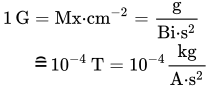

The gauss is the unit of magnetic flux density B in the system of Gaussian units and is equal to Mx/cm2 or g/Bi/s2, while the oersted is the unit of H-field. One tesla (T) corresponds to 104 gauss, and one ampere (A) per metre corresponds to 4π × 10−3 oersted.
Typical values
[edit | edit source]- 10−9–10−8 G – the magnetic field of the human brain
- 10−6–10−3 G – the magnetic field of Galactic molecular clouds. Typical magnetic field strengths within the interstellar medium of the Milky Way are ~5 μG.
- 0.25–0.60 G – the Earth's magnetic field at its surface
- 4 G – near Jupiter's equator
- 25 G – the Earth's magnetic field in its core[5]
- 50 G – a typical refrigerator magnet
- 100 G – an iron magnet
- 1500 G – within a sun spot[6]
- 10000 to 13000 G – remanence of a neodymium-iron-boron (NIB) magnet[7]
- 16000 to 22000 G – saturation of high permeability iron alloys used in transformers[8]
- 3000–70000 G – a medical magnetic resonance imaging machine
- 1012–1013 G – the surface of a neutron star[9]
- 4 × 10¹³ G – the Schwinger limit
- 1014 G – the magnetic field of SGR J1745-2900, orbiting the supermassive black hole Sgr A* in the center of the Milky Way.
- 1015 G – the magnetic field of some newly created magnetars[10]
- 1017 G – the upper limit to neutron star magnetism[10]
See also
[edit | edit source]Notes
[edit | edit source]References
[edit | edit source]- ↑ J. B. Zirker, The Magnetic Universe., Johns Hopkins University Press, Baltimore, 2009, p. 281.
- ↑ NIST Special Publication 1038, Section 4.3.1
- ↑ Template:SIbrochure9th
- ↑ Template:SIbrochure8th
- ↑ Buffett, Bruce A. (2010), "Tidal dissipation and the strength of the Earth's internal magnetic field", Nature, volume 468, pages 952–954, doi:10.1038/nature09643
- ↑ Hoadley, Rick. "How strong are magnets?". www.coolmagnetman.com. Retrieved 2017-01-26.
- ↑ Pyrhönen, Juha; Jokinen, Tapani; Hrabovcová, Valéria (2009). Design of Rotating Electrical Machines. John Wiley and Sons. p. 232. ISBN 978-0-470-69516-6.
- ↑ Laughton, Michael A.; Warne, Douglas F., eds. (2003). "8". Electrical Engineer's Reference Book (Sixteenth ed.). Newnes. ISBN 0-7506-4637-3.
- ↑ "How strong are magnets?". Experiments with magnets and our surroundings. Magcraft. Retrieved 2007-12-14.
- ↑ 10.0 10.1 Duncan, Robert C. (March 2003). "Magnetars, Soft Gamma Repeaters and Very Strong Magnetic Fields". University of Texas at Austin. Archived from the original on 2007-06-11. Retrieved 2007-05-23.