Lagrange inversion theorem
In mathematical analysis, the Lagrange inversion theorem, also known as the Lagrange–Bürmann formula, gives the Taylor series expansion of the inverse function of an analytic function. Lagrange inversion is a special case of the inverse function theorem.
Statement
[edit]Suppose z is defined as a function of w by an equation of the form
- Failed to parse (Conversion error. Server ("https://wikimedia.org/api/rest_") reported: "Cannot get mml. Server problem."): {\displaystyle z=f(w)}
where f is analytic at a point a and Failed to parse (Conversion error. Server ("https://wikimedia.org/api/rest_") reported: "Cannot get mml. Server problem."): {\displaystyle f'(a)\neq 0.} Then it is possible to invert or solve the equation for w, expressing it in the form Failed to parse (Conversion error. Server ("https://wikimedia.org/api/rest_") reported: "Cannot get mml. Server problem."): {\displaystyle w=g(z)} given by a power series[1]
- Failed to parse (Conversion error. Server ("https://wikimedia.org/api/rest_") reported: "Cannot get mml. Server problem."): {\displaystyle g(z)=a+\sum _{n=1}^{\infty }g_{n}{\frac {(z-f(a))^{n}}{n!}},}
where
- Failed to parse (Conversion error. Server ("https://wikimedia.org/api/rest_") reported: "Cannot get mml. Server problem."): {\displaystyle g_{n}=\lim _{w\to a}{\frac {d^{n-1}}{dw^{n-1}}}\left[\left({\frac {w-a}{f(w)-f(a)}}\right)^{n}\right].}
The theorem further states that this series has a non-zero radius of convergence, i.e., represents an analytic function of z in a neighbourhood of This is also called reversion of series.


If the assertions about analyticity are omitted, the formula is also valid for formal power series and can be generalized in various ways: It can be formulated for functions of several variables; it can be extended to provide a ready formula for F(g(z)) for any analytic function F; and it can be generalized to the case where the inverse g is a multivalued function.

The theorem was proved by Lagrange[2] and generalized by Hans Heinrich Bürmann,[3][4][5] both in the late 18th century. There is a straightforward derivation using complex analysis and contour integration;[6] the complex formal power series version is a consequence of knowing the formula for polynomials, so the theory of analytic functions may be applied. Actually, the machinery from analytic function theory enters only in a formal way in this proof, in that what is really needed is some property of the formal residue, and a more direct formal proof is available. In fact, the Lagrange inversion theorem has a number of additional rather different proofs, including ones using tree-counting arguments or induction.[7][8][9]
If f is a formal power series, then the above formula does not give the coefficients of the compositional inverse series g directly in terms for the coefficients of the series f. If one can express the functions f and g in formal power series as

with f0 = 0 and f1 ≠ 0, then an explicit form of inverse coefficients can be given in term of Bell polynomials:[10]

where
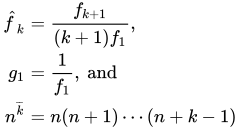
is the rising factorial.
When f1 = 1, the last formula can be interpreted in terms of the faces of associahedra [11]

where Failed to parse (Conversion error. Server ("https://wikimedia.org/api/rest_") reported: "Cannot get mml. Server problem."): {\displaystyle f_{F}=f_{i_{1}}\cdots f_{i_{m}}} for each face Failed to parse (Conversion error. Server ("https://wikimedia.org/api/rest_") reported: "Cannot get mml. Server problem."): {\displaystyle F=K_{i_{1}}\times \cdots \times K_{i_{m}}} of the associahedron Failed to parse (Conversion error. Server ("https://wikimedia.org/api/rest_") reported: "Cannot get mml. Server problem."): {\displaystyle K_{n}.}
Example
[edit]For instance, the algebraic equation of degree p

can be solved for x by means of the Lagrange inversion formula for the function f(x) = x − xp, resulting in a formal series solution
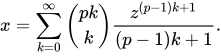
By convergence tests, this series is in fact convergent for which is also the largest disk in which a local inverse to f can be defined.

Applications
[edit]Lagrange–Bürmann formula
[edit]There is a special case of Lagrange inversion theorem that is used in combinatorics and applies when for some analytic with Take to obtain Then for the inverse (satisfying ), we have




- Failed to parse (SVG (MathML can be enabled via browser plugin): Invalid response ("Math extension cannot connect to Restbase.") from server "https://wikimedia.org/api/rest_v1/":): {\displaystyle \begin{align} g(z) &= \sum_{n=1}^{\infty} \left[ \lim_{w \to 0} \frac {d^{n-1}}{dw^{n-1}} \left(\left( \frac{w}{w/\phi(w)} \right)^n \right)\right] \frac{z^n}{n!} \\ {} &= \sum_{n=1}^{\infty} \frac{1}{n} \left[\frac{1}{(n-1)!} \lim_{w \to 0} \frac{d^{n-1}}{dw^{n-1}} (\phi(w)^n) \right] z^n, \end{align}}
which can be written alternatively as
- Failed to parse (SVG (MathML can be enabled via browser plugin): Invalid response ("Math extension cannot connect to Restbase.") from server "https://wikimedia.org/api/rest_v1/":): {\displaystyle [z^n] g(z) = \frac{1}{n} [w^{n-1}] \phi(w)^n,}
where Failed to parse (SVG (MathML can be enabled via browser plugin): Invalid response ("Math extension cannot connect to Restbase.") from server "https://wikimedia.org/api/rest_v1/":): {\displaystyle [w^r]} is an operator which extracts the coefficient of Failed to parse (SVG (MathML can be enabled via browser plugin): Invalid response ("Math extension cannot connect to Restbase.") from server "https://wikimedia.org/api/rest_v1/":): {\displaystyle w^r} in the Taylor series of a function of w.
A generalization of the formula is known as the Lagrange–Bürmann formula:
- Failed to parse (SVG (MathML can be enabled via browser plugin): Invalid response ("Math extension cannot connect to Restbase.") from server "https://wikimedia.org/api/rest_v1/":): {\displaystyle [z^n] H (g(z)) = \frac{1}{n} [w^{n-1}] (H' (w) \phi(w)^n)}
where H is an arbitrary analytic function.
Sometimes, the derivative Template:Prime(w) can be quite complicated. A simpler version of the formula replaces Template:Prime(w) with H(w)(1 − Template:Prime(w)/φ(w)) to get
- Failed to parse (SVG (MathML can be enabled via browser plugin): Invalid response ("Math extension cannot connect to Restbase.") from server "https://wikimedia.org/api/rest_v1/":): {\displaystyle [z^n] H (g(z)) = [w^n] H(w) \phi(w)^{n-1} (\phi(w) - w \phi'(w)), }
which involves Template:Prime(w) instead of Template:Prime(w).
Lambert W function
[edit]The Lambert W function is the function Failed to parse (SVG (MathML can be enabled via browser plugin): Invalid response ("Math extension cannot connect to Restbase.") from server "https://wikimedia.org/api/rest_v1/":): {\displaystyle W(z)} that is implicitly defined by the equation
- Failed to parse (SVG (MathML can be enabled via browser plugin): Invalid response ("Math extension cannot connect to Restbase.") from server "https://wikimedia.org/api/rest_v1/":): {\displaystyle W(z) e^{W(z)} = z.}
We may use the theorem to compute the Taylor series of Failed to parse (SVG (MathML can be enabled via browser plugin): Invalid response ("Math extension cannot connect to Restbase.") from server "https://wikimedia.org/api/rest_v1/":): {\displaystyle W(z)} at Failed to parse (SVG (MathML can be enabled via browser plugin): Invalid response ("Math extension cannot connect to Restbase.") from server "https://wikimedia.org/api/rest_v1/":): {\displaystyle z=0.} We take Failed to parse (SVG (MathML can be enabled via browser plugin): Invalid response ("Math extension cannot connect to Restbase.") from server "https://wikimedia.org/api/rest_v1/":): {\displaystyle f(w) = we^w} and Failed to parse (SVG (MathML can be enabled via browser plugin): Invalid response ("Math extension cannot connect to Restbase.") from server "https://wikimedia.org/api/rest_v1/":): {\displaystyle a = 0.} Recognizing that
- Failed to parse (SVG (MathML can be enabled via browser plugin): Invalid response ("Math extension cannot connect to Restbase.") from server "https://wikimedia.org/api/rest_v1/":): {\displaystyle \frac{d^n}{dx^n} e^{\alpha x} = \alpha^n e^{\alpha x},}
this gives
- Failed to parse (SVG (MathML can be enabled via browser plugin): Invalid response ("Math extension cannot connect to Restbase.") from server "https://wikimedia.org/api/rest_v1/":): {\displaystyle \begin{align} W(z) &= \sum_{n=1}^{\infty} \left[\lim_{w \to 0} \frac{d^{n-1}}{dw^{n-1}} e^{-nw} \right] \frac{z^n}{n!} \\ {} &= \sum_{n=1}^{\infty} (-n)^{n-1} \frac{z^n}{n!} \\ {} &= z-z^2+\frac{3}{2}z^3-\frac{8}{3}z^4+O(z^5). \end{align}}
The radius of convergence of this series is Failed to parse (SVG (MathML can be enabled via browser plugin): Invalid response ("Math extension cannot connect to Restbase.") from server "https://wikimedia.org/api/rest_v1/":): {\displaystyle e^{-1}} (giving the principal branch of the Lambert function).
A series that converges for Failed to parse (SVG (MathML can be enabled via browser plugin): Invalid response ("Math extension cannot connect to Restbase.") from server "https://wikimedia.org/api/rest_v1/":): {\displaystyle |\ln(z)-1|<\sqrt{{4+\pi^2}}} (approximately Failed to parse (SVG (MathML can be enabled via browser plugin): Invalid response ("Math extension cannot connect to Restbase.") from server "https://wikimedia.org/api/rest_v1/":): {\displaystyle 0.0655 < z < 112.63} ) can also be derived by series inversion. The function Failed to parse (SVG (MathML can be enabled via browser plugin): Invalid response ("Math extension cannot connect to Restbase.") from server "https://wikimedia.org/api/rest_v1/":): {\displaystyle f(z) = W(e^z) - 1} satisfies the equation
- Failed to parse (SVG (MathML can be enabled via browser plugin): Invalid response ("Math extension cannot connect to Restbase.") from server "https://wikimedia.org/api/rest_v1/":): {\displaystyle 1 + f(z) + \ln (1 + f(z)) = z.}
Then Failed to parse (SVG (MathML can be enabled via browser plugin): Invalid response ("Math extension cannot connect to Restbase.") from server "https://wikimedia.org/api/rest_v1/":): {\displaystyle z + \ln (1 + z)} can be expanded into a power series and inverted.[12] This gives a series for Failed to parse (SVG (MathML can be enabled via browser plugin): Invalid response ("Math extension cannot connect to Restbase.") from server "https://wikimedia.org/api/rest_v1/":): {\displaystyle f(z+1) = W(e^{z+1})-1\text{:}}
- Failed to parse (SVG (MathML can be enabled via browser plugin): Invalid response ("Math extension cannot connect to Restbase.") from server "https://wikimedia.org/api/rest_v1/":): {\displaystyle W(e^{1+z}) = 1 + \frac{z}{2} + \frac{z^2}{16} - \frac{z^3}{192} - \frac{z^4}{3072} + \frac{13 z^5}{61440} - O(z^6).}
Failed to parse (SVG (MathML can be enabled via browser plugin): Invalid response ("Math extension cannot connect to Restbase.") from server "https://wikimedia.org/api/rest_v1/":): {\displaystyle W(x)} can be computed by substituting Failed to parse (SVG (MathML can be enabled via browser plugin): Invalid response ("Math extension cannot connect to Restbase.") from server "https://wikimedia.org/api/rest_v1/":): {\displaystyle \ln x - 1} for z in the above series. For example, substituting −1 for z gives the value of Failed to parse (SVG (MathML can be enabled via browser plugin): Invalid response ("Math extension cannot connect to Restbase.") from server "https://wikimedia.org/api/rest_v1/":): {\displaystyle W(1) \approx 0.567143.}
Binary trees
[edit]Consider[13] the set Failed to parse (SVG (MathML can be enabled via browser plugin): Invalid response ("Math extension cannot connect to Restbase.") from server "https://wikimedia.org/api/rest_v1/":): {\displaystyle \mathcal{B}} of unlabelled binary trees. An element of Failed to parse (SVG (MathML can be enabled via browser plugin): Invalid response ("Math extension cannot connect to Restbase.") from server "https://wikimedia.org/api/rest_v1/":): {\displaystyle \mathcal{B}} is either a leaf of size zero, or a root node with two subtrees. Denote by Failed to parse (SVG (MathML can be enabled via browser plugin): Invalid response ("Math extension cannot connect to Restbase.") from server "https://wikimedia.org/api/rest_v1/":): {\displaystyle B_n} the number of binary trees on Failed to parse (SVG (MathML can be enabled via browser plugin): Invalid response ("Math extension cannot connect to Restbase.") from server "https://wikimedia.org/api/rest_v1/":): {\displaystyle n} nodes.
Removing the root splits a binary tree into two trees of smaller size. This yields the functional equation on the generating function Failed to parse (SVG (MathML can be enabled via browser plugin): Invalid response ("Math extension cannot connect to Restbase.") from server "https://wikimedia.org/api/rest_v1/":): {\displaystyle \textstyle B(z) = \sum_{n=0}^\infty B_n z^n\text{:}}
- Failed to parse (SVG (MathML can be enabled via browser plugin): Invalid response ("Math extension cannot connect to Restbase.") from server "https://wikimedia.org/api/rest_v1/":): {\displaystyle B(z) = 1 + z B(z)^2.}
Letting Failed to parse (SVG (MathML can be enabled via browser plugin): Invalid response ("Math extension cannot connect to Restbase.") from server "https://wikimedia.org/api/rest_v1/":): {\displaystyle C(z) = B(z) - 1} , one has thus Failed to parse (SVG (MathML can be enabled via browser plugin): Invalid response ("Math extension cannot connect to Restbase.") from server "https://wikimedia.org/api/rest_v1/":): {\displaystyle C(z) = z (C(z)+1)^2.} Applying the theorem with Failed to parse (SVG (MathML can be enabled via browser plugin): Invalid response ("Math extension cannot connect to Restbase.") from server "https://wikimedia.org/api/rest_v1/":): {\displaystyle \phi(w) = (w+1)^2} yields
- Failed to parse (SVG (MathML can be enabled via browser plugin): Invalid response ("Math extension cannot connect to Restbase.") from server "https://wikimedia.org/api/rest_v1/":): {\displaystyle B_n = [z^n] C(z) = \frac{1}{n} [w^{n-1}] (w+1)^{2n} = \frac{1}{n} \binom{2n}{n-1} = \frac{1}{n+1} \binom{2n}{n}.}
This shows that Failed to parse (SVG (MathML can be enabled via browser plugin): Invalid response ("Math extension cannot connect to Restbase.") from server "https://wikimedia.org/api/rest_v1/":): {\displaystyle B_n} is the nth Catalan number.
Asymptotic approximation of integrals
[edit]In the Laplace–Erdelyi theorem that gives the asymptotic approximation for Laplace-type integrals, the function inversion is taken as a crucial step.
See also
[edit]- Faà di Bruno's formula gives coefficients of the composition of two formal power series in terms of the coefficients of those two series. Equivalently, it is a formula for the nth derivative of a composite function.
- Lagrange reversion theorem for another theorem sometimes called the inversion theorem
- Formal power series § The Lagrange inversion formula
References
[edit]- ↑ M. Abramowitz; I. A. Stegun, eds. (1972). "3.6.6. Lagrange's Expansion". Handbook of Mathematical Functions with Formulas, Graphs, and Mathematical Tables. New York: Dover. p. 14.
- ↑ Lagrange, Joseph-Louis (1770). "Nouvelle méthode pour résoudre les équations littérales par le moyen des séries". Histoire de l'Académie Royale des Sciences et Belles-Lettres de Berlin: 251–326. https://archive.org/details/uvresdelagrange18natigoog/page/n13 (Note: Although Lagrange submitted this article in 1768, it was not published until 1770.)
- ↑ Bürmann, Hans Heinrich, "Essai de calcul fonctionnaire aux constantes ad-libitum," submitted in 1796 to the Institut National de France. For a summary of this article, see: Hindenburg, Carl Friedrich, ed. (1798). "Versuch einer vereinfachten Analysis; ein Auszug eines Auszuges von Herrn Bürmann" [Attempt at a simplified analysis; an extract of an abridgement by Mr. Bürmann]. Archiv der reinen und angewandten Mathematik [Archive of pure and applied mathematics]. 2. Leipzig, Germany: Schäferischen Buchhandlung. pp. 495–499.
- ↑ Bürmann, Hans Heinrich, "Formules du développement, de retour et d'integration," submitted to the Institut National de France. Bürmann's manuscript survives in the archives of the École Nationale des Ponts et Chaussées [National School of Bridges and Roads] in Paris. (See ms. 1715.)
- ↑ A report on Bürmann's theorem by Joseph-Louis Lagrange and Adrien-Marie Legendre appears in: "Rapport sur deux mémoires d'analyse du professeur Burmann," Mémoires de l'Institut National des Sciences et Arts: Sciences Mathématiques et Physiques, vol. 2, pages 13–17 (1799).
- ↑ E. T. Whittaker and G. N. Watson. A Course of Modern Analysis. Cambridge University Press; 4th edition (January 2, 1927), pp. 129–130
- ↑ Richard, Stanley (2012). Enumerative combinatorics. Volume 1. Cambridge Stud. Adv. Math. 49. Cambridge: Cambridge University Press. ISBN 978-1-107-60262-5. MR 2868112.
- ↑ Ira, Gessel (2016), "Lagrange inversion", Journal of Combinatorial Theory, Series A, 144: 212–249, arXiv:1609.05988, doi:10.1016/j.jcta.2016.06.018, MR 3534068
- ↑ Surya, Erlang; Warnke, Lutz (2023), "Lagrange Inversion Formula by Induction", The American Mathematical Monthly, 130 (10): 944–948, arXiv:2305.17576, doi:10.1080/00029890.2023.2251344, MR 4669236
- ↑ Charalambides, C.A. (2002). "§11.6 Inversion of Power Series (Equation 11.43)". [[[:Template:GBurl]] Enumerative Combinatorics] Check
|url=value (help). Chapman & Hall/CRC. p. 437. ISBN 978-1-58488-290-9. - ↑ Aguiar, Marcelo; Ardila, Federico (2017). "Hopf monoids and generalized permutahedra". arXiv:1709.07504 [math.CO].
- ↑ Corless, Robert M.; Jeffrey, David J.; Knuth, Donald E. (July 1997). "A sequence of series for the Lambert W function". Proceedings of the 1997 international symposium on Symbolic and algebraic computation. pp. 197–204. doi:10.1145/258726.258783.
- ↑ Harris, John; Hirst, Jeffry L.; Mossinghoff, Michael (2008). Combinatorics and Graph Theory. Springer. pp. 185–189. ISBN 978-0387797113.