Mean value theorem
In calculus and real analysis, the mean value theorem (or Lagrange's mean value theorem) is a theorem about differentiable functions, roughly stating that the average rate of change of such a function over an interval is equal to the instantaneous rate of change at some point in the interval. For example, if a car smoothly travels a certain distance over a given finite time interval, then at some moment during the trip, its instantaneous speed equals its average speed for the whole trip.
The theorem states precisely that if a real-valued function is continuous on a closed interval , with , and differentiable on the interior , then there is at least one point in where the derivative equals the function's average rate of change over the whole interval. Geometrically, this means that at some point the tangent to the graph is parallel to the secant line through the interval's endpoints. It is used in proving other general properties of differentiable functions.
![{\displaystyle [a,b]}](https://wikimedia.org/api/rest_v1/media/math/render/svg/9c4b788fc5c637e26ee98b45f89a5c08c85f7935)


History
[edit | edit source]A special case of this theorem for inverse interpolation of the sine was first described by Parameshvara (1380–1460), from the Kerala School of Astronomy and Mathematics in India, in his commentaries on Govindasvāmi and Bhāskara II.[1] A restricted form of the theorem was proved by Michel Rolle in 1691; the result was what is now known as Rolle's theorem, and was proved only for polynomials, without the techniques of calculus. The mean value theorem in its modern form was stated and proved by Augustin Louis Cauchy in 1823.[2] Many variations of this theorem have been proved since then.[3][4]
Statement
[edit | edit source]


Let be a continuous function on the closed interval , and differentiable on the open interval , where . Then there exists some in such that:[5]
![{\displaystyle f:[a,b]\to \mathbb {R} }](https://wikimedia.org/api/rest_v1/media/math/render/svg/b592d102ccd1ba134d401c5b3ea177baaba3ffac)

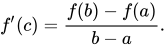
The mean value theorem is a generalization of Rolle's theorem, which assumes , so that the right-hand side above is zero.

The mean value theorem is still valid in a slightly more general setting. One only needs to assume that is continuous on , and that for every in the limit

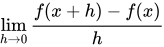
exists as a finite number or equals or . If finite, that limit equals . An example where this version of the theorem applies is given by the real-valued cube root function mapping , whose derivative tends to infinity at the origin.


Proof
[edit | edit source]The expression gives the slope of the line joining the points and , which is a chord of the graph of , while gives the slope of the tangent to the curve at the point . Thus the mean value theorem says that given any chord of a smooth curve, we can find a point on the curve lying between the end-points of the chord such that the tangent of the curve at that point is parallel to the chord. The following proof illustrates this idea.


Define , where is a constant. Since is continuous on and differentiable on , the same is true for . We now want to choose so that satisfies the conditions of Rolle's theorem. Namely



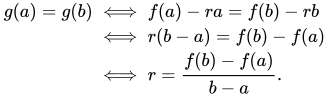
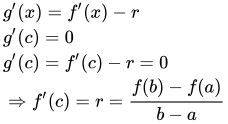
By Rolle's theorem, since is differentiable and , there is some in for which , and it follows from the equality that,


Implications
[edit | edit source]Theorem 1: Assume that is a continuous, real-valued function, defined on an arbitrary interval of the real line. If the derivative of at every interior point of the interval exists and is zero, then is constant on .

Proof: Assume the derivative of at every interior point of the interval exists and is zero. Let be an arbitrary open interval in . By the mean value theorem, there exists a point in such that
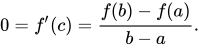
This implies that . Thus, is constant on the interior of and thus is constant on by continuity. (See below for a multivariable version of this result.)
Remarks:
- Only continuity of , not differentiability, is needed at the endpoints of the interval . No hypothesis of continuity needs to be stated if is an open interval, since the existence of a derivative at a point implies the continuity at this point. (See the section continuity and differentiability of the article derivative.)
- The differentiability of can be relaxed to one-sided differentiability, a proof is given in the article on semi-differentiability.
Theorem 2: If for all in an interval of the domain of these functions, then is constant, i.e. where is a constant on .
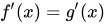


Proof: Let , then on the interval , so the above theorem 1 tells that is a constant or .


Theorem 3: If is an antiderivative of on an interval , then the most general antiderivative of on is where is a constant.


Proof: It directly follows from the theorem 2 above.
Cauchy's mean value theorem
[edit | edit source]Cauchy's mean value theorem, also known as the extended mean value theorem, is a generalization of the mean value theorem.[6][7] It states: if the functions and are both continuous on the closed interval Failed to parse (SVG (MathML can be enabled via browser plugin): Invalid response ("Math extension cannot connect to Restbase.") from server "https://wikimedia.org/api/rest_v1/":): {\displaystyle [a,b]} and differentiable on the open interval , then there exists some Failed to parse (SVG (MathML can be enabled via browser plugin): Invalid response ("Math extension cannot connect to Restbase.") from server "https://wikimedia.org/api/rest_v1/":): {\displaystyle c \in (a,b)} , such that
- Failed to parse (SVG (MathML can be enabled via browser plugin): Invalid response ("Math extension cannot connect to Restbase.") from server "https://wikimedia.org/api/rest_v1/":): {\displaystyle (f(b)-f(a))g'(c)=(g(b)-g(a))f'(c).}
Of course, if Failed to parse (SVG (MathML can be enabled via browser plugin): Invalid response ("Math extension cannot connect to Restbase.") from server "https://wikimedia.org/api/rest_v1/":): {\displaystyle g(a) \neq g(b)} and Failed to parse (SVG (MathML can be enabled via browser plugin): Invalid response ("Math extension cannot connect to Restbase.") from server "https://wikimedia.org/api/rest_v1/":): {\displaystyle g'(c) \neq 0} , this is equivalent to:
- Failed to parse (SVG (MathML can be enabled via browser plugin): Invalid response ("Math extension cannot connect to Restbase.") from server "https://wikimedia.org/api/rest_v1/":): {\displaystyle \frac{f'(c)}{g'(c)}=\frac{f(b)-f(a)}{g(b)-g(a)}.}
Geometrically, this means that there is some tangent to the graph of the curve[8]
- Failed to parse (SVG (MathML can be enabled via browser plugin): Invalid response ("Math extension cannot connect to Restbase.") from server "https://wikimedia.org/api/rest_v1/":): {\displaystyle \begin{cases}[a,b] \to \R^2\\t\mapsto (f(t),g(t))\end{cases}}
which is parallel to the line defined by the points Failed to parse (SVG (MathML can be enabled via browser plugin): Invalid response ("Math extension cannot connect to Restbase.") from server "https://wikimedia.org/api/rest_v1/":): {\displaystyle (f(a), g(a))} and Failed to parse (SVG (MathML can be enabled via browser plugin): Invalid response ("Math extension cannot connect to Restbase.") from server "https://wikimedia.org/api/rest_v1/":): {\displaystyle (f(b), g(b))} . However, Cauchy's theorem does not claim the existence of such a tangent in all cases where Failed to parse (SVG (MathML can be enabled via browser plugin): Invalid response ("Math extension cannot connect to Restbase.") from server "https://wikimedia.org/api/rest_v1/":): {\displaystyle (f(a), g(a))} and Failed to parse (SVG (MathML can be enabled via browser plugin): Invalid response ("Math extension cannot connect to Restbase.") from server "https://wikimedia.org/api/rest_v1/":): {\displaystyle (f(b), g(b))} are distinct points, since it might be satisfied only for some value Failed to parse (SVG (MathML can be enabled via browser plugin): Invalid response ("Math extension cannot connect to Restbase.") from server "https://wikimedia.org/api/rest_v1/":): {\displaystyle c} with Failed to parse (SVG (MathML can be enabled via browser plugin): Invalid response ("Math extension cannot connect to Restbase.") from server "https://wikimedia.org/api/rest_v1/":): {\displaystyle f'(c) = g'(c) = 0} , in other words a value for which the mentioned curve is stationary; in such points no tangent to the curve is likely to be defined at all. An example of this situation is the curve given by
- Failed to parse (SVG (MathML can be enabled via browser plugin): Invalid response ("Math extension cannot connect to Restbase.") from server "https://wikimedia.org/api/rest_v1/":): {\displaystyle t \mapsto \left(t^3,1-t^2\right),}
which on the interval Failed to parse (SVG (MathML can be enabled via browser plugin): Invalid response ("Math extension cannot connect to Restbase.") from server "https://wikimedia.org/api/rest_v1/":): {\displaystyle [-1,1]} goes from the point Failed to parse (SVG (MathML can be enabled via browser plugin): Invalid response ("Math extension cannot connect to Restbase.") from server "https://wikimedia.org/api/rest_v1/":): {\displaystyle (-1, 0)} to Failed to parse (SVG (MathML can be enabled via browser plugin): Invalid response ("Math extension cannot connect to Restbase.") from server "https://wikimedia.org/api/rest_v1/":): {\displaystyle (1, 0)} , yet never has a horizontal tangent; however it has a stationary point (in fact a cusp) at Failed to parse (SVG (MathML can be enabled via browser plugin): Invalid response ("Math extension cannot connect to Restbase.") from server "https://wikimedia.org/api/rest_v1/":): {\displaystyle t = 0} .
Cauchy's mean value theorem can be used to prove L'Hôpital's rule. The mean value theorem is the special case of Cauchy's mean value theorem when Failed to parse (SVG (MathML can be enabled via browser plugin): Invalid response ("Math extension cannot connect to Restbase.") from server "https://wikimedia.org/api/rest_v1/":): {\displaystyle g(t) = t} .
Proof
[edit | edit source]The proof of Cauchy's mean value theorem is based on the same idea as the proof of the mean value theorem.
Define Failed to parse (SVG (MathML can be enabled via browser plugin): Invalid response ("Math extension cannot connect to Restbase.") from server "https://wikimedia.org/api/rest_v1/":): {\displaystyle h(x) = (g(b)-g(a))f(x) - (f(b)-f(a))g(x)} , then we easily see Failed to parse (SVG (MathML can be enabled via browser plugin): Invalid response ("Math extension cannot connect to Restbase.") from server "https://wikimedia.org/api/rest_v1/":): {\displaystyle h(a)=h(b)=f(a)g(b)-f(b)g(a)} .
Since Failed to parse (SVG (MathML can be enabled via browser plugin): Invalid response ("Math extension cannot connect to Restbase.") from server "https://wikimedia.org/api/rest_v1/":): {\displaystyle f} and Failed to parse (SVG (MathML can be enabled via browser plugin): Invalid response ("Math extension cannot connect to Restbase.") from server "https://wikimedia.org/api/rest_v1/":): {\displaystyle g} are continuous on Failed to parse (SVG (MathML can be enabled via browser plugin): Invalid response ("Math extension cannot connect to Restbase.") from server "https://wikimedia.org/api/rest_v1/":): {\displaystyle [a,b]} and differentiable on Failed to parse (SVG (MathML can be enabled via browser plugin): Invalid response ("Math extension cannot connect to Restbase.") from server "https://wikimedia.org/api/rest_v1/":): {\displaystyle (a,b)} , the same is true for Failed to parse (SVG (MathML can be enabled via browser plugin): Invalid response ("Math extension cannot connect to Restbase.") from server "https://wikimedia.org/api/rest_v1/":): {\displaystyle h} . All in all, Failed to parse (SVG (MathML can be enabled via browser plugin): Invalid response ("Math extension cannot connect to Restbase.") from server "https://wikimedia.org/api/rest_v1/":): {\displaystyle h} satisfies the conditions of Rolle's theorem. Consequently, there is some Failed to parse (SVG (MathML can be enabled via browser plugin): Invalid response ("Math extension cannot connect to Restbase.") from server "https://wikimedia.org/api/rest_v1/":): {\displaystyle c} in Failed to parse (SVG (MathML can be enabled via browser plugin): Invalid response ("Math extension cannot connect to Restbase.") from server "https://wikimedia.org/api/rest_v1/":): {\displaystyle (a,b)} for which Failed to parse (SVG (MathML can be enabled via browser plugin): Invalid response ("Math extension cannot connect to Restbase.") from server "https://wikimedia.org/api/rest_v1/":): {\displaystyle h'(c) = 0} . Now using the definition of Failed to parse (SVG (MathML can be enabled via browser plugin): Invalid response ("Math extension cannot connect to Restbase.") from server "https://wikimedia.org/api/rest_v1/":): {\displaystyle h} we have:
- Failed to parse (SVG (MathML can be enabled via browser plugin): Invalid response ("Math extension cannot connect to Restbase.") from server "https://wikimedia.org/api/rest_v1/":): {\displaystyle 0=h'(c)=(g(b)-g(a))f'(c)-(f(b)-f(a))g'(c)}
The result easily follows.
Mean value theorem in several variables
[edit | edit source]The mean value theorem generalizes to real functions of multiple variables. The trick is to use parametrization to create a real function of one variable, and then apply the one-variable theorem.
Let Failed to parse (SVG (MathML can be enabled via browser plugin): Invalid response ("Math extension cannot connect to Restbase.") from server "https://wikimedia.org/api/rest_v1/":): {\displaystyle G} be an open subset of Failed to parse (SVG (MathML can be enabled via browser plugin): Invalid response ("Math extension cannot connect to Restbase.") from server "https://wikimedia.org/api/rest_v1/":): {\displaystyle \R^n} , and let Failed to parse (SVG (MathML can be enabled via browser plugin): Invalid response ("Math extension cannot connect to Restbase.") from server "https://wikimedia.org/api/rest_v1/":): {\displaystyle f:G\to\R} be a differentiable function. Fix points Failed to parse (SVG (MathML can be enabled via browser plugin): Invalid response ("Math extension cannot connect to Restbase.") from server "https://wikimedia.org/api/rest_v1/":): {\displaystyle x,y\in G} such that the line segment between Failed to parse (SVG (MathML can be enabled via browser plugin): Invalid response ("Math extension cannot connect to Restbase.") from server "https://wikimedia.org/api/rest_v1/":): {\displaystyle x, y} lies in Failed to parse (SVG (MathML can be enabled via browser plugin): Invalid response ("Math extension cannot connect to Restbase.") from server "https://wikimedia.org/api/rest_v1/":): {\displaystyle G} , and define Failed to parse (SVG (MathML can be enabled via browser plugin): Invalid response ("Math extension cannot connect to Restbase.") from server "https://wikimedia.org/api/rest_v1/":): {\displaystyle g(t)=f\big((1-t)x+ty\big)} . Since Failed to parse (SVG (MathML can be enabled via browser plugin): Invalid response ("Math extension cannot connect to Restbase.") from server "https://wikimedia.org/api/rest_v1/":): {\displaystyle g} is a differentiable function in one variable, the mean value theorem gives:
- Failed to parse (SVG (MathML can be enabled via browser plugin): Invalid response ("Math extension cannot connect to Restbase.") from server "https://wikimedia.org/api/rest_v1/":): {\displaystyle g(1)-g(0)=g'(c)}
for some Failed to parse (SVG (MathML can be enabled via browser plugin): Invalid response ("Math extension cannot connect to Restbase.") from server "https://wikimedia.org/api/rest_v1/":): {\displaystyle c} between 0 and 1. But since Failed to parse (SVG (MathML can be enabled via browser plugin): Invalid response ("Math extension cannot connect to Restbase.") from server "https://wikimedia.org/api/rest_v1/":): {\displaystyle g(1)=f(y)} and Failed to parse (SVG (MathML can be enabled via browser plugin): Invalid response ("Math extension cannot connect to Restbase.") from server "https://wikimedia.org/api/rest_v1/":): {\displaystyle g(0)=f(x)} , computing Failed to parse (SVG (MathML can be enabled via browser plugin): Invalid response ("Math extension cannot connect to Restbase.") from server "https://wikimedia.org/api/rest_v1/":): {\displaystyle g'(c)} explicitly we have:
- Failed to parse (SVG (MathML can be enabled via browser plugin): Invalid response ("Math extension cannot connect to Restbase.") from server "https://wikimedia.org/api/rest_v1/":): {\displaystyle f(y)-f(x)=\nabla f\big((1-c)x+cy\big)\cdot (y-x)}
where Failed to parse (SVG (MathML can be enabled via browser plugin): Invalid response ("Math extension cannot connect to Restbase.") from server "https://wikimedia.org/api/rest_v1/":): {\displaystyle \nabla} denotes a gradient and Failed to parse (SVG (MathML can be enabled via browser plugin): Invalid response ("Math extension cannot connect to Restbase.") from server "https://wikimedia.org/api/rest_v1/":): {\displaystyle \cdot} a dot product. This is an exact analog of the theorem in one variable (in the case Failed to parse (SVG (MathML can be enabled via browser plugin): Invalid response ("Math extension cannot connect to Restbase.") from server "https://wikimedia.org/api/rest_v1/":): {\displaystyle n=1} this is the theorem in one variable). By the Cauchy–Schwarz inequality, the equation gives the estimate:
- Failed to parse (SVG (MathML can be enabled via browser plugin): Invalid response ("Math extension cannot connect to Restbase.") from server "https://wikimedia.org/api/rest_v1/":): {\displaystyle \Bigl|f(y)-f(x)\Bigr| \le \Bigl|\nabla f\big((1-c)x+cy\big)\Bigr|\ \Bigl|y - x\Bigr|.}
In particular, when Failed to parse (SVG (MathML can be enabled via browser plugin): Invalid response ("Math extension cannot connect to Restbase.") from server "https://wikimedia.org/api/rest_v1/":): {\displaystyle G} is convex and the partial derivatives of Failed to parse (SVG (MathML can be enabled via browser plugin): Invalid response ("Math extension cannot connect to Restbase.") from server "https://wikimedia.org/api/rest_v1/":): {\displaystyle f} are bounded, Failed to parse (SVG (MathML can be enabled via browser plugin): Invalid response ("Math extension cannot connect to Restbase.") from server "https://wikimedia.org/api/rest_v1/":): {\displaystyle f} is Lipschitz continuous (and therefore uniformly continuous).
As an application of the above, we prove that Failed to parse (SVG (MathML can be enabled via browser plugin): Invalid response ("Math extension cannot connect to Restbase.") from server "https://wikimedia.org/api/rest_v1/":): {\displaystyle f} is constant if the open subset Failed to parse (SVG (MathML can be enabled via browser plugin): Invalid response ("Math extension cannot connect to Restbase.") from server "https://wikimedia.org/api/rest_v1/":): {\displaystyle G} is connected and every partial derivative of Failed to parse (SVG (MathML can be enabled via browser plugin): Invalid response ("Math extension cannot connect to Restbase.") from server "https://wikimedia.org/api/rest_v1/":): {\displaystyle f} is 0. Pick some point Failed to parse (SVG (MathML can be enabled via browser plugin): Invalid response ("Math extension cannot connect to Restbase.") from server "https://wikimedia.org/api/rest_v1/":): {\displaystyle x_0\in G} , and let Failed to parse (SVG (MathML can be enabled via browser plugin): Invalid response ("Math extension cannot connect to Restbase.") from server "https://wikimedia.org/api/rest_v1/":): {\displaystyle g(x)=f(x)-f(x_0)} . We want to show for every . For that, let . Then is closed in and nonempty. It is open too: for every ,






for every in open ball centered at and contained in Failed to parse (SVG (MathML can be enabled via browser plugin): Invalid response ("Math extension cannot connect to Restbase.") from server "https://wikimedia.org/api/rest_v1/":): {\displaystyle G} . Since Failed to parse (SVG (MathML can be enabled via browser plugin): Invalid response ("Math extension cannot connect to Restbase.") from server "https://wikimedia.org/api/rest_v1/":): {\displaystyle G} is connected, we conclude Failed to parse (SVG (MathML can be enabled via browser plugin): Invalid response ("Math extension cannot connect to Restbase.") from server "https://wikimedia.org/api/rest_v1/":): {\displaystyle E=G} .


The above arguments are made in a coordinate-free manner; hence, they generalize to the case when Failed to parse (SVG (MathML can be enabled via browser plugin): Invalid response ("Math extension cannot connect to Restbase.") from server "https://wikimedia.org/api/rest_v1/":): {\displaystyle G} is a subset of a Banach space.
Mean value theorem for vector-valued functions
[edit | edit source]There is no exact analog of the mean value theorem for vector-valued functions (see below). However, there is an inequality which can be applied to many of the same situations to which the mean value theorem is applicable in the one dimensional case:[9]
Mean value inequality
[edit | edit source]Jean Dieudonné in his classic treatise Foundations of Modern Analysis discards the mean value theorem and replaces it by mean inequality as the proof is not constructive and one cannot find the mean value and in applications one only needs mean inequality. Serge Lang in Analysis I uses the mean value theorem, in integral form, as an instant reflex but this use requires the continuity of the derivative. If one uses the Henstock–Kurzweil integral one can have the mean value theorem in integral form without the additional assumption that derivative should be continuous as every derivative is Henstock–Kurzweil integrable.
The reason why there is no analog of mean value equality is the following: If f : U → Rm is a differentiable function (where U ⊂ Rn is open) and if x + th, x, h ∈ Rn, t ∈ [0, 1] is the line segment in question (lying inside U), then one can apply the above parametrization procedure to each of the component functions fi (i = 1, …, m) of f (in the above notation set y = x + h). In doing so one finds points x + tih on the line segment satisfying
- Failed to parse (SVG (MathML can be enabled via browser plugin): Invalid response ("Math extension cannot connect to Restbase.") from server "https://wikimedia.org/api/rest_v1/":): {\displaystyle f_i(x+h) - f_i(x) = \nabla f_i (x + t_ih) \cdot h.}
But generally there will not be a single point x + t*h on the line segment satisfying
- Failed to parse (SVG (MathML can be enabled via browser plugin): Invalid response ("Math extension cannot connect to Restbase.") from server "https://wikimedia.org/api/rest_v1/":): {\displaystyle f_i(x+h) - f_i(x) = \nabla f_i (x + t^* h) \cdot h.}
for all i simultaneously. For example, define:
- Failed to parse (SVG (MathML can be enabled via browser plugin): Invalid response ("Math extension cannot connect to Restbase.") from server "https://wikimedia.org/api/rest_v1/":): {\displaystyle \begin{cases} f : [0, 2 \pi] \to \R^2 \\ f(x) = (\cos(x), \sin(x)) \end{cases}}
Then Failed to parse (SVG (MathML can be enabled via browser plugin): Invalid response ("Math extension cannot connect to Restbase.") from server "https://wikimedia.org/api/rest_v1/":): {\displaystyle f(2\pi) - f(0) = \mathbf{0} \in \R^2} , but Failed to parse (SVG (MathML can be enabled via browser plugin): Invalid response ("Math extension cannot connect to Restbase.") from server "https://wikimedia.org/api/rest_v1/":): {\displaystyle f_1'(x) = -\sin (x)} and Failed to parse (SVG (MathML can be enabled via browser plugin): Invalid response ("Math extension cannot connect to Restbase.") from server "https://wikimedia.org/api/rest_v1/":): {\displaystyle f_2'(x) = \cos (x)} are never simultaneously zero as Failed to parse (SVG (MathML can be enabled via browser plugin): Invalid response ("Math extension cannot connect to Restbase.") from server "https://wikimedia.org/api/rest_v1/":): {\displaystyle x} ranges over Failed to parse (SVG (MathML can be enabled via browser plugin): Invalid response ("Math extension cannot connect to Restbase.") from server "https://wikimedia.org/api/rest_v1/":): {\displaystyle \left[0, 2 \pi\right]} .
The above theorem implies the following: Template:Math theorem
In fact, the above statement suffices for many applications and can be proved directly as follows. (We shall write Failed to parse (SVG (MathML can be enabled via browser plugin): Invalid response ("Math extension cannot connect to Restbase.") from server "https://wikimedia.org/api/rest_v1/":): {\displaystyle f} for Failed to parse (SVG (MathML can be enabled via browser plugin): Invalid response ("Math extension cannot connect to Restbase.") from server "https://wikimedia.org/api/rest_v1/":): {\displaystyle \textbf{f}} for readability.) Template:Math proof
Cases where the theorem cannot be applied
[edit | edit source]All conditions for the mean value theorem are necessary:
- Failed to parse (SVG (MathML can be enabled via browser plugin): Invalid response ("Math extension cannot connect to Restbase.") from server "https://wikimedia.org/api/rest_v1/":): {\displaystyle \boldsymbol{f} } is differentiable on Failed to parse (SVG (MathML can be enabled via browser plugin): Invalid response ("Math extension cannot connect to Restbase.") from server "https://wikimedia.org/api/rest_v1/":): {\displaystyle \boldsymbol{(a,b)} }
- Failed to parse (SVG (MathML can be enabled via browser plugin): Invalid response ("Math extension cannot connect to Restbase.") from server "https://wikimedia.org/api/rest_v1/":): {\displaystyle \boldsymbol{f} } is continuous on Failed to parse (SVG (MathML can be enabled via browser plugin): Invalid response ("Math extension cannot connect to Restbase.") from server "https://wikimedia.org/api/rest_v1/":): {\displaystyle \boldsymbol{[a,b]} }
- Failed to parse (SVG (MathML can be enabled via browser plugin): Invalid response ("Math extension cannot connect to Restbase.") from server "https://wikimedia.org/api/rest_v1/":): {\displaystyle \boldsymbol{f} } is real-valued
When one of the above conditions is not satisfied, the mean value theorem is not valid in general, and so it cannot be applied.

The necessity of the first condition can be seen by the counterexample where the function Failed to parse (SVG (MathML can be enabled via browser plugin): Invalid response ("Math extension cannot connect to Restbase.") from server "https://wikimedia.org/api/rest_v1/":): {\displaystyle f} given by Failed to parse (SVG (MathML can be enabled via browser plugin): Invalid response ("Math extension cannot connect to Restbase.") from server "https://wikimedia.org/api/rest_v1/":): {\displaystyle f(x)=|x| } on Failed to parse (SVG (MathML can be enabled via browser plugin): Invalid response ("Math extension cannot connect to Restbase.") from server "https://wikimedia.org/api/rest_v1/":): {\displaystyle [-1,1]} is non-differentiable at at least one point in Failed to parse (SVG (MathML can be enabled via browser plugin): Invalid response ("Math extension cannot connect to Restbase.") from server "https://wikimedia.org/api/rest_v1/":): {\displaystyle (-1,1)} .
The necessity of the second condition can be seen by the counterexample where the function Failed to parse (SVG (MathML can be enabled via browser plugin): Invalid response ("Math extension cannot connect to Restbase.") from server "https://wikimedia.org/api/rest_v1/":): {\displaystyle f} given by Failed to parse (SVG (MathML can be enabled via browser plugin): Invalid response ("Math extension cannot connect to Restbase.") from server "https://wikimedia.org/api/rest_v1/":): {\displaystyle f(x) = \begin{cases} 1, & \text{at }x=0 \\ 0, & \text{if }x\in( 0,1] \end{cases} } satisfies criteria 1 since Failed to parse (SVG (MathML can be enabled via browser plugin): Invalid response ("Math extension cannot connect to Restbase.") from server "https://wikimedia.org/api/rest_v1/":): {\displaystyle f'(x)=0 } on Failed to parse (SVG (MathML can be enabled via browser plugin): Invalid response ("Math extension cannot connect to Restbase.") from server "https://wikimedia.org/api/rest_v1/":): {\displaystyle (0,1) } but not criteria 2 since Failed to parse (SVG (MathML can be enabled via browser plugin): Invalid response ("Math extension cannot connect to Restbase.") from server "https://wikimedia.org/api/rest_v1/":): {\displaystyle f} is not left-continuous at Failed to parse (SVG (MathML can be enabled via browser plugin): Invalid response ("Math extension cannot connect to Restbase.") from server "https://wikimedia.org/api/rest_v1/":): {\displaystyle 0} . The average rate of change of Failed to parse (SVG (MathML can be enabled via browser plugin): Invalid response ("Math extension cannot connect to Restbase.") from server "https://wikimedia.org/api/rest_v1/":): {\displaystyle f} over Failed to parse (SVG (MathML can be enabled via browser plugin): Invalid response ("Math extension cannot connect to Restbase.") from server "https://wikimedia.org/api/rest_v1/":): {\displaystyle [0,1]} is given by Failed to parse (SVG (MathML can be enabled via browser plugin): Invalid response ("Math extension cannot connect to Restbase.") from server "https://wikimedia.org/api/rest_v1/":): {\displaystyle \frac{f(1)-f(0)}{1-0}=-1 } but there doesn't exist Failed to parse (SVG (MathML can be enabled via browser plugin): Invalid response ("Math extension cannot connect to Restbase.") from server "https://wikimedia.org/api/rest_v1/":): {\displaystyle x\in (0,1) } such that Failed to parse (SVG (MathML can be enabled via browser plugin): Invalid response ("Math extension cannot connect to Restbase.") from server "https://wikimedia.org/api/rest_v1/":): {\displaystyle f'(x)=-1} , so the theorem doesn't hold.
The theorem is false if a differentiable function is complex-valued instead of real-valued. For example, if Failed to parse (SVG (MathML can be enabled via browser plugin): Invalid response ("Math extension cannot connect to Restbase.") from server "https://wikimedia.org/api/rest_v1/":): {\displaystyle f(x) = e^{xi}} for all real Failed to parse (SVG (MathML can be enabled via browser plugin): Invalid response ("Math extension cannot connect to Restbase.") from server "https://wikimedia.org/api/rest_v1/":): {\displaystyle x} , then Failed to parse (SVG (MathML can be enabled via browser plugin): Invalid response ("Math extension cannot connect to Restbase.") from server "https://wikimedia.org/api/rest_v1/":): {\displaystyle f(2\pi)-f(0)=0=0(2\pi-0)} while Failed to parse (SVG (MathML can be enabled via browser plugin): Invalid response ("Math extension cannot connect to Restbase.") from server "https://wikimedia.org/api/rest_v1/":): {\displaystyle f'(x)\ne 0} for any real Failed to parse (SVG (MathML can be enabled via browser plugin): Invalid response ("Math extension cannot connect to Restbase.") from server "https://wikimedia.org/api/rest_v1/":): {\displaystyle x} .
Mean value theorems for definite integrals
[edit | edit source]First mean value theorem for definite integrals
[edit | edit source]
Let f : [a, b] → R be a continuous function. Then there exists c in (a, b) such that
- Failed to parse (SVG (MathML can be enabled via browser plugin): Invalid response ("Math extension cannot connect to Restbase.") from server "https://wikimedia.org/api/rest_v1/":): {\displaystyle \int_a^b f(x) \, dx = f(c)(b - a).}
This follows at once from the fundamental theorem of calculus, together with the mean value theorem for derivatives. Since the mean value of f on [a, b] is defined as
- Failed to parse (SVG (MathML can be enabled via browser plugin): Invalid response ("Math extension cannot connect to Restbase.") from server "https://wikimedia.org/api/rest_v1/":): {\displaystyle \frac{1}{b-a} \int_a^b f(x) \, dx,}
we can interpret the conclusion as f achieves its mean value at some c in (a, b).[11]
In general, if f : [a, b] → R is continuous and g is an integrable function that does not change sign on [a, b], then there exists c in (a, b) such that
- Failed to parse (SVG (MathML can be enabled via browser plugin): Invalid response ("Math extension cannot connect to Restbase.") from server "https://wikimedia.org/api/rest_v1/":): {\displaystyle \int_a^b f(x) g(x) \, dx = f(c) \int_a^b g(x) \, dx.}
Second mean value theorem for definite integrals
[edit | edit source]There are various slightly different theorems called the second mean value theorem for definite integrals. A commonly found version is as follows:
- If Failed to parse (SVG (MathML can be enabled via browser plugin): Invalid response ("Math extension cannot connect to Restbase.") from server "https://wikimedia.org/api/rest_v1/":): {\displaystyle G : [a,b]\to \mathbb{R}}
is a positive monotonically decreasing function and Failed to parse (SVG (MathML can be enabled via browser plugin): Invalid response ("Math extension cannot connect to Restbase.") from server "https://wikimedia.org/api/rest_v1/":): {\displaystyle \varphi : [a,b]\to \mathbb{R}}
is an integrable function, then there exists a number x in (a, b] such that
- Failed to parse (SVG (MathML can be enabled via browser plugin): Invalid response ("Math extension cannot connect to Restbase.") from server "https://wikimedia.org/api/rest_v1/":): {\displaystyle \int_a^b G(t)\varphi(t)\,dt = G(a^+) \int_a^x \varphi(t)\,dt. }
Here Failed to parse (SVG (MathML can be enabled via browser plugin): Invalid response ("Math extension cannot connect to Restbase.") from server "https://wikimedia.org/api/rest_v1/":): {\displaystyle G(a^+)} stands for Failed to parse (SVG (MathML can be enabled via browser plugin): Invalid response ("Math extension cannot connect to Restbase.") from server "https://wikimedia.org/api/rest_v1/":): {\textstyle {\lim_{x\to a^+}G(x)}} , the existence of which follows from the conditions. Note that it is essential that the interval (a, b] contains b. A variant not having this requirement is:[12]
- If Failed to parse (SVG (MathML can be enabled via browser plugin): Invalid response ("Math extension cannot connect to Restbase.") from server "https://wikimedia.org/api/rest_v1/":): {\displaystyle G : [a,b]\to \mathbb{R}}
is a monotonic (not necessarily decreasing and positive) function and Failed to parse (SVG (MathML can be enabled via browser plugin): Invalid response ("Math extension cannot connect to Restbase.") from server "https://wikimedia.org/api/rest_v1/":): {\displaystyle \varphi : [a,b]\to \mathbb{R}}
is an integrable function, then there exists a number x in (a, b) such that
- Failed to parse (SVG (MathML can be enabled via browser plugin): Invalid response ("Math extension cannot connect to Restbase.") from server "https://wikimedia.org/api/rest_v1/":): {\displaystyle \int_a^b G(t)\varphi(t)\,dt = G(a^+) \int_a^x \varphi(t)\,dt + G(b^-) \int_x^b \varphi(t)\,dt. }
If the function Failed to parse (SVG (MathML can be enabled via browser plugin): Invalid response ("Math extension cannot connect to Restbase.") from server "https://wikimedia.org/api/rest_v1/":): {\displaystyle G} returns a multi-dimensional vector, then the MVT for integration is not true, even if the domain of Failed to parse (SVG (MathML can be enabled via browser plugin): Invalid response ("Math extension cannot connect to Restbase.") from server "https://wikimedia.org/api/rest_v1/":): {\displaystyle G} is also multi-dimensional.
For example, consider the following 2-dimensional function defined on an Failed to parse (SVG (MathML can be enabled via browser plugin): Invalid response ("Math extension cannot connect to Restbase.") from server "https://wikimedia.org/api/rest_v1/":): {\displaystyle n} -dimensional cube:
- Failed to parse (SVG (MathML can be enabled via browser plugin): Invalid response ("Math extension cannot connect to Restbase.") from server "https://wikimedia.org/api/rest_v1/":): {\displaystyle \begin{cases} G: [0,2\pi]^n \to \R^2 \\ G(x_1, \dots, x_n) = \left(\sin(x_1 + \cdots + x_n), \cos(x_1 + \cdots + x_n) \right) \end{cases} }
Then, by symmetry it is easy to see that the mean value of Failed to parse (SVG (MathML can be enabled via browser plugin): Invalid response ("Math extension cannot connect to Restbase.") from server "https://wikimedia.org/api/rest_v1/":): {\displaystyle G} over its domain is (0,0):
- Failed to parse (SVG (MathML can be enabled via browser plugin): Invalid response ("Math extension cannot connect to Restbase.") from server "https://wikimedia.org/api/rest_v1/":): {\displaystyle \int_{[0,2\pi]^n} G(x_1,\dots,x_n) dx_1 \cdots dx_n = (0,0)}
However, there is no point in which Failed to parse (SVG (MathML can be enabled via browser plugin): Invalid response ("Math extension cannot connect to Restbase.") from server "https://wikimedia.org/api/rest_v1/":): {\displaystyle G=(0,0)} , because Failed to parse (SVG (MathML can be enabled via browser plugin): Invalid response ("Math extension cannot connect to Restbase.") from server "https://wikimedia.org/api/rest_v1/":): {\displaystyle |G|=1} everywhere.
Generalizations
[edit | edit source]Linear algebra
[edit | edit source]Assume that Failed to parse (SVG (MathML can be enabled via browser plugin): Invalid response ("Math extension cannot connect to Restbase.") from server "https://wikimedia.org/api/rest_v1/":): {\displaystyle f, g,} and Failed to parse (SVG (MathML can be enabled via browser plugin): Invalid response ("Math extension cannot connect to Restbase.") from server "https://wikimedia.org/api/rest_v1/":): {\displaystyle h} are differentiable functions on Failed to parse (SVG (MathML can be enabled via browser plugin): Invalid response ("Math extension cannot connect to Restbase.") from server "https://wikimedia.org/api/rest_v1/":): {\displaystyle (a,b)} that are continuous on Failed to parse (SVG (MathML can be enabled via browser plugin): Invalid response ("Math extension cannot connect to Restbase.") from server "https://wikimedia.org/api/rest_v1/":): {\displaystyle [a,b]} . Define
- Failed to parse (SVG (MathML can be enabled via browser plugin): Invalid response ("Math extension cannot connect to Restbase.") from server "https://wikimedia.org/api/rest_v1/":): {\displaystyle D(x) = \begin{vmatrix} f(x) & g(x) & h(x)\\ f(a) & g(a) & h(a)\\ f(b) & g(b) & h(b) \end{vmatrix}}
There exists Failed to parse (SVG (MathML can be enabled via browser plugin): Invalid response ("Math extension cannot connect to Restbase.") from server "https://wikimedia.org/api/rest_v1/":): {\displaystyle c\in(a,b)} such that Failed to parse (SVG (MathML can be enabled via browser plugin): Invalid response ("Math extension cannot connect to Restbase.") from server "https://wikimedia.org/api/rest_v1/":): {\displaystyle D'(c)=0} .
Notice that
- Failed to parse (SVG (MathML can be enabled via browser plugin): Invalid response ("Math extension cannot connect to Restbase.") from server "https://wikimedia.org/api/rest_v1/":): {\displaystyle D'(x) = \begin{vmatrix} f'(x) & g'(x)& h'(x)\\ f(a) & g(a) & h(a)\\ f(b) & g(b)& h(b) \end{vmatrix}}
and if we place Failed to parse (SVG (MathML can be enabled via browser plugin): Invalid response ("Math extension cannot connect to Restbase.") from server "https://wikimedia.org/api/rest_v1/":): {\displaystyle h(x)=1} , we get Cauchy's mean value theorem. If we place Failed to parse (SVG (MathML can be enabled via browser plugin): Invalid response ("Math extension cannot connect to Restbase.") from server "https://wikimedia.org/api/rest_v1/":): {\displaystyle h(x)=1} and Failed to parse (SVG (MathML can be enabled via browser plugin): Invalid response ("Math extension cannot connect to Restbase.") from server "https://wikimedia.org/api/rest_v1/":): {\displaystyle g(x)=x} we get Lagrange's mean value theorem.
The proof of the generalization is quite simple: each of Failed to parse (SVG (MathML can be enabled via browser plugin): Invalid response ("Math extension cannot connect to Restbase.") from server "https://wikimedia.org/api/rest_v1/":): {\displaystyle D(a)} and Failed to parse (SVG (MathML can be enabled via browser plugin): Invalid response ("Math extension cannot connect to Restbase.") from server "https://wikimedia.org/api/rest_v1/":): {\displaystyle D(b)} are determinants with two identical rows, hence Failed to parse (SVG (MathML can be enabled via browser plugin): Invalid response ("Math extension cannot connect to Restbase.") from server "https://wikimedia.org/api/rest_v1/":): {\displaystyle D(a)=D(b)=0} . Then Rolle's theorem implies that there exists Failed to parse (SVG (MathML can be enabled via browser plugin): Invalid response ("Math extension cannot connect to Restbase.") from server "https://wikimedia.org/api/rest_v1/":): {\displaystyle c\in (a,b)} such that Failed to parse (SVG (MathML can be enabled via browser plugin): Invalid response ("Math extension cannot connect to Restbase.") from server "https://wikimedia.org/api/rest_v1/":): {\displaystyle D'(c)=0} .
Probability theory
[edit | edit source]Let X and Y be non-negative random variables such that E[X] < E[Y] < ∞ and Failed to parse (SVG (MathML can be enabled via browser plugin): Invalid response ("Math extension cannot connect to Restbase.") from server "https://wikimedia.org/api/rest_v1/":): {\displaystyle X \leq_{st} Y} (i.e. X is smaller than Y in the usual stochastic order). Then there exists an absolutely continuous non-negative random variable Z having probability density function
- Failed to parse (SVG (MathML can be enabled via browser plugin): Invalid response ("Math extension cannot connect to Restbase.") from server "https://wikimedia.org/api/rest_v1/":): {\displaystyle f_Z(x)={\Pr(Y>x)-\Pr(X>x)\over {\rm E}[Y]-{\rm E}[X]}\,, \qquad x\geqslant 0.}
Let g be a measurable and differentiable function such that E[g(X)], E[g(Y)] < ∞, and let its derivative g′ be measurable and Riemann-integrable on the interval [x, y] for all y ≥ x ≥ 0. Then, E[g′(Z)] is finite and[13]
- Failed to parse (SVG (MathML can be enabled via browser plugin): Invalid response ("Math extension cannot connect to Restbase.") from server "https://wikimedia.org/api/rest_v1/":): {\displaystyle {\rm E}[g(Y)]-{\rm E}[g(X)]={\rm E}[g'(Z)]\,[{\rm E}(Y)-{\rm E}(X)].}
Complex analysis
[edit | edit source]As noted above, the theorem does not hold for differentiable complex-valued functions. Instead, a generalization of the theorem is stated such:[14]
Let f : Ω → C be a holomorphic function on the open convex set Ω, and let a and b be distinct points in Ω. Then there exist points u, v on the interior of the line segment from a to b such that
- Failed to parse (SVG (MathML can be enabled via browser plugin): Invalid response ("Math extension cannot connect to Restbase.") from server "https://wikimedia.org/api/rest_v1/":): {\displaystyle \operatorname{Re}(f'(u)) = \operatorname{Re}\left ( \frac{f(b)-f(a)}{b-a} \right),}
- Failed to parse (SVG (MathML can be enabled via browser plugin): Invalid response ("Math extension cannot connect to Restbase.") from server "https://wikimedia.org/api/rest_v1/":): {\displaystyle \operatorname{Im}(f'(v)) = \operatorname{Im}\left ( \frac{f(b)-f(a)}{b-a} \right).}
Where Re() is the real part and Im() is the imaginary part of a complex-valued function.
See also
[edit | edit source]- Intermediate value theorem
- Mean value problem
- Mean value theorem (divided differences)
- Newmark-beta method
- Racetrack principle
- Stolarsky mean
Notes
[edit | edit source]- ↑ J. J. O'Connor and E. F. Robertson (2000). Paramesvara, MacTutor History of Mathematics archive.
- ↑ Ádám Besenyei. "Historical development of the mean value theorem" (PDF).
- ↑ Lozada-Cruz, German (2020-10-02). "Some variants of Cauchy's mean value theorem". International Journal of Mathematical Education in Science and Technology. 51 (7): 1155–1163. Bibcode:2020IJMES..51.1155L. doi:10.1080/0020739X.2019.1703150. ISSN 0020-739X. S2CID 213335491.
- ↑ Sahoo, Prasanna. (1998). Mean value theorems and functional equations. Riedel, T. (Thomas), 1962-. Singapore: World Scientific. ISBN 981-02-3544-5. OCLC 40951137.
- ↑ Rudin 1976, p. 108.
- ↑ Weisstein, Eric W. "Extended Mean-Value Theorem". MathWorld.
- ↑ Rudin 1976, pp. 107–108.
- ↑ "Cauchy's Mean Value Theorem". Math24. Retrieved 2018-10-08.
- ↑ Rudin 1976, p. 113.
- ↑ "Mathwords: Mean Value Theorem for Integrals". www.mathwords.com.
- ↑ Michael Comenetz (2002). Calculus: The Elements. World Scientific. p. 159. ISBN 978-981-02-4904-5.
- ↑ Hobson, E. W. (1909). "On the Second Mean-Value Theorem of the Integral Calculus". Proc. London Math. Soc. S2–7 (1): 14–23. Bibcode:1909PLMS...27...14H. doi:10.1112/plms/s2-7.1.14. MR 1575669.
- ↑ Di Crescenzo, A. (1999). "A Probabilistic Analogue of the Mean Value Theorem and Its Applications to Reliability Theory". J. Appl. Probab. 36 (3): 706–719. doi:10.1239/jap/1032374628. JSTOR 3215435. S2CID 250351233 Check
|s2cid=value (help). - ↑ 1 J.-Cl. Evard, F. Jafari, A Complex Rolle’s Theorem, American Mathematical Monthly, Vol. 99, Issue 9, (Nov. 1992), pp. 858-861.
References
[edit | edit source]- Rudin, Walter (1976). Principles of Mathematical Analysis. Auckland: McGraw-Hill Publishing Company. ISBN 978-0-07-085613-4.
- Hörmander, Lars (2015), The Analysis of Linear Partial Differential Operators I: Distribution Theory and Fourier Analysis, Classics in Mathematics (2nd ed.), Springer, ISBN 9783642614972