Jones calculus
In optics, polarized light can be described using the Jones calculus,[1] invented by R. C. Jones in 1941. Polarized light is represented by a Jones vector, and linear optical elements are represented by Jones matrices. When light crosses an optical element the resulting polarization of the emerging light is found by taking the product of the Jones matrix of the optical element and the Jones vector of the incident light. Note that Jones calculus is only applicable to light that is already fully polarized. Light which is randomly polarized, partially polarized, or incoherent must be treated using Mueller calculus.
Jones vector
[edit]The Jones vector describes the polarization of light in free space or another homogeneous isotropic non-attenuating medium, where the light can be properly described as transverse waves. Suppose that a monochromatic plane wave of light is travelling in the positive z-direction, with angular frequency ω and wave vector k = (0,0,k), where the wavenumber k = ω/c. Then the electric and magnetic fields E and H are orthogonal to k at each point; they both lie in the plane "transverse" to the direction of motion. Furthermore, H is determined from E by 90-degree rotation and a fixed multiplier depending on the wave impedance of the medium. So the polarization of the light can be determined by studying E. The complex amplitude of E is written:
- Failed to parse (Conversion error. Server ("https://wikimedia.org/api/rest_") reported: "Cannot get mml. Server problem."): {\displaystyle {\begin{pmatrix}E_{x}(t)\\E_{y}(t)\\0\end{pmatrix}}={\begin{pmatrix}E_{0x}e^{i(kz-\omega t+\phi _{x})}\\E_{0y}e^{i(kz-\omega t+\phi _{y})}\\0\end{pmatrix}}={\begin{pmatrix}E_{0x}e^{i\phi _{x}}\\E_{0y}e^{i\phi _{y}}\\0\end{pmatrix}}e^{i(kz-\omega t)}.}
Note that the physical E field is the real part of this vector; the complex multiplier serves up the phase information. Here is the imaginary unit with Failed to parse (Conversion error. Server ("https://wikimedia.org/api/rest_") reported: "Cannot get mml. Server problem."): {\displaystyle i^{2}=-1} .

The Jones vector is

Thus, the Jones vector represents the amplitude and phase of the electric field in the x and y directions.
The sum of the squares of the absolute values of the two components of Jones vectors is proportional to the intensity of light. It is common to normalize it to 1 at the starting point of calculation for simplification. It is also common to constrain the first component of the Jones vectors to be a real number. This discards the overall phase information that would be needed for calculation of interference with other beams.
Note that all Jones vectors and matrices in this article employ the convention that the phase of the light wave is given by Failed to parse (Conversion error. Server ("https://wikimedia.org/api/rest_") reported: "Cannot get mml. Server problem."): {\displaystyle \phi =kz-\omega t} , a convention used by Eugene Hecht.[2] Under this convention, increase in Failed to parse (Conversion error. Server ("https://wikimedia.org/api/rest_") reported: "Cannot get mml. Server problem."): {\displaystyle \phi _{x}} (or Failed to parse (Conversion error. Server ("https://wikimedia.org/api/rest_") reported: "Cannot get mml. Server problem."): {\displaystyle \phi _{y}} ) indicates retardation (delay) in phase, while decrease indicates advance in phase. For example, a Jones vectors component of (Failed to parse (Conversion error. Server ("https://wikimedia.org/api/rest_") reported: "Cannot get mml. Server problem."): {\displaystyle =e^{i\pi /2}} ) indicates retardation by Failed to parse (Conversion error. Server ("https://wikimedia.org/api/rest_") reported: "Cannot get mml. Server problem."): {\displaystyle \pi /2} (or 90 degrees) compared to 1 (Failed to parse (Conversion error. Server ("https://wikimedia.org/api/rest_") reported: "Cannot get mml. Server problem."): {\displaystyle =e^{0}} ). Collett[3] uses the opposite definition for the phase (Failed to parse (Conversion error. Server ("https://wikimedia.org/api/rest_") reported: "Cannot get mml. Server problem."): {\displaystyle \phi =\omega t-kz} ). Also, Collet and Jones follow different conventions for the definitions of handedness of circular polarization. Jones's convention is called: "From the point of view of the receiver", while Collett's convention is called: "From the point of view of the source". The reader should be wary of the choice of convention when consulting references on the Jones calculus.
The following table gives the 6 common examples of normalized Jones vectors.
| Polarization | Jones vector | Typical ket notation[citation needed] |
|---|---|---|
| Linear polarized in the x direction Typically called "horizontal" |
Failed to parse (Conversion error. Server ("https://wikimedia.org/api/rest_") reported: "Cannot get mml. Server problem."): {\displaystyle {\begin{pmatrix}1\\0\end{pmatrix}}} | Failed to parse (Conversion error. Server ("https://wikimedia.org/api/rest_") reported: "Cannot get mml. Server problem."): {\displaystyle |H\rangle } |
| Linear polarized in the y direction Typically called "vertical" |
Failed to parse (Conversion error. Server ("https://wikimedia.org/api/rest_") reported: "Cannot get mml. Server problem."): {\displaystyle {\begin{pmatrix}0\\1\end{pmatrix}}} | |
| Linear polarized at 45° from the x axis Typically called "diagonal" L+45 |
Failed to parse (Conversion error. Server ("https://wikimedia.org/api/rest_") reported: "Cannot get mml. Server problem."): {\displaystyle {\frac {1}{\sqrt {2}}}{\begin{pmatrix}1\\1\end{pmatrix}}} | Failed to parse (Conversion error. Server ("https://wikimedia.org/api/rest_") reported: "Cannot get mml. Server problem."): {\displaystyle |D\rangle ={\frac {1}{\sqrt {2}}}{\big (}|H\rangle +|V\rangle {\big )}} |
| Linear polarized at −45° from the x axis Typically called "anti-diagonal" L−45 |
Failed to parse (Conversion error. Server ("https://wikimedia.org/api/rest_") reported: "Cannot get mml. Server problem."): {\displaystyle {\frac {1}{\sqrt {2}}}{\begin{pmatrix}1\\-1\end{pmatrix}}} | Failed to parse (Conversion error. Server ("https://wikimedia.org/api/rest_") reported: "Cannot get mml. Server problem."): {\displaystyle |A\rangle ={\frac {1}{\sqrt {2}}}{\big (}|H\rangle -|V\rangle {\big )}} |
| Right-hand circular polarized Typically called "RCP" or "RHCP" |
Failed to parse (Conversion error. Server ("https://wikimedia.org/api/rest_") reported: "Cannot get mml. Server problem."): {\displaystyle {\frac {1}{\sqrt {2}}}{\begin{pmatrix}1\\-i\end{pmatrix}}} | Failed to parse (Conversion error. Server ("https://wikimedia.org/api/rest_") reported: "Cannot get mml. Server problem."): {\displaystyle |R\rangle ={\frac {1}{\sqrt {2}}}{\big (}|H\rangle -i|V\rangle {\big )}} |
| Left-hand circular polarized Typically called "LCP" or "LHCP" |
Failed to parse (Conversion error. Server ("https://wikimedia.org/api/rest_") reported: "Cannot get mml. Server problem."): {\displaystyle {\frac {1}{\sqrt {2}}}{\begin{pmatrix}1\\+i\end{pmatrix}}} |

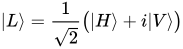
A general vector that points to any place on the surface is written as a ket . When employing the Poincaré sphere (also known as the Bloch sphere), the basis kets ( and ) must be assigned to opposing (antipodal) pairs of the kets listed above. For example, one might assign = Failed to parse (Conversion error. Server ("https://wikimedia.org/api/rest_") reported: "Cannot get mml. Server problem."): {\displaystyle |H\rangle } and = . These assignments are arbitrary. Opposing pairs are


- Failed to parse (Conversion error. Server ("https://wikimedia.org/api/rest_") reported: "Cannot get mml. Server problem."): {\displaystyle |H\rangle } and
- Failed to parse (Conversion error. Server ("https://wikimedia.org/api/rest_") reported: "Cannot get mml. Server problem."): {\displaystyle |D\rangle } and Failed to parse (Conversion error. Server ("https://wikimedia.org/api/rest_") reported: "Cannot get mml. Server problem."): {\displaystyle |A\rangle }
- Failed to parse (Conversion error. Server ("https://wikimedia.org/api/rest_") reported: "Cannot get mml. Server problem."): {\displaystyle |R\rangle } and Failed to parse (Conversion error. Server ("https://wikimedia.org/api/rest_") reported: "Cannot get mml. Server problem."): {\displaystyle |L\rangle }
The polarization of any point not equal to or Failed to parse (Conversion error. Server ("https://wikimedia.org/api/rest_") reported: "Cannot get mml. Server problem."): {\displaystyle |L\rangle } and not on the circle that passes through Failed to parse (Conversion error. Server ("https://wikimedia.org/api/rest_") reported: "Cannot get mml. Server problem."): {\displaystyle |H\rangle ,|D\rangle ,|V\rangle ,|A\rangle } is known as elliptical polarization.

Jones matrices
[edit]Jones calculus is a matrix calculus developed in 1941 by Henry Hurwitz Jr. and R. Clark Jones and published in the Journal of the Optical Society of America.[4][5][6][7]
The Jones matrices are operators that act on the Jones vectors defined above. These matrices are implemented by various optical elements such as lenses, beam splitters, mirrors, etc. Each matrix represents projection onto a one-dimensional complex subspace of the Jones vectors. The following table gives examples of Jones matrices for polarizers:
| Optical element | Jones matrix |
|---|---|
| Linear polarizer with axis of transmission horizontal[8] |
Failed to parse (Conversion error. Server ("https://wikimedia.org/api/rest_") reported: "Cannot get mml. Server problem."): {\displaystyle {\begin{pmatrix}1&0\\0&0\end{pmatrix}}} |
| Linear polarizer with axis of transmission vertical[8] |
Failed to parse (Conversion error. Server ("https://wikimedia.org/api/rest_") reported: "Cannot get mml. Server problem."): {\displaystyle {\begin{pmatrix}0&0\\0&1\end{pmatrix}}} |
| Linear polarizer with axis of transmission at ±45° with the horizontal[8] |
Failed to parse (Conversion error. Server ("https://wikimedia.org/api/rest_") reported: "Cannot get mml. Server problem."): {\displaystyle {\frac {1}{2}}{\begin{pmatrix}1&\pm 1\\\pm 1&1\end{pmatrix}}} |
| Linear polarizer with axis of transmission angle from the horizontal[8] |
Failed to parse (Conversion error. Server ("https://wikimedia.org/api/rest_") reported: "Cannot get mml. Server problem."): {\displaystyle {\begin{pmatrix}\cos ^{2}(\theta )&\cos(\theta )\sin(\theta )\\\cos(\theta )\sin(\theta )&\sin ^{2}(\theta )\end{pmatrix}}} |
| Right circular polarizer[8] |
Failed to parse (Conversion error. Server ("https://wikimedia.org/api/rest_") reported: "Cannot get mml. Server problem."): {\displaystyle {\frac {1}{2}}{\begin{pmatrix}1&i\\-i&1\end{pmatrix}}} |
| Left circular polarizer[8] |
Failed to parse (Conversion error. Server ("https://wikimedia.org/api/rest_") reported: "Cannot get mml. Server problem."): {\displaystyle {\frac {1}{2}}{\begin{pmatrix}1&-i\\i&1\end{pmatrix}}} |

Phase retarders
[edit]A phase retarder is an optical element that produces a phase difference between two orthogonal polarization components of a monochromatic polarized beam of light.[9] Mathematically, using kets to represent Jones vectors, this means that the action of a phase retarder is to transform light with polarization

to
- Failed to parse (Conversion error. Server ("https://wikimedia.org/api/rest_") reported: "Cannot get mml. Server problem."): {\displaystyle |P'\rangle =c_{1}{\rm {e}}^{i\eta /2}|1\rangle +c_{2}{\rm {e}}^{-i\eta /2}|2\rangle }
where Failed to parse (Conversion error. Server ("https://wikimedia.org/api/rest_") reported: "Cannot get mml. Server problem."): {\displaystyle |1\rangle ,|2\rangle } are orthogonal polarization components (i.e. Failed to parse (Conversion error. Server ("https://wikimedia.org/api/rest_") reported: "Cannot get mml. Server problem."): {\displaystyle \langle 1|2\rangle =0} ) that are determined by the physical nature of the phase retarder. In general, the orthogonal components could be any two basis vectors. For example, the action of the circular phase retarder is such that
- Failed to parse (Conversion error. Server ("https://wikimedia.org/api/rest_") reported: "Cannot get mml. Server problem."): {\displaystyle |1\rangle ={\frac {1}{\sqrt {2}}}{\begin{pmatrix}1\\-i\end{pmatrix}}\qquad {\text{ and }}\qquad |2\rangle ={\frac {1}{\sqrt {2}}}{\begin{pmatrix}1\\i\end{pmatrix}}}
However, linear phase retarders, for which Failed to parse (Conversion error. Server ("https://wikimedia.org/api/rest_") reported: "Cannot get mml. Server problem."): {\displaystyle |1\rangle ,|2\rangle } are linear polarizations, are more commonly encountered in discussion and in practice. In fact, sometimes the term "phase retarder" is used to refer specifically to linear phase retarders.
Linear phase retarders are usually made out of birefringent uniaxial crystals such as calcite, MgF2 or quartz. Plates made of these materials for this purpose are referred to as waveplates. Uniaxial crystals have one crystal axis that is different from the other two crystal axes (i.e., ni ≠ nj = nk). This unique axis is called the extraordinary axis and is also referred to as the optic axis. An optic axis can be the fast or the slow axis for the crystal depending on the crystal at hand. Light travels with a higher phase velocity along an axis that has the smallest refractive index and this axis is called the fast axis. Similarly, an axis which has the largest refractive index is called a slow axis since the phase velocity of light is the lowest along this axis. "Negative" uniaxial crystals (e.g., calcite CaCO3, sapphire Al2O3) have ne < no so for these crystals, the extraordinary axis (optic axis) is the fast axis, whereas for "positive" uniaxial crystals (e.g., quartz SiO2, magnesium fluoride MgF2, rutile TiO2), ne > no and thus the extraordinary axis (optic axis) is the slow axis. Other commercially available linear phase retarders exist and are used in more specialized applications. The Fresnel rhombs is one such alternative.
Any linear phase retarder with its fast axis defined as the x- or y-axis has zero off-diagonal terms and thus can be conveniently expressed as
- Failed to parse (Conversion error. Server ("https://wikimedia.org/api/rest_") reported: "Cannot get mml. Server problem."): {\displaystyle {\begin{pmatrix}{\rm {e}}^{i\phi _{x}}&0\\0&{\rm {e}}^{i\phi _{y}}\end{pmatrix}}}
where Failed to parse (Conversion error. Server ("https://wikimedia.org/api/rest_") reported: "Cannot get mml. Server problem."): {\displaystyle \phi _{x}} and Failed to parse (Conversion error. Server ("https://wikimedia.org/api/rest_") reported: "Cannot get mml. Server problem."): {\displaystyle \phi _{y}} are the phase offsets of the electric fields in and directions respectively. In the phase convention Failed to parse (Conversion error. Server ("https://wikimedia.org/api/rest_") reported: "Cannot get mml. Server problem."): {\displaystyle \phi =kz-\omega t} , define the relative phase between the two waves as . Then a positive (i.e. Failed to parse (Conversion error. Server ("https://wikimedia.org/api/rest_") reported: "Cannot get mml. Server problem."): {\displaystyle \phi _{y}} > Failed to parse (Conversion error. Server ("https://wikimedia.org/api/rest_") reported: "Cannot get mml. Server problem."): {\displaystyle \phi _{x}} ) means that Failed to parse (Conversion error. Server ("https://wikimedia.org/api/rest_") reported: "Cannot get mml. Server problem."): {\displaystyle E_{y}} doesn't attain the same value as until a later time, i.e. leads Failed to parse (Conversion error. Server ("https://wikimedia.org/api/rest_") reported: "Cannot get mml. Server problem."): {\displaystyle E_{y}} . Similarly, if Failed to parse (Conversion error. Server ("https://wikimedia.org/api/rest_") reported: "Cannot get mml. Server problem."): {\displaystyle \epsilon <0} , then Failed to parse (Conversion error. Server ("https://wikimedia.org/api/rest_") reported: "Cannot get mml. Server problem."): {\displaystyle E_{y}} leads .


For example, if the fast axis of a quarter waveplate is horizontal, then the phase velocity along the horizontal direction is ahead of the vertical direction i.e., leads Failed to parse (Conversion error. Server ("https://wikimedia.org/api/rest_") reported: "Cannot get mml. Server problem."): {\displaystyle E_{y}} . Thus, Failed to parse (Conversion error. Server ("https://wikimedia.org/api/rest_") reported: "Cannot get mml. Server problem."): {\displaystyle \phi _{x}<\phi _{y}} which for a quarter waveplate yields Failed to parse (Conversion error. Server ("https://wikimedia.org/api/rest_") reported: "Cannot get mml. Server problem."): {\displaystyle \phi _{y}=\phi _{x}+\pi /2} .
In the opposite convention , define the relative phase as Failed to parse (Conversion error. Server ("https://wikimedia.org/api/rest_") reported: "Cannot get mml. Server problem."): {\displaystyle \epsilon =\phi _{x}-\phi _{y}} . Then Failed to parse (Conversion error. Server ("https://wikimedia.org/api/rest_") reported: "Cannot get mml. Server problem."): {\displaystyle \epsilon >0} means that Failed to parse (Conversion error. Server ("https://wikimedia.org/api/rest_") reported: "Cannot get mml. Server problem."): {\displaystyle E_{y}} doesn't attain the same value as until a later time, i.e. leads Failed to parse (Conversion error. Server ("https://wikimedia.org/api/rest_") reported: "Cannot get mml. Server problem."): {\displaystyle E_{y}} .

| Phase retarders | Corresponding Jones matrix |
|---|---|
| Quarter-wave plate with fast axis vertical[2][note 1] | Failed to parse (Conversion error. Server ("https://wikimedia.org/api/rest_") reported: "Cannot get mml. Server problem."): {\displaystyle {\rm {e}}^{\frac {i\pi }{4}}{\begin{pmatrix}1&0\\0&-i\end{pmatrix}}} |
| Quarter-wave plate with fast axis horizontal[2] | |
| Quarter-wave plate with fast axis at angle w.r.t the horizontal axis | Failed to parse (Conversion error. Server ("https://wikimedia.org/api/rest_") reported: "Cannot get mml. Server problem."): {\displaystyle {\rm {e}}^{-{\frac {i\pi }{4}}}{\begin{pmatrix}\cos ^{2}\theta +i\sin ^{2}\theta &(1-i)\sin \theta \cos \theta \\(1-i)\sin \theta \cos \theta &\sin ^{2}\theta +i\cos ^{2}\theta \end{pmatrix}}} |
| Half-wave plate rotated by [1] | Failed to parse (Conversion error. Server ("https://wikimedia.org/api/rest_") reported: "Cannot get mml. Server problem."): {\displaystyle {\begin{pmatrix}\cos 2\theta &\sin 2\theta \\\sin 2\theta &-\cos 2\theta \end{pmatrix}}} |
| Half-wave plate with fast axis at angle w.r.t the horizontal axis[11] | Failed to parse (Conversion error. Server ("https://wikimedia.org/api/rest_") reported: "Cannot get mml. Server problem."): {\displaystyle {\rm {e}}^{-{\frac {i\pi }{2}}}{\begin{pmatrix}\cos ^{2}\theta -\sin ^{2}\theta &2\cos \theta \sin \theta \\2\cos \theta \sin \theta &\sin ^{2}\theta -\cos ^{2}\theta \end{pmatrix}}} |
| General Waveplate (Linear Phase Retarder)[9] | Failed to parse (Conversion error. Server ("https://wikimedia.org/api/rest_") reported: "Cannot get mml. Server problem."): {\displaystyle {\rm {e}}^{-{\frac {i\eta }{2}}}{\begin{pmatrix}\cos ^{2}\theta +{\rm {e}}^{i\eta }\sin ^{2}\theta &\left(1-{\rm {e}}^{i\eta }\right)\cos \theta \sin \theta \\\left(1-{\rm {e}}^{i\eta }\right)\cos \theta \sin \theta &\sin ^{2}\theta +{\rm {e}}^{i\eta }\cos ^{2}\theta \end{pmatrix}}} |
| Arbitrary birefringent material (Elliptical phase retarder)[9][12] | Failed to parse (Conversion error. Server ("https://wikimedia.org/api/rest_") reported: "Cannot get mml. Server problem."): {\displaystyle {\rm {e}}^{-{\frac {i\eta }{2}}}{\begin{pmatrix}\cos ^{2}\theta +{\rm {e}}^{i\eta }\sin ^{2}\theta &\left(1-{\rm {e}}^{i\eta }\right){\rm {e}}^{-i\phi }\cos \theta \sin \theta \\\left(1-{\rm {e}}^{i\eta }\right){\rm {e}}^{i\phi }\cos \theta \sin \theta &\sin ^{2}\theta +{\rm {e}}^{i\eta }\cos ^{2}\theta \end{pmatrix}}} |
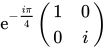
The Jones matrix for an arbitrary birefringent material is the most general form of a polarization transformation in the Jones calculus; it can represent any polarization transformation. To see this, one can show

The above matrix is a general parametrization for the elements of SU(2), using the convention
- Failed to parse (Conversion error. Server ("https://wikimedia.org/api/rest_") reported: "Cannot get mml. Server problem."): {\displaystyle \operatorname {SU} (2)=\left\{{\begin{pmatrix}\alpha &-{\overline {\beta }}\\\beta &{\overline {\alpha }}\end{pmatrix}}:\ \ \alpha ,\beta \in \mathbb {C} ,\ \ |\alpha |^{2}+|\beta |^{2}=1\right\}~}
where the overline denotes complex conjugation.
Finally, recognizing that the set of unitary transformations on can be expressed as

- Failed to parse (Conversion error. Server ("https://wikimedia.org/api/rest_") reported: "Cannot get mml. Server problem."): {\displaystyle \left\{{\rm {e}}^{i\gamma }{\begin{pmatrix}\alpha &-{\overline {\beta }}\\\beta &{\overline {\alpha }}\end{pmatrix}}:\ \ \alpha ,\beta \in \mathbb {C} ,\ \ |\alpha |^{2}+|\beta |^{2}=1,\ \ \gamma \in [0,2\pi ]\right\}}
it becomes clear that the Jones matrix for an arbitrary birefringent material represents any unitary transformation, up to a phase factor Failed to parse (Conversion error. Server ("https://wikimedia.org/api/rest_") reported: "Cannot get mml. Server problem."): {\displaystyle {\rm {e}}^{i\gamma }} . Therefore, for appropriate choice of Failed to parse (SVG (MathML can be enabled via browser plugin): Invalid response ("Math extension cannot connect to Restbase.") from server "https://wikimedia.org/api/rest_v1/":): {\displaystyle \eta} , , and , a transformation between any two Jones vectors can be found, up to a phase factor Failed to parse (SVG (MathML can be enabled via browser plugin): Invalid response ("Math extension cannot connect to Restbase.") from server "https://wikimedia.org/api/rest_v1/":): {\displaystyle {\rm e}^{i\gamma}} . However, in the Jones calculus, such phase factors do not change the represented polarization of a Jones vector, so are either considered arbitrary or imposed ad hoc to conform to a set convention.

The special expressions for the phase retarders can be obtained by taking suitable parameter values in the general expression for a birefringent material.[12] In the general expression:
- The relative phase retardation induced between the fast axis and the slow axis is given by Failed to parse (SVG (MathML can be enabled via browser plugin): Invalid response ("Math extension cannot connect to Restbase.") from server "https://wikimedia.org/api/rest_v1/":): {\displaystyle \eta = \phi_y - \phi_x }
- Failed to parse (SVG (MathML can be enabled via browser plugin): Invalid response ("Math extension cannot connect to Restbase.") from server "https://wikimedia.org/api/rest_v1/":): {\displaystyle \theta} is the orientation of the fast axis with respect to the x-axis.
- Failed to parse (SVG (MathML can be enabled via browser plugin): Invalid response ("Math extension cannot connect to Restbase.") from server "https://wikimedia.org/api/rest_v1/":): {\displaystyle \phi} is the circularity.
Note that for linear retarders, Failed to parse (SVG (MathML can be enabled via browser plugin): Invalid response ("Math extension cannot connect to Restbase.") from server "https://wikimedia.org/api/rest_v1/":): {\displaystyle \phi} = 0 and for circular retarders, Failed to parse (SVG (MathML can be enabled via browser plugin): Invalid response ("Math extension cannot connect to Restbase.") from server "https://wikimedia.org/api/rest_v1/":): {\displaystyle \phi} = ± Failed to parse (SVG (MathML can be enabled via browser plugin): Invalid response ("Math extension cannot connect to Restbase.") from server "https://wikimedia.org/api/rest_v1/":): {\displaystyle \pi} /2, Failed to parse (SVG (MathML can be enabled via browser plugin): Invalid response ("Math extension cannot connect to Restbase.") from server "https://wikimedia.org/api/rest_v1/":): {\displaystyle \theta} = Failed to parse (SVG (MathML can be enabled via browser plugin): Invalid response ("Math extension cannot connect to Restbase.") from server "https://wikimedia.org/api/rest_v1/":): {\displaystyle \pi} /4. In general for elliptical retarders, Failed to parse (SVG (MathML can be enabled via browser plugin): Invalid response ("Math extension cannot connect to Restbase.") from server "https://wikimedia.org/api/rest_v1/":): {\displaystyle \phi} takes on values between - Failed to parse (SVG (MathML can be enabled via browser plugin): Invalid response ("Math extension cannot connect to Restbase.") from server "https://wikimedia.org/api/rest_v1/":): {\displaystyle \pi} /2 and Failed to parse (SVG (MathML can be enabled via browser plugin): Invalid response ("Math extension cannot connect to Restbase.") from server "https://wikimedia.org/api/rest_v1/":): {\displaystyle \pi} /2.
Axially rotated elements
[edit]Assume an optical element has its optic axis[clarification needed] perpendicular to the surface vector for the plane of incidence[clarification needed] and is rotated about this surface vector by angle θ/2 (i.e., the principal plane through which the optic axis passes,[clarification needed] makes angle θ/2 with respect to the plane of polarization of the electric field[clarification needed] of the incident TE wave). Recall that a half-wave plate rotates polarization as twice the angle between incident polarization and optic axis (principal plane). Therefore, the Jones matrix for the rotated polarization state, M(θ), is
- Failed to parse (SVG (MathML can be enabled via browser plugin): Invalid response ("Math extension cannot connect to Restbase.") from server "https://wikimedia.org/api/rest_v1/":): {\displaystyle M(\theta )=R(-\theta )\,M\,R(\theta ),}
- where Failed to parse (SVG (MathML can be enabled via browser plugin): Invalid response ("Math extension cannot connect to Restbase.") from server "https://wikimedia.org/api/rest_v1/":): {\displaystyle R(\theta ) = \begin{pmatrix} \cos \theta & \sin \theta \\ -\sin \theta & \cos \theta \end{pmatrix}.}
This agrees with the expression for a half-wave plate in the table above. These rotations are identical to beam unitary splitter transformation in optical physics given by
- Failed to parse (SVG (MathML can be enabled via browser plugin): Invalid response ("Math extension cannot connect to Restbase.") from server "https://wikimedia.org/api/rest_v1/":): {\displaystyle R(\theta ) = \begin{pmatrix} r & t'\\ t & r' \end{pmatrix}}
where the primed and unprimed coefficients represent beams incident from opposite sides of the beam splitter. The reflected and transmitted components acquire a phase θr and θt, respectively. The requirements for a valid representation of the element are [13]
- Failed to parse (SVG (MathML can be enabled via browser plugin): Invalid response ("Math extension cannot connect to Restbase.") from server "https://wikimedia.org/api/rest_v1/":): {\displaystyle \theta_\text{t} - \theta_\text{r} + \theta_\text{t'} - \theta_\text{r'} = \pm \pi }
and Failed to parse (SVG (MathML can be enabled via browser plugin): Invalid response ("Math extension cannot connect to Restbase.") from server "https://wikimedia.org/api/rest_v1/":): {\displaystyle r^*t' + t^*r' = 0.}
- Both of these representations are unitary matrices fitting these requirements; and as such, are both valid.
Arbitrarily rotated elements
[edit]![[icon]](/w/index.php?title=File:Wiki_letter_w_cropped.svg) | This section needs expansion. You can help by adding to it. (July 2014) |
Finding the Jones matrix, J(α, β, γ), for an arbitrary rotation involves a three-dimensional rotation matrix. In the following notation α, β and γ are the yaw, pitch, and roll angles (rotation about the z-, y-, and x-axes, with x being the direction of propagation), respectively. The full combination of the 3-dimensional rotation matrices is the following:
- Failed to parse (SVG (MathML can be enabled via browser plugin): Invalid response ("Math extension cannot connect to Restbase.") from server "https://wikimedia.org/api/rest_v1/":): {\displaystyle R_{3D}(\theta)=\begin{bmatrix} \cos\alpha\cos\beta & \cos\alpha\sin\beta\sin\gamma - \sin\alpha\cos\gamma & \cos\alpha\sin\beta\cos\gamma + \sin\alpha\sin\gamma \\ \sin\alpha\cos\beta & \sin\alpha\sin\beta\sin\gamma + \cos\alpha\cos\gamma & \sin\alpha\sin\beta\cos\gamma - \cos\alpha\sin\gamma \\ -\sin\beta & \cos\beta\sin\gamma & \cos\beta\cos\gamma \\ \end{bmatrix}}
Using the above, for any base Jones matrix J, you can find the rotated state J(α, β, γ) using:
- Failed to parse (SVG (MathML can be enabled via browser plugin): Invalid response ("Math extension cannot connect to Restbase.") from server "https://wikimedia.org/api/rest_v1/":): {\displaystyle J(\alpha,\beta,\gamma) = R_{3D}(-\alpha,-\beta,-\gamma)\cdot J \cdot R_{3D}(\alpha,\beta,\gamma)} [1]
The simplest case, where the Jones matrix is for an ideal linear horizontal polarizer, reduces then to:
- Failed to parse (SVG (MathML can be enabled via browser plugin): Invalid response ("Math extension cannot connect to Restbase.") from server "https://wikimedia.org/api/rest_v1/":): {\displaystyle J(\alpha, \beta, \gamma) = \begin{bmatrix} c^2_{\alpha} c^2_{\beta} & c_{\alpha} c_{\beta} [c_{\alpha} s_{\beta} s_{\gamma} - s_{\alpha} c_{\gamma}] & c_{\alpha} c_{\beta} [c_{\alpha} s_{\beta} c_{\gamma} + s_{\alpha} s_{\gamma}]\\ s_{\alpha} c_{\alpha} c^2_{\beta} & s_{\alpha} c_{\beta} [c_{\alpha} s_{\beta} s_{\gamma} - s_{\alpha} c_{\gamma}] & s_{\alpha} c_{\beta} [c_{\alpha} s_{\beta} c_{\gamma} + s_{\alpha} s_{\gamma}] \\ -c_{\alpha} s_{\beta} c_{\beta} & -s_{\beta} [c_{\alpha} s_{\beta} s_{\gamma} - s_{\alpha} c_{\gamma}] & -s_{\beta} [c_{\alpha} s_{\beta} c_{\gamma} + s_{\alpha} s_{\gamma}]\\ \end{bmatrix} }
where ci and si represent the cosine or sine of a given angle "i", respectively.
See Russell A. Chipman and Garam Yun for further work done based on this.[14][15][16][17][18]
See also
[edit]Notes
[edit]- ↑ The prefactor Failed to parse (Conversion error. Server ("https://wikimedia.org/api/rest_") reported: "Cannot get mml. Server problem."): {\displaystyle {\rm {e}}^{i\pi /4}} appears only if one defines the phase delays in a symmetric fashion; that is, Failed to parse (Conversion error. Server ("https://wikimedia.org/api/rest_") reported: "Cannot get mml. Server problem."): {\displaystyle \phi _{x}=-\phi _{y}=\pi /4} . This is done in Hecht[2] but not in Fowles[8] or Peatross and Ware.[10] In the latter two references the Jones matrices for a quarter-wave plate have no prefactor.
References
[edit]- ↑ 1.0 1.1 1.2 Collett (2005), pp. 57–61, "Jones Calculus".
- ↑ 2.0 2.1 2.2 2.3 Eugene Hecht (2001). Optics (4th ed.). Addison-Wesley. p. 378. ISBN 978-0805385663.
- ↑ Collett, E. (2005). Field Guide to Polarization. SPIE Field Guides. SPIE. ISBN 0-8194-5868-6. FG05.
- ↑ Hurwitz, Henry; Jones, R. Clark (1941). "A new calculus for the treatment of optical systems, II. Proof of three general equivalence theorems". Journal of the Optical Society of America. 31 (7): 493–499. Bibcode:1941JOSA...31..493H. doi:10.1364/JOSA.31.000493.
- ↑ Jones, R. Clark (1941). "A new calculus for the treatment of optical systems, I. Description and Discussion of the Calculus". Journal of the Optical Society of America. 31 (7): 488–493. Bibcode:1941JOSA...31..488J. doi:10.1364/JOSA.31.000488.
- ↑ Jones, R. Clark (1941). "A new calculus for the treatment of optical systems, III. The Sohncke Theory of optical activity". Journal of the Optical Society of America. 31 (7): 500–503. Bibcode:1941JOSA...31..500J. doi:10.1364/JOSA.31.000500.
- ↑ Jones, R. Clark (1942). "A new calculus for the treatment of optical systems, IV". Journal of the Optical Society of America. 32 (8): 486–493. Bibcode:1942JOSA...32..486C. doi:10.1364/JOSA.32.000486.
- ↑ 8.0 8.1 8.2 8.3 8.4 8.5 8.6 Fowles, G. (1989). Introduction to Modern Optics (2nd ed.). Dover. p. 35. ISBN 9780486659572.
- ↑ 9.0 9.1 9.2 P.S. Theocaris; E.E. Gdoutos (1979). Matrix Theory of Photoelasticity. Springer Series in Optical Sciences. 11 (1st ed.). Springer-Verlag. doi:10.1007/978-3-540-35789-6. ISBN 978-3-662-15807-4.
- ↑ Peatross, Justin; Ware, Michael (2025). Physics of Light and Optics (2015 edition, Jan. 31, 2025 revision ed.). Lulu.com. ISBN 978-1-312-92927-2.
- ↑ Gerald, A.; Burch, J.M. (1975). Introduction to Matrix Methods in Optics (1st ed.). John Wiley & Sons. p. 212. ISBN 978-0471296850.
- ↑ 12.0 12.1 Gill, Jose Jorge; Bernabeu, Eusebio (1987). "Obtainment of the polarizing and retardation parameters of a non-depolarizing optical system from the polar decomposition of its Mueller matrix". Optik. 76 (2): 67–71. ISSN 0030-4026.
- ↑ Ou, Z. Y.; Mandel, L. (1989). "Derivation of reciprocity relations for a beam splitter from energy balance". Am. J. Phys. 57 (1): 66. Bibcode:1989AmJPh..57...66O. doi:10.1119/1.15873.
- ↑ Chipman, R.A.; Lam, W.S.T.; Young, G. (2018). Polarized Light and Optical Systems. Optical Sciences and Applications of Light. CRC Press. ISBN 978-1-4987-0057-3. Retrieved 2023-01-20.
- ↑ Chipman, Russell A. (1995). "Mechanics of polarization ray tracing". Opt. Eng. 34 (6): 1636–1645. Bibcode:1995OptEn..34.1636C. doi:10.1117/12.202061.
- ↑ Yun, Garam; Crabtree, Karlton; Chipman, Russell A. (2011). "Three-dimensional polarization ray-tracing calculus I: definition and diattenuation". Applied Optics. 50 (18): 2855–2865. Bibcode:2011ApOpt..50.2855Y. doi:10.1364/AO.50.002855. PMID 21691348.
- ↑ Yun, Garam; McClain, Stephen C.; Chipman, Russell A. (2011). "Three-dimensional polarization ray-tracing calculus II: retardance". Applied Optics. 50 (18): 2866–2874. Bibcode:2011ApOpt..50.2866Y. doi:10.1364/AO.50.002866. PMID 21691349.
- ↑ Template:Cite thesis
Further reading
[edit] | This article includes a list of general references, but it remains largely unverified because it lacks sufficient corresponding inline citations. (July 2014) |
- Brosseau, Christian; Givens, Clark R.; Kostinski, Alexander B. (1993). "Generalized trace condition on the Mueller-Jones polarization matrix". Journal of the Optical Society of America A. 10 (10): 2248–2251. Bibcode:1993JOSAA..10.2248B. doi:10.1364/JOSAA.10.002248.
- Fymat, A. L. (1971). "Jones's Matrix Representation of Optical Instruments. 1: Beam Splitters". Applied Optics. 10 (11): 2499–2505. Bibcode:1971ApOpt..10.2499F. doi:10.1364/AO.10.002499. PMID 20111363.
- Fymat, A. L. (1971). "Jones's Matrix Representation of Optical Instruments. 2: Fourier Interferometers (Spectrometers and Spectropolarimeters)". Applied Optics. 10 (12): 2711–2716. Bibcode:1971ApOpt..10.2711F. doi:10.1364/AO.10.002711. PMID 20111418.
- Fymat, A. L. (1972). "Polarization Effects in Fourier Spectroscopy. I: Coherency Matrix Representation". Applied Optics. 11 (1): 160–173. Bibcode:1972ApOpt..11..160F. doi:10.1364/AO.11.000160. PMID 20111472.
- Gerald, A.; Burch, J. M. (1975). Introduction to Matrix Methods in Optics (1st ed.). John Wiley & Sons. ISBN 0-471-29685-6.
- Gill, Jose Jorge; Bernabeu, Eusebio (1987). "Obtainment of the polarizing and retardation parameters of a non-depolarizing optical system from the polar decomposition of its Mueller matrix". Optik. 76: 67–71.
- Goldstein, D.; Collett, E. (2003). Polarized Light (2nd ed.). CRC Press. ISBN 0-8247-4053-X.
- Hecht, E. (1987). Optics (2nd ed.). Addison-Wesley. ISBN 0-201-11609-X.
- McGuire, James P.; Chipman, Russel A. (1994). "Polarization aberrations. 1. Rotationally symmetric optical systems". Applied Optics. 33 (22): 5080–5100. Bibcode:1994ApOpt..33.5080M. doi:10.1364/AO.33.005080. PMID 20935891. S2CID 3805982.
- Moreno, Ignacio; Yzuel, Maria J.; Campos, Juan; Vargas, Asticio (2004). "Jones matrix treatment for polarization Fourier optics". Journal of Modern Optics. 51 (14): 2031–2038. Bibcode:2004JMOp...51.2031M. doi:10.1080/09500340408232511. hdl:10533/175322. S2CID 120169144.
- Moreno, Ivan (2004). "Jones matrix for image-rotation prisms". Applied Optics. 43 (17): 3373–3381. Bibcode:2004ApOpt..43.3373M. doi:10.1364/AO.43.003373. PMID 15219016. S2CID 24268298.
- Shiell, Rayf; McNab, Iain (2024). Pedrottis' Introduction to Optics (4th ed.). United Kingdom: Cambridge University Press. ISBN 978-1316518625.
- Pistoni, Natale C. (1995). "Simplified approach to the Jones calculus in retracing optical circuits". Applied Optics. 34 (34): 7870–7876. Bibcode:1995ApOpt..34.7870P. doi:10.1364/AO.34.007870. PMID 2106888.
- Shurcliff, William (1966). "Chapter 8: Mueller Calculus and Jones Calculus". Polarized Light: Production and Use. Harvard University Press. p. 109.
- Articles with unsourced statements from December 2024
- Wikipedia articles needing clarification from May 2015
- Articles to be expanded from July 2014
- Articles lacking in-text citations from July 2014
- All articles lacking in-text citations
- Optics
- Polarization (waves)
- Matrices (mathematics)
- Pages with math render errors
- Pages that use a deprecated format of the math tags
- Pages with math errors