Cauchy's integral formula
Template:Complex analysis sidebar In mathematics, Cauchy's integral formula, named after Augustin-Louis Cauchy, is a central statement in complex analysis. It expresses the fact that a holomorphic function defined on a disk is completely determined by its values on the boundary of the disk, and it provides integral formulas for all derivatives of a holomorphic function. Cauchy's formula shows that, in complex analysis, "differentiation is equivalent to integration": complex differentiation, like integration, behaves well under uniform limits – a result that does not hold in real analysis.
Theorem
[edit]Let be an open subset of the complex plane Template:Tmath, and suppose the closed disk Failed to parse (SVG (MathML can be enabled via browser plugin): Invalid response ("Math extension cannot connect to Restbase.") from server "https://wikimedia.org/api/rest_v1/":): {\displaystyle D} defined as Failed to parse (SVG (MathML can be enabled via browser plugin): Invalid response ("Math extension cannot connect to Restbase.") from server "https://wikimedia.org/api/rest_v1/":): {\displaystyle D = \bigl\{z\in\mathbb{C}:|z - z_0| \leq r\bigr\}} is completely contained in Template:Tmath. Let Failed to parse (SVG (MathML can be enabled via browser plugin): Invalid response ("Math extension cannot connect to Restbase.") from server "https://wikimedia.org/api/rest_v1/":): {\displaystyle f:U\to\mathbb{C}} be a holomorphic function, and let be the circle, oriented counterclockwise, forming the boundary of Template:Tmath. Then for every in the interior of Template:Tmath,


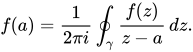
The proof of this statement uses the Cauchy integral theorem and like that theorem, it only requires to be complex differentiable. Because can be expanded as a power series in the variable as it follows that holomorphic functions are analytic, i.e. they can be expanded as convergent power series. In particular is actually infinitely differentiable, with


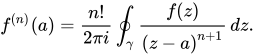
This formula is sometimes referred to as Cauchy's differentiation formula.
The theorem stated above can be generalized. The circle can be replaced by any closed rectifiable curve in that has winding number one about Template:Tmath. Moreover, as for the Cauchy integral theorem, it is sufficient to require that be holomorphic in the open region enclosed by the path and continuous on its closure.

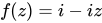
Note that not every continuous function on the boundary can be used to produce a function inside the boundary that fits the given boundary function. For instance, if we put the function Template:Tmath, defined for Template:Tmath, into the Cauchy integral formula, we get zero for all points inside the circle. In fact, giving just the real part on the boundary of a holomorphic function is enough to determine the function up to an imaginary constant – there is only one imaginary part on the boundary that corresponds to the given real part, up to addition of a constant. We can use a combination of a Möbius transformation and the Stieltjes inversion formula to construct the holomorphic function from the real part on the boundary. For example, the function has real part Template:Tmath. On the unit circle this can be written Template:Tmath. Using the Möbius transformation and the Stieltjes formula we construct the function inside the circle. The term makes no contribution, and we find the function Template:Tmath. This has the correct real part on the boundary, and also gives us the corresponding imaginary part, but off by a constant, namely Template:Tmath.

Proof sketch
[edit]By using the Cauchy integral theorem, one can show that the integral over (or the closed rectifiable curve) is equal to the same integral taken over an arbitrarily small circle around Template:Tmath. Since is continuous, we can choose a circle small enough on which is arbitrarily close to Template:Tmath. On the other hand, the integral over any circle centered at Template:Tmath. This can be calculated directly via a parametrization (integration by substitution) where and is the radius of the circle.


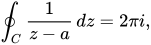
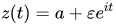


Letting gives the desired estimate

![{\displaystyle {\begin{aligned}\left|{\frac {1}{2\pi i}}\oint _{C}{\frac {f(z)}{z-a}}\,dz-f(a)\right|&=\left|{\frac {1}{2\pi i}}\oint _{C}{\frac {f(z)-f(a)}{z-a}}\,dz\right|\\[1ex]&=\left|{\frac {1}{2\pi i}}\int _{0}^{2\pi }\left({\frac {f{\bigl (}z(t){\bigr )}-f(a)}{\varepsilon e^{it}}}\cdot \varepsilon e^{it}i\right)\,dt\right|\\[1ex]&\leq {\frac {1}{2\pi }}\int _{0}^{2\pi }{\frac {\left|f{\bigl (}z(t){\bigr )}-f(a)\right|}{\varepsilon }}\,\varepsilon \,dt\\[1ex]&\leq \max _{|z-a|=\varepsilon }\left|f(z)-f(a)\right|~~{\xrightarrow[{\varepsilon \to 0}]{}}~~0.\end{aligned}}}](https://wikimedia.org/api/rest_v1/media/math/render/svg/f0eeb75dfa5eb4b157b56927fc8946283271ca58)
Example
[edit]
Let and let be the contour described by (the circle of radius 2).
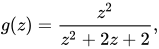

To find the integral of around the contour Template:Tmath, we need to know the singularities of Template:Tmath. Observe that we can rewrite as follows: where and Template:Tmath.


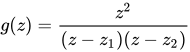

Thus, has poles at and Template:Tmath. The moduli of these points are less than 2 and thus lie inside the contour. This integral can be split into two smaller integrals by Cauchy–Goursat theorem; that is, we can express the integral around the contour as the sum of the integral around and where the contour is a small circle around each pole. Call these contours around and around Template:Tmath.


Now, each of these smaller integrals can be evaluated by the Cauchy integral formula, but they first must be rewritten to apply the theorem. For the integral around Template:Tmath, define as Template:Tmath. This is analytic (since the contour does not contain the other singularity). We can simplify to be: and now

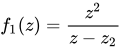
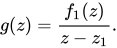
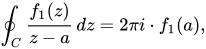
Since the Cauchy integral formula says that: we can evaluate the integral as follows:

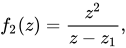
Doing likewise for the other contour: we evaluate

The integral around the original contour then is the sum of these two integrals:
![{\displaystyle {\begin{aligned}\oint _{C}g(z)\,dz&{}=\oint _{C_{1}}g(z)\,dz+\oint _{C_{2}}g(z)\,dz\\[.5em]&{}=2\pi i\left({\frac {z_{1}^{2}}{z_{1}-z_{2}}}+{\frac {z_{2}^{2}}{z_{2}-z_{1}}}\right)\\[.5em]&{}=2\pi i(-2)\\[.3em]&{}=-4\pi i.\end{aligned}}}](https://wikimedia.org/api/rest_v1/media/math/render/svg/4b9c7903019d4df4e582611b34645258bc49b532)
An elementary trick using partial fraction decomposition:

Consequences
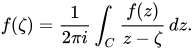
[edit]The integral formula has broad applications. First, it implies that a function that is holomorphic in an open set is in fact infinitely differentiable there. Furthermore, it is an analytic function, meaning that it can be represented as a power series. The proof of this uses the dominated convergence theorem and the geometric series applied to
The formula is also used to prove the residue theorem, which is a result for meromorphic functions, and a related result, the argument principle. It is known from Morera's theorem that the uniform limit of holomorphic functions is holomorphic. This can also be deduced from Cauchy's integral formula: indeed the formula also holds in the limit and the integrand, and hence the integral, can be expanded as a power series. In addition the Cauchy formulas for the higher order derivatives show that all these derivatives also converge uniformly.
The analog of the Cauchy integral formula in real analysis is the Poisson integral formula for harmonic functions; many of the results for holomorphic functions carry over to this setting. No such results, however, are valid for more general classes of differentiable or real analytic functions. For instance, the existence of the first derivative of a real function need not imply the existence of higher order derivatives, nor in particular the analyticity of the function. Likewise, the uniform limit of a sequence of (real) differentiable functions may fail to be differentiable, or may be differentiable but with a derivative that is not the limit of the derivatives of the members of the sequence.
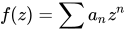
Another consequence is that if is holomorphic in and then the coefficients satisfy Cauchy's estimate[1]


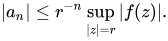
From Cauchy's estimate, one can easily deduce that every bounded entire function must be constant (which is Liouville's theorem).
The formula can also be used to derive Gauss's mean-value theorem, which states[2]
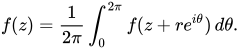
In other words, the average value of over the circle centered at with radius is Template:Tmath. This can be calculated directly via a parametrization of the circle.


Generalizations
[edit]Smooth functions
[edit]A version of Cauchy's integral formula is the Cauchy–Pompeiu formula,[3] and holds for smooth functions as well, as it is based on Stokes' theorem. Let be a disc in and suppose that is a complex-valued [[continuously differentiable function|CTemplate:Isup]] function on the closure of Template:Tmath. Then[4][5]


One may use this representation formula to solve the inhomogeneous Cauchy–Riemann equations in Template:Tmath. Indeed, if is a function in Template:Tmath, then a particular solution of the equation is a holomorphic function outside the support of Template:Tmath. Moreover, if in an open set Template:Tmath, for some (where Template:Tmath, then is also in and satisfies the equation


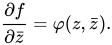
The first conclusion is, succinctly, that the convolution of a compactly supported measure with the Cauchy kernel is a holomorphic function off the support of Template:Tmath. Here denotes the principal value. The second conclusion asserts that the Cauchy kernel is a fundamental solution of the Cauchy–Riemann equations. Note that for smooth complex-valued functions of compact support on the generalized Cauchy integral formula simplifies to and is a restatement of the fact that, considered as a distribution, is a fundamental solution of the Cauchy–Riemann operator Template:Tmath.[6]

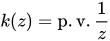

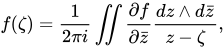

The generalized Cauchy integral formula can be deduced for any bounded open region with boundary from this result and the formula for the distributional derivative of the characteristic function of Template:Tmath: where the distribution on the right hand side denotes contour integration along Template:Tmath.[7] Template:Math proof


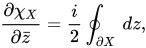
Now we can deduce the generalized Cauchy integral formula: Template:Math proof
Several variables
[edit]In several complex variables, the Cauchy integral formula can be generalized to polydiscs.[8] Let be the polydisc given as the Cartesian product of open discs Template:Tmath:


Suppose that is a holomorphic function in continuous on the closure of Template:Tmath. Then Failed to parse (SVG (MathML can be enabled via browser plugin): Invalid response ("Math extension cannot connect to Restbase.") from server "https://wikimedia.org/api/rest_v1/":): {\displaystyle f(\zeta) = \frac{1}{\left(2\pi i\right)^n}\int\cdots\iint_{\partial D_1\times\cdots\times\partial D_n} \frac{f(z_1,\ldots,z_n)}{(z_1-\zeta_1)\cdots(z_n-\zeta_n)} \, dz_1\cdots dz_n} where Template:Tmath.
In real algebras
[edit]The Cauchy integral formula is generalizable to real vector spaces of two or more dimensions. The insight into this property comes from geometric algebra, where objects beyond scalars and vectors (such as planar bivectors and volumetric trivectors) are considered, and a proper generalization of Stokes' theorem.
Geometric calculus defines a derivative operator Failed to parse (SVG (MathML can be enabled via browser plugin): Invalid response ("Math extension cannot connect to Restbase.") from server "https://wikimedia.org/api/rest_v1/":): {\displaystyle \nabla=\hat e_j\partial_j} under its geometric product – that is, for a Failed to parse (SVG (MathML can be enabled via browser plugin): Invalid response ("Math extension cannot connect to Restbase.") from server "https://wikimedia.org/api/rest_v1/":): {\displaystyle k} -vector field Template:Tmath, the derivative Failed to parse (SVG (MathML can be enabled via browser plugin): Invalid response ("Math extension cannot connect to Restbase.") from server "https://wikimedia.org/api/rest_v1/":): {\displaystyle \nabla\psi} generally contains terms of grade Failed to parse (SVG (MathML can be enabled via browser plugin): Invalid response ("Math extension cannot connect to Restbase.") from server "https://wikimedia.org/api/rest_v1/":): {\displaystyle k+1} and Template:Tmath. For example, a vector field Failed to parse (SVG (MathML can be enabled via browser plugin): Invalid response ("Math extension cannot connect to Restbase.") from server "https://wikimedia.org/api/rest_v1/":): {\displaystyle k=1} generally has in its derivative a scalar part, the divergence (Template:Tmath), and a bivector part, the curl (Template:Tmath). This particular derivative operator has a Green's function: Failed to parse (SVG (MathML can be enabled via browser plugin): Invalid response ("Math extension cannot connect to Restbase.") from server "https://wikimedia.org/api/rest_v1/":): {\displaystyle G\left(\mathbf r, \mathbf r'\right) = \frac{1}{S_n} \frac{\mathbf r - \mathbf r'}{\left|\mathbf r - \mathbf r'\right|^n}} where Failed to parse (SVG (MathML can be enabled via browser plugin): Invalid response ("Math extension cannot connect to Restbase.") from server "https://wikimedia.org/api/rest_v1/":): {\displaystyle S_n} is the surface area of a unit Failed to parse (SVG (MathML can be enabled via browser plugin): Invalid response ("Math extension cannot connect to Restbase.") from server "https://wikimedia.org/api/rest_v1/":): {\displaystyle n} -ball in the space (that is, Template:Tmath, the circumference of a circle with radius Template:Tmath, and Template:Tmath, the surface area of a sphere with radius Template:Tmath). By definition of a Green's function, Failed to parse (SVG (MathML can be enabled via browser plugin): Invalid response ("Math extension cannot connect to Restbase.") from server "https://wikimedia.org/api/rest_v1/":): {\displaystyle \nabla G\left(\mathbf r, \mathbf r'\right) = \delta\left(\mathbf r- \mathbf r'\right).}
It is this useful property that can be used, in conjunction with the generalized Stokes theorem: Failed to parse (SVG (MathML can be enabled via browser plugin): Invalid response ("Math extension cannot connect to Restbase.") from server "https://wikimedia.org/api/rest_v1/":): {\displaystyle \oint_{\partial V} d\mathbf S \; f(\mathbf r) = \int_V d\mathbf V \; \nabla f(\mathbf r)} where, for an Failed to parse (SVG (MathML can be enabled via browser plugin): Invalid response ("Math extension cannot connect to Restbase.") from server "https://wikimedia.org/api/rest_v1/":): {\displaystyle n} -dimensional vector space, Failed to parse (SVG (MathML can be enabled via browser plugin): Invalid response ("Math extension cannot connect to Restbase.") from server "https://wikimedia.org/api/rest_v1/":): {\displaystyle dS} is an Failed to parse (SVG (MathML can be enabled via browser plugin): Invalid response ("Math extension cannot connect to Restbase.") from server "https://wikimedia.org/api/rest_v1/":): {\displaystyle n-1} -vector and Failed to parse (SVG (MathML can be enabled via browser plugin): Invalid response ("Math extension cannot connect to Restbase.") from server "https://wikimedia.org/api/rest_v1/":): {\displaystyle dV} is an Failed to parse (SVG (MathML can be enabled via browser plugin): Invalid response ("Math extension cannot connect to Restbase.") from server "https://wikimedia.org/api/rest_v1/":): {\displaystyle n} -vector. The function Failed to parse (SVG (MathML can be enabled via browser plugin): Invalid response ("Math extension cannot connect to Restbase.") from server "https://wikimedia.org/api/rest_v1/":): {\displaystyle f(r)} can, in principle, be composed of any combination of multivectors. The proof of Cauchy's integral theorem for higher dimensional spaces relies on the using the generalized Stokes theorem on the quantity Failed to parse (SVG (MathML can be enabled via browser plugin): Invalid response ("Math extension cannot connect to Restbase.") from server "https://wikimedia.org/api/rest_v1/":): {\displaystyle G(r,r')f(r)} and use of the product rule: Failed to parse (SVG (MathML can be enabled via browser plugin): Invalid response ("Math extension cannot connect to Restbase.") from server "https://wikimedia.org/api/rest_v1/":): {\displaystyle \oint_{\partial V'} G\left(\mathbf r, \mathbf r'\right)\; d\mathbf S' \; f\left(\mathbf r'\right) = \int_V \left(\left[\nabla' G\left(\mathbf r, \mathbf r'\right)\right] f\left(\mathbf r'\right) + G\left(\mathbf r, \mathbf r'\right) \nabla' f\left(\mathbf r'\right)\right) \; d\mathbf V}
When Template:Tmath, Failed to parse (SVG (MathML can be enabled via browser plugin): Invalid response ("Math extension cannot connect to Restbase.") from server "https://wikimedia.org/api/rest_v1/":): {\displaystyle f(r)} is called a monogenic function, the generalization of holomorphic functions to higher-dimensional spaces – indeed, it can be shown that the Cauchy–Riemann condition is just the two-dimensional expression of the monogenic condition. When that condition is met, the second term in the right-hand integral vanishes, leaving only Failed to parse (SVG (MathML can be enabled via browser plugin): Invalid response ("Math extension cannot connect to Restbase.") from server "https://wikimedia.org/api/rest_v1/":): {\displaystyle \oint_{\partial V'} G\left(\mathbf r, \mathbf r'\right)\; d\mathbf S' \; f\left(\mathbf r'\right) = \int_V \left[\nabla' G\left(\mathbf r, \mathbf r'\right)\right] f\left(\mathbf r'\right) = -\int_V \delta\left(\mathbf r - \mathbf r'\right) f\left(\mathbf r'\right) \; d\mathbf V =- i_n f(\mathbf r)} where Failed to parse (SVG (MathML can be enabled via browser plugin): Invalid response ("Math extension cannot connect to Restbase.") from server "https://wikimedia.org/api/rest_v1/":): {\displaystyle i_n} is that algebra's unit Failed to parse (SVG (MathML can be enabled via browser plugin): Invalid response ("Math extension cannot connect to Restbase.") from server "https://wikimedia.org/api/rest_v1/":): {\displaystyle n} -vector, the pseudoscalar. The result is Failed to parse (SVG (MathML can be enabled via browser plugin): Invalid response ("Math extension cannot connect to Restbase.") from server "https://wikimedia.org/api/rest_v1/":): {\displaystyle f(\mathbf r) =- \frac{1}{i_n} \oint_{\partial V} G\left(\mathbf r, \mathbf r'\right)\; d\mathbf S \; f\left(\mathbf r'\right) = -\frac{1}{i_n} \oint_{\partial V} \frac{\mathbf r - \mathbf r'}{S_n \left|\mathbf r - \mathbf r'\right|^n} \; d\mathbf S \; f\left(\mathbf r'\right)}
Thus, as in the two-dimensional (complex analysis) case, the value of an analytic (monogenic) function at a point can be found by an integral over the surface surrounding the point, and this is valid not only for scalar functions but vector and general multivector functions as well.
See also
[edit]Notes
[edit]- ↑ Titchmarsh 1939, p. 84
- ↑ Template:WolframAlpha
- ↑ Pompeiu 1905
- ↑ Hörmander 1966, Theorem 1.2.1
- ↑ Lebl 2025, p. 130
- ↑ Hörmander 1983, pp. 63, 81
- ↑ Hörmander 1983, pp. 62–63
- ↑ Hörmander 1966, Theorem 2.2.1
References
[edit]- Ahlfors, Lars (1979). Complex analysis (3rd ed.). McGraw Hill. ISBN 978-0-07-000657-7.
- Doran, Chris; Lasenby, Anthony (2003). Geometric Algebra for Physicists. Cambridge University Press. ISBN 978-0-521-71595-9.
- Hörmander, Lars (1966). An Introduction to Complex Analysis in Several Variables. Van Nostrand.
- Hörmander, Lars (1983). The Analysis of Linear Partial Differential Operators I. Springer. ISBN 3-540-12104-8.
- Lebl, Jiří (May 20, 2025). Tasty Bits of Several Complex Variables – A Whirlwind Tour of the Subject (PDF).
- Pompeiu, D. (1905). "Sur la continuité des fonctions de variables complexes" [On the continuity of complex variable functions] (PDF). Annales de la Faculté des Sciences de Toulouse [Annals of the Faculty of Sciences of Toulouse]. Série 2 (in French). 7 (3): 265–315.
- Titchmarsh, E. C. (1939). Theory of functions (2nd ed.). Oxford University Press.