Tietze extension theorem
In topology, the Tietze extension theorem (also known as the Tietze–Urysohn–Brouwer extension theorem or Urysohn-Brouwer lemma[1]) states that any real-valued, continuous function on a closed subset of a normal topological space can be extended to the entire space, preserving boundedness if necessary.
Formal statement
[edit | edit source]If is a normal space and is a continuous map from a closed subset of into the real numbers carrying the standard topology, then there exists a continuous extension of Failed to parse (Conversion error. Server ("https://wikimedia.org/api/rest_") reported: "Cannot get mml. Server problem."): {\displaystyle f} to Failed to parse (Conversion error. Server ("https://wikimedia.org/api/rest_") reported: "Cannot get mml. Server problem."): {\displaystyle X;} that is, there exists a map continuous on all of with Failed to parse (Conversion error. Server ("https://wikimedia.org/api/rest_") reported: "Cannot get mml. Server problem."): {\displaystyle F(a)=f(a)} for all Moreover, may be chosen such that Failed to parse (Conversion error. Server ("https://wikimedia.org/api/rest_") reported: "Cannot get mml. Server problem."): {\displaystyle \sup\{|f(a)|:a\in A\}~=~\sup\{|F(x)|:x\in X\},} that is, if Failed to parse (Conversion error. Server ("https://wikimedia.org/api/rest_") reported: "Cannot get mml. Server problem."): {\displaystyle f} is bounded then may be chosen to be bounded (with the same bound as Failed to parse (Conversion error. Server ("https://wikimedia.org/api/rest_") reported: "Cannot get mml. Server problem."): {\displaystyle f} ).


Proof
[edit | edit source]We prove the theorem in the case where Failed to parse (Conversion error. Server ("https://wikimedia.org/api/rest_") reported: "Cannot get mml. Server problem."): {\displaystyle f} is bounded.
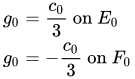
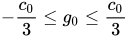
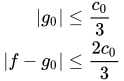
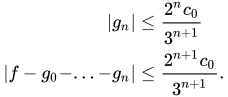
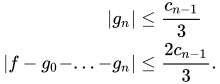
The function is constructed iteratively. Firstly, we define Failed to parse (Conversion error. Server ("https://wikimedia.org/api/rest_") reported: "Cannot get mml. Server problem."): {\displaystyle {\begin{aligned}c_{0}&=\sup\{|f(a)|:a\in A\}\\E_{0}&=\{a\in A:f(a)\geq c_{0}/3\}\\F_{0}&=\{a\in A:f(a)\leq -c_{0}/3\}.\end{aligned}}} Observe that and are closed and disjoint subsets of . By taking a linear combination of the function obtained from the proof of Urysohn's lemma, there exists a continuous function such that and furthermore on . In particular, it follows that on . We now use induction to construct a sequence of continuous functions such that We've shown that this holds for and assume that have been constructed. Define and repeat the above argument replacing with and replacing with . Then we find that there exists a continuous function such that By the inductive hypothesis, Failed to parse (Conversion error. Server ("https://wikimedia.org/api/rest_") reported: "Cannot get mml. Server problem."): {\displaystyle c_{n-1}\leq 2^{n}c_{0}/3^{n}} hence we obtain the required identities and the induction is complete. Now, we define a continuous function Failed to parse (Conversion error. Server ("https://wikimedia.org/api/rest_") reported: "Cannot get mml. Server problem."): {\displaystyle F_{n}:X\to \mathbb {R} } as Given Failed to parse (Conversion error. Server ("https://wikimedia.org/api/rest_") reported: "Cannot get mml. Server problem."): {\displaystyle n\geq m} , Failed to parse (Conversion error. Server ("https://wikimedia.org/api/rest_") reported: "Cannot get mml. Server problem."): {\displaystyle {\begin{aligned}|F_{n}-F_{m}|&=|g_{m+1}+...+g_{n}|\\&\leq \left(\left({\frac {2}{3}}\right)^{m+1}+...+\left({\frac {2}{3}}\right)^{n}\right){\frac {c_{0}}{3}}\\&\leq \left({\frac {2}{3}}\right)^{m+1}c_{0}.\end{aligned}}} Therefore, the sequence is Cauchy. Since the space of continuous functions on together with the sup norm is a complete metric space, it follows that there exists a continuous function such that converges uniformly to . Since Failed to parse (SVG (MathML can be enabled via browser plugin): Invalid response ("Math extension cannot connect to Restbase.") from server "https://wikimedia.org/api/rest_v1/":): {\displaystyle |f-F_n|\leq \frac{2^{n+1}c_0}{3^{n+1}}} on Failed to parse (SVG (MathML can be enabled via browser plugin): Invalid response ("Math extension cannot connect to Restbase.") from server "https://wikimedia.org/api/rest_v1/":): {\displaystyle A} , it follows that Failed to parse (SVG (MathML can be enabled via browser plugin): Invalid response ("Math extension cannot connect to Restbase.") from server "https://wikimedia.org/api/rest_v1/":): {\displaystyle F=f} on Failed to parse (SVG (MathML can be enabled via browser plugin): Invalid response ("Math extension cannot connect to Restbase.") from server "https://wikimedia.org/api/rest_v1/":): {\displaystyle A} . Finally, we observe that Failed to parse (SVG (MathML can be enabled via browser plugin): Invalid response ("Math extension cannot connect to Restbase.") from server "https://wikimedia.org/api/rest_v1/":): {\displaystyle |F_n|\leq \sum_{n=0}^\infty |g_n|\leq c_0 } hence Failed to parse (SVG (MathML can be enabled via browser plugin): Invalid response ("Math extension cannot connect to Restbase.") from server "https://wikimedia.org/api/rest_v1/":): {\displaystyle F} is bounded and has the same bound as Failed to parse (SVG (MathML can be enabled via browser plugin): Invalid response ("Math extension cannot connect to Restbase.") from server "https://wikimedia.org/api/rest_v1/":): {\displaystyle f} . Failed to parse (SVG (MathML can be enabled via browser plugin): Invalid response ("Math extension cannot connect to Restbase.") from server "https://wikimedia.org/api/rest_v1/":): {\displaystyle \square}













History
[edit | edit source]L. E. J. Brouwer and Henri Lebesgue proved a special case of the theorem, when Failed to parse (SVG (MathML can be enabled via browser plugin): Invalid response ("Math extension cannot connect to Restbase.") from server "https://wikimedia.org/api/rest_v1/":): {\displaystyle X} is a finite-dimensional real vector space. Heinrich Tietze extended it to all metric spaces, and Pavel Urysohn proved the theorem as stated here, for normal topological spaces.[2][3]
Equivalent statements
[edit | edit source]This theorem is equivalent to Urysohn's lemma (which is also equivalent to the normality of the space) and is widely applicable, since all metric spaces and all compact Hausdorff spaces are normal. It can be generalized by replacing Failed to parse (SVG (MathML can be enabled via browser plugin): Invalid response ("Math extension cannot connect to Restbase.") from server "https://wikimedia.org/api/rest_v1/":): {\displaystyle \R} with Failed to parse (SVG (MathML can be enabled via browser plugin): Invalid response ("Math extension cannot connect to Restbase.") from server "https://wikimedia.org/api/rest_v1/":): {\displaystyle \R^J} for some indexing set Failed to parse (SVG (MathML can be enabled via browser plugin): Invalid response ("Math extension cannot connect to Restbase.") from server "https://wikimedia.org/api/rest_v1/":): {\displaystyle J,} any retract of Failed to parse (SVG (MathML can be enabled via browser plugin): Invalid response ("Math extension cannot connect to Restbase.") from server "https://wikimedia.org/api/rest_v1/":): {\displaystyle \R^J,} or any normal absolute retract whatsoever.
Variations
[edit | edit source]If Failed to parse (SVG (MathML can be enabled via browser plugin): Invalid response ("Math extension cannot connect to Restbase.") from server "https://wikimedia.org/api/rest_v1/":): {\displaystyle X} is a metric space, Failed to parse (SVG (MathML can be enabled via browser plugin): Invalid response ("Math extension cannot connect to Restbase.") from server "https://wikimedia.org/api/rest_v1/":): {\displaystyle A} a non-empty subset of Failed to parse (SVG (MathML can be enabled via browser plugin): Invalid response ("Math extension cannot connect to Restbase.") from server "https://wikimedia.org/api/rest_v1/":): {\displaystyle X} and Failed to parse (SVG (MathML can be enabled via browser plugin): Invalid response ("Math extension cannot connect to Restbase.") from server "https://wikimedia.org/api/rest_v1/":): {\displaystyle f : A \to \R} is a Lipschitz continuous function with Lipschitz constant Failed to parse (SVG (MathML can be enabled via browser plugin): Invalid response ("Math extension cannot connect to Restbase.") from server "https://wikimedia.org/api/rest_v1/":): {\displaystyle K,} then Failed to parse (SVG (MathML can be enabled via browser plugin): Invalid response ("Math extension cannot connect to Restbase.") from server "https://wikimedia.org/api/rest_v1/":): {\displaystyle f} can be extended to a Lipschitz continuous function Failed to parse (SVG (MathML can be enabled via browser plugin): Invalid response ("Math extension cannot connect to Restbase.") from server "https://wikimedia.org/api/rest_v1/":): {\displaystyle F : X \to \R} with same constant Failed to parse (SVG (MathML can be enabled via browser plugin): Invalid response ("Math extension cannot connect to Restbase.") from server "https://wikimedia.org/api/rest_v1/":): {\displaystyle K.} This theorem is also valid for Hölder continuous functions, that is, if Failed to parse (SVG (MathML can be enabled via browser plugin): Invalid response ("Math extension cannot connect to Restbase.") from server "https://wikimedia.org/api/rest_v1/":): {\displaystyle f : A \to \R} is Hölder continuous function with constant less than or equal to Failed to parse (SVG (MathML can be enabled via browser plugin): Invalid response ("Math extension cannot connect to Restbase.") from server "https://wikimedia.org/api/rest_v1/":): {\displaystyle 1,} then Failed to parse (SVG (MathML can be enabled via browser plugin): Invalid response ("Math extension cannot connect to Restbase.") from server "https://wikimedia.org/api/rest_v1/":): {\displaystyle f} can be extended to a Hölder continuous function Failed to parse (SVG (MathML can be enabled via browser plugin): Invalid response ("Math extension cannot connect to Restbase.") from server "https://wikimedia.org/api/rest_v1/":): {\displaystyle F : X \to \R} with the same constant.[4]
Another variant (in fact, generalization) of Tietze's theorem is due to H.Tong and Z. Ercan:[5] Let Failed to parse (SVG (MathML can be enabled via browser plugin): Invalid response ("Math extension cannot connect to Restbase.") from server "https://wikimedia.org/api/rest_v1/":): {\displaystyle A} be a closed subset of a normal topological space Failed to parse (SVG (MathML can be enabled via browser plugin): Invalid response ("Math extension cannot connect to Restbase.") from server "https://wikimedia.org/api/rest_v1/":): {\displaystyle X.} If Failed to parse (SVG (MathML can be enabled via browser plugin): Invalid response ("Math extension cannot connect to Restbase.") from server "https://wikimedia.org/api/rest_v1/":): {\displaystyle f : X \to \R} is an upper semicontinuous function, Failed to parse (SVG (MathML can be enabled via browser plugin): Invalid response ("Math extension cannot connect to Restbase.") from server "https://wikimedia.org/api/rest_v1/":): {\displaystyle g : X \to \R} a lower semicontinuous function, and Failed to parse (SVG (MathML can be enabled via browser plugin): Invalid response ("Math extension cannot connect to Restbase.") from server "https://wikimedia.org/api/rest_v1/":): {\displaystyle h : A \to \R} a continuous function such that Failed to parse (SVG (MathML can be enabled via browser plugin): Invalid response ("Math extension cannot connect to Restbase.") from server "https://wikimedia.org/api/rest_v1/":): {\displaystyle f(x) \leq g(x)} for each Failed to parse (SVG (MathML can be enabled via browser plugin): Invalid response ("Math extension cannot connect to Restbase.") from server "https://wikimedia.org/api/rest_v1/":): {\displaystyle x \in X} and Failed to parse (SVG (MathML can be enabled via browser plugin): Invalid response ("Math extension cannot connect to Restbase.") from server "https://wikimedia.org/api/rest_v1/":): {\displaystyle f(a) \leq h(a) \leq g(a)} for each Failed to parse (SVG (MathML can be enabled via browser plugin): Invalid response ("Math extension cannot connect to Restbase.") from server "https://wikimedia.org/api/rest_v1/":): {\displaystyle a \in A} , then there is a continuous extension Failed to parse (SVG (MathML can be enabled via browser plugin): Invalid response ("Math extension cannot connect to Restbase.") from server "https://wikimedia.org/api/rest_v1/":): {\displaystyle H : X \to \R} of Failed to parse (SVG (MathML can be enabled via browser plugin): Invalid response ("Math extension cannot connect to Restbase.") from server "https://wikimedia.org/api/rest_v1/":): {\displaystyle h} such that Failed to parse (SVG (MathML can be enabled via browser plugin): Invalid response ("Math extension cannot connect to Restbase.") from server "https://wikimedia.org/api/rest_v1/":): {\displaystyle f(x) \leq H(x) \leq g(x)} for each Failed to parse (SVG (MathML can be enabled via browser plugin): Invalid response ("Math extension cannot connect to Restbase.") from server "https://wikimedia.org/api/rest_v1/":): {\displaystyle x \in X.} This theorem is also valid with some additional hypothesis if Failed to parse (SVG (MathML can be enabled via browser plugin): Invalid response ("Math extension cannot connect to Restbase.") from server "https://wikimedia.org/api/rest_v1/":): {\displaystyle \R} is replaced by a general locally solid Riesz space.[5]
Dugundji (1951) extends the theorem as follows: If Failed to parse (SVG (MathML can be enabled via browser plugin): Invalid response ("Math extension cannot connect to Restbase.") from server "https://wikimedia.org/api/rest_v1/":): {\displaystyle X} is a metric space, Failed to parse (SVG (MathML can be enabled via browser plugin): Invalid response ("Math extension cannot connect to Restbase.") from server "https://wikimedia.org/api/rest_v1/":): {\displaystyle Y} is a locally convex topological vector space, Failed to parse (SVG (MathML can be enabled via browser plugin): Invalid response ("Math extension cannot connect to Restbase.") from server "https://wikimedia.org/api/rest_v1/":): {\displaystyle A} is a closed subset of Failed to parse (SVG (MathML can be enabled via browser plugin): Invalid response ("Math extension cannot connect to Restbase.") from server "https://wikimedia.org/api/rest_v1/":): {\displaystyle X} and Failed to parse (SVG (MathML can be enabled via browser plugin): Invalid response ("Math extension cannot connect to Restbase.") from server "https://wikimedia.org/api/rest_v1/":): {\displaystyle f:A\to Y} is continuous, then it could be extended to a continuous function Failed to parse (SVG (MathML can be enabled via browser plugin): Invalid response ("Math extension cannot connect to Restbase.") from server "https://wikimedia.org/api/rest_v1/":): {\displaystyle \tilde f} defined on all of Failed to parse (SVG (MathML can be enabled via browser plugin): Invalid response ("Math extension cannot connect to Restbase.") from server "https://wikimedia.org/api/rest_v1/":): {\displaystyle X} . Moreover, the extension could be chosen such that Failed to parse (SVG (MathML can be enabled via browser plugin): Invalid response ("Math extension cannot connect to Restbase.") from server "https://wikimedia.org/api/rest_v1/":): {\displaystyle \tilde f(X)\subseteq \text{conv} f(A)}
See also
[edit | edit source]- Blumberg theorem
- Hahn–Banach theorem – Theorem on extension of bounded linear functionals
- Whitney extension theorem
- Dugundji extension theorem
References
[edit | edit source]- ↑ Template:Springer
- ↑ Template:Springer
- ↑ Urysohn, Paul (1925), "Über die Mächtigkeit der zusammenhängenden Mengen", Mathematische Annalen, 94 (1): 262–295, doi:10.1007/BF01208659, hdl:10338.dmlcz/101038.
- ↑ McShane, E. J. (1 December 1934). "Extension of range of functions". Bulletin of the American Mathematical Society. 40 (12): 837–843. doi:10.1090/S0002-9904-1934-05978-0.
- ↑ 5.0 5.1 Zafer, Ercan (1997). "Extension and Separation of Vector Valued Functions" (PDF). Turkish Journal of Mathematics. 21 (4): 423–430.
External links
[edit | edit source]- Weisstein, Eric W. "Tietze's Extension Theorem." From MathWorld
- Mizar system proof: http://mizar.org/version/current/html/tietze.html#T23
- Bonan, Edmond (1971), "Relèvements-Prolongements à valeurs dans les espaces de Fréchet", Comptes Rendus de l'Académie des Sciences, Série I, 272: 714–717.